Understand unstructured requests
Agents earn their place where the input is everyday language and the possible paths cannot be listed in advance. Where they can, a Flow is usually the better answer.
Agentforce consulting · Agentforce implementation · Agentforce partner · Salesforce AI agents · AI automation · United States & Australia
Most Agentforce pilots that stall are a data, permission or ownership problem that looked like an AI problem. Our Agentforce implementation fixes those first, so your Salesforce Agentforce rollout reaches production and stays accountable after launch.
What Agentforce is for
Salesforce AI agents that reason, act and hand off, inside a boundary you wrote
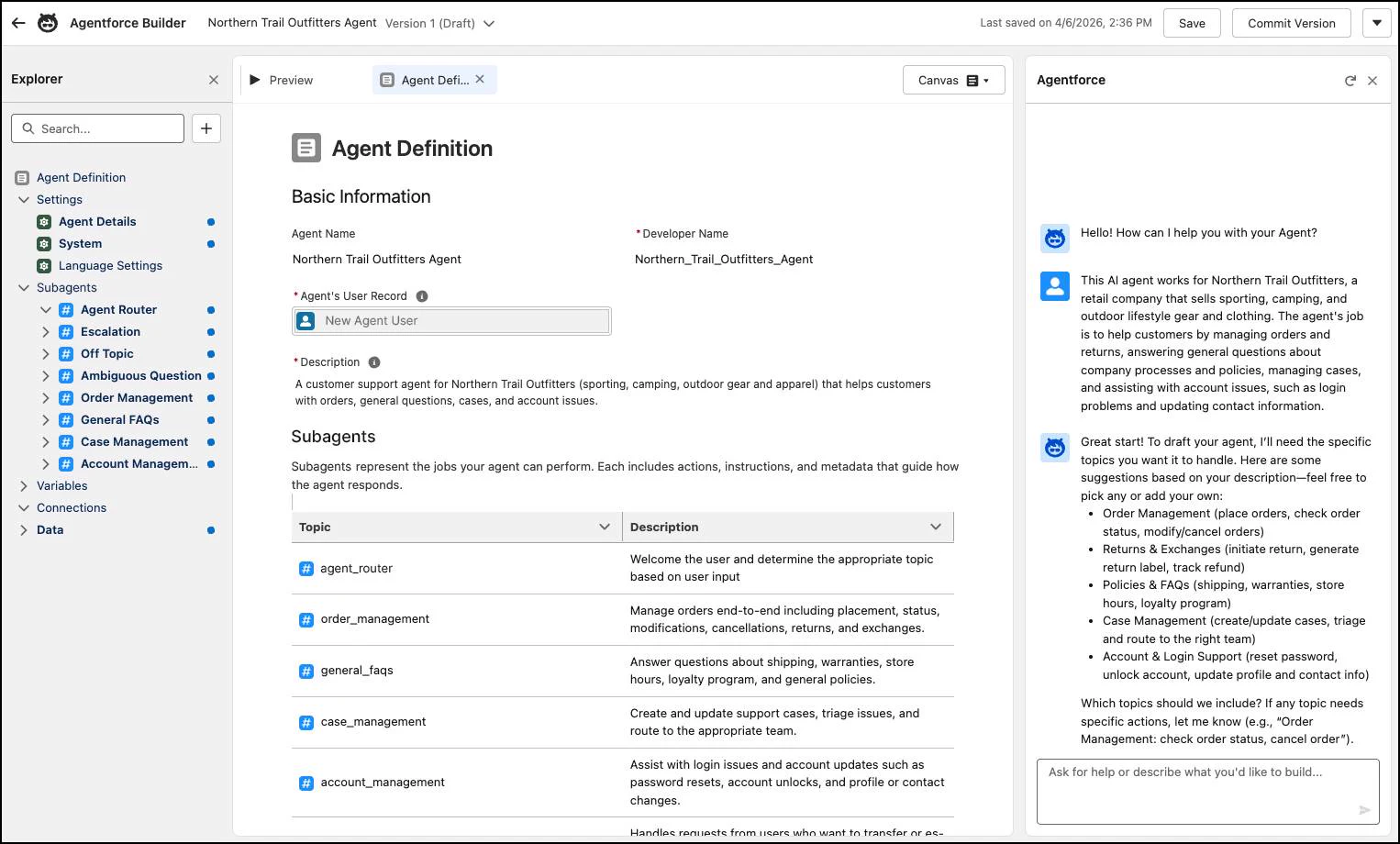
Definition. Agentforce consulting and Agentforce implementation is the work of planning, building and governing Salesforce AI agents so they do real work safely in production: choosing the first use case, preparing the data and knowledge the agent reads, configuring topics, actions and guardrails in Agentforce Builder, testing against real requests, and rolling out in phases with measures agreed up front.
Agentforce is how Salesforce builds and runs AI agents that use your CRM data, knowledge and governed actions. Unlike a scripted bot, an agent plans multi-step work, calls the actions it is permitted to use and escalates with context when a request is beyond its scope. Salesforce now groups this portfolio under the Agentforce 360 name, and what you can switch on still depends on edition, region and release. Our Agentforce implementation guide walks through the setup step by step.
Agents earn their place where the input is everyday language and the possible paths cannot be listed in advance. Where they can, a Flow is usually the better answer.
The agent decides what to do; the actions it calls, often Flows, Apex or API calls, do it deterministically, with their own permissions, validation and log entry.
When a case exceeds policy, the agent escalates to a person with a summary of what it found, so nobody starts again from a blank transcript.
Pressure we surface early
Programs stall when agents ship without data ownership, testing discipline and a named owner. The demo works because the demo data is clean. Production is where contradictory articles, over-broad permissions and preview features your org cannot license yet show up, usually all at once.

Knowledge written once for a launch, policies in three versions and CRM fields nobody described. The agent inherits all of it and states it with confidence, which is worse than no answer.
Agents are often pointed at a user whose access was assembled for someone doing a much broader role. The permissions work, and they are far wider than the agent needs.
An intent list without an out-of-scope list beside it invites the agent to answer everything. The questions it should refuse are as important to design as the ones it should answer.
A pilot that starts without a scored regression set has no baseline. When answer quality drifts after a prompt or model change, there is no way to show it, or to prove it was fixed.
An unowned agent degrades quietly. Topics, grounding sources and evaluation sets each need a named owner, or the first person to notice a problem is a customer.
Roadmap slides and preview features are not your entitlements. We check edition, region and general availability first, so the steering committee is shown what the org can actually run.
Agentforce use cases by function
The best first use cases are bounded, rich in feedback and cheap to get wrong. Anything that depends on judgment your business has never written down, such as pricing exceptions or complaint outcomes, comes later. Phase one is normally one workflow from this list, chosen on value, data readiness and risk.
SynconAI pattern for Agentforce workshops. Refunds, credits, access changes and contractual language stop at a named human by design, whatever the channel.
Deflection, triage, case updates, case summaries and drafted replies on Service Cloud, grounded in reviewed knowledge, with a clean handoff when the case exceeds policy. Voice and contact center patterns sit with our call center solutions.
Meeting prep, follow-up and qualification loops on Sales Cloud data your RevOps team can tune, plus guided selling aligned to your own playbook rather than generic chat. More in Agentforce for sales teams.
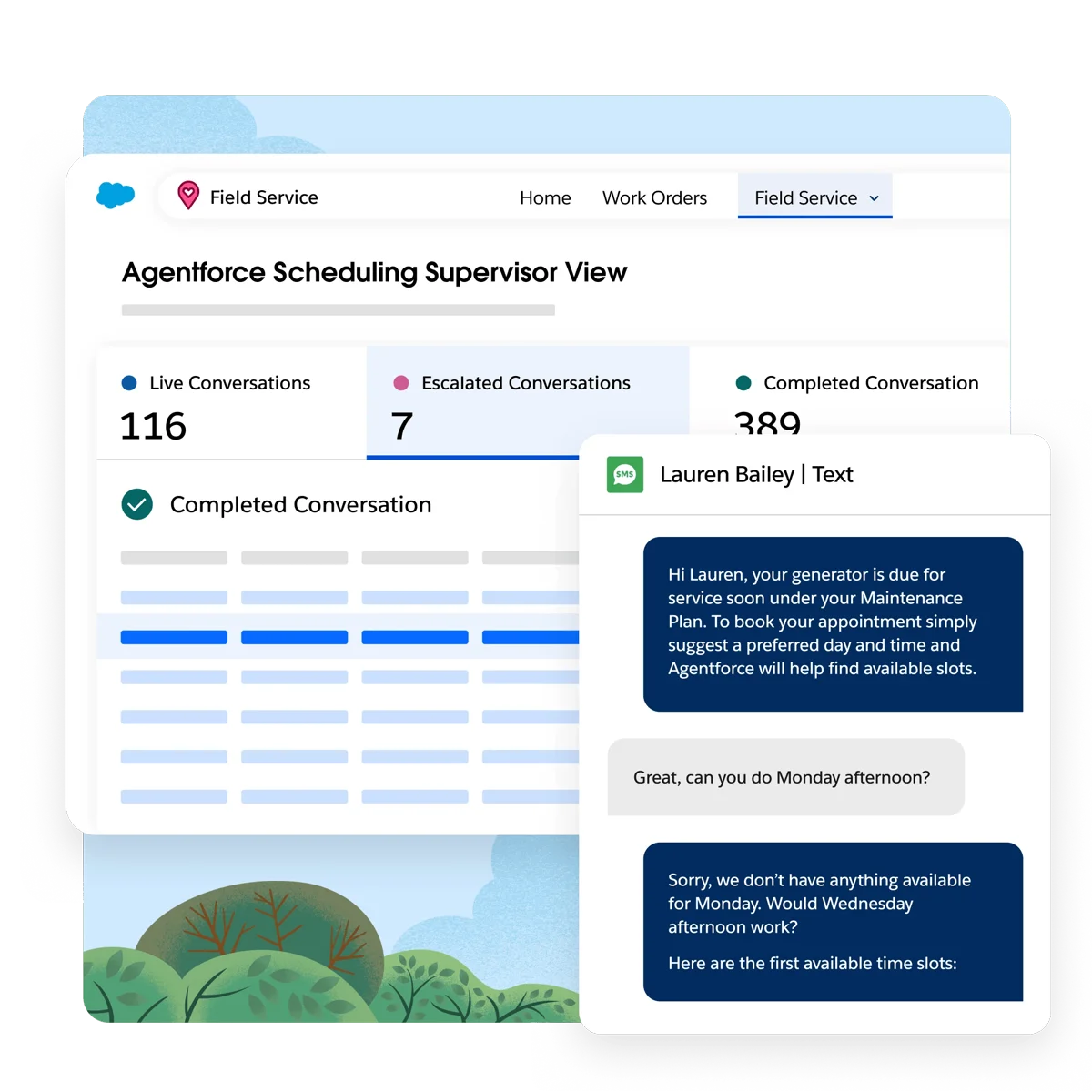
Appointment booking and rescheduling, technician prep and job summaries on Salesforce Field Service, grounded in asset and work order data the agent can trust at the asset level.
Access requests, how-to questions and ticket triage where your ITSM maturity supports it, answered from approved runbooks and escalated with context to the right resolver group.
Policy, leave and onboarding questions answered from approved documents in Lightning, mobile or Slack. Internal agents are usually the safest place to start, because the audience is forgiving and the feedback is fast.
Account lookups, order status, record updates and back-office requests that today pass through a shared inbox, using deterministic Flow actions for every step that must not vary.
Salesforce ships agent templates for common jobs, and we start from them where they fit, then harden topics, actions and grounding for your org. Industry context changes the integration pattern, not the need for grounded agents and clear handoffs: we map the subset that fits financial services, healthcare and life sciences, manufacturing, retail and communications. For a longer list, read Agentforce use cases that survive a business case.
Agentforce consulting services
Scoped the way enterprise teams buy work: outcomes, a RACI and measurable pilot gates across Service Cloud, Sales Cloud, Field Service and the integrations behind them. We engineer grounding, quality gates, governance and change on one roadmap, because an agent that ships without any one of them tends to come back.
A use-case shortlist ranked on value, data readiness and risk, and an honest map of what needs low-code agent configuration, deterministic controls or pro-code work.
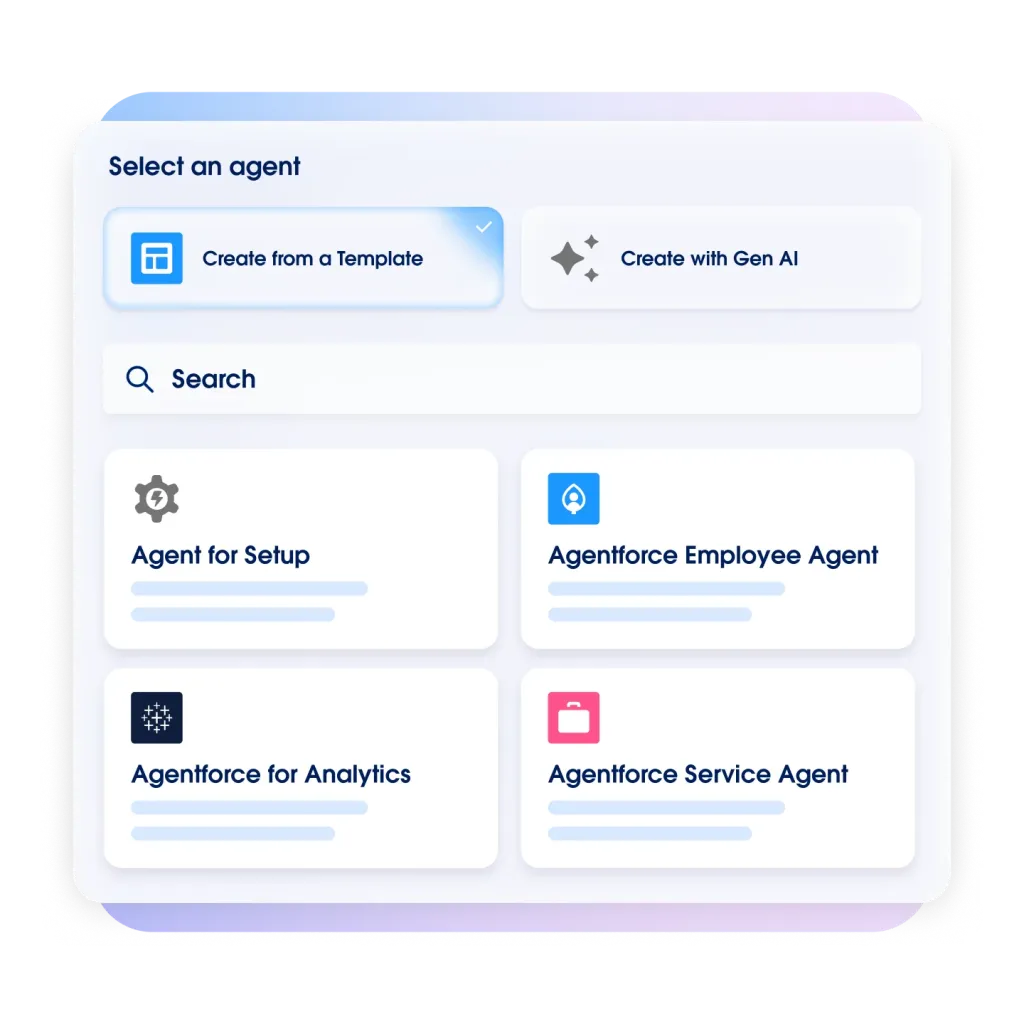
Agent topics, instructions, actions and placement in service, sales and employee contexts, built sandbox-first in Agentforce Builder with channel rollout plans that match your generally available feature set.
Secure calls to ERP and SaaS systems, grounding in documents and structured CRM data, and Data 360 programs where the agent needs a governed customer layer rather than raw fields.
Policies for retention, human handoff and approval, aligned to the Salesforce trust documentation your compliance team already uses, with change control on every prompt and action.
Enablement so service leaders, RevOps and architects know how to tune instructions, read a trace and retire risky shortcuts after we step back.
Regression checks, drift monitoring and a backlog for model or action updates, optionally as part of our Salesforce managed services.
Scope of delivery
From a written readiness read through to run-state support across Agentforce, Data 360, Service Cloud, Sales Cloud, Field Service and the integrations that hold the answers, with a measured baseline and pilot exit criteria your leadership can review.
An agent is only as good as two things underneath it: what it can retrieve, and what its running user is allowed to do. Fix those and most of the rest follows. Skip them and no prompt rescues it.
Stakeholders, channels, risk posture and an honest check of what your editions and contracts let you run today, before anything is designed.
A shortlist priced as a whole program, not a license line, with one high-signal workflow chosen to prove first and an out-of-scope list beside it.
One authoritative source per intent, knowledge with owners and review dates, and field descriptions retrieval can actually use.
Instructions, actions with a single job each, a least-privilege running user and human approval on anything irreversible.
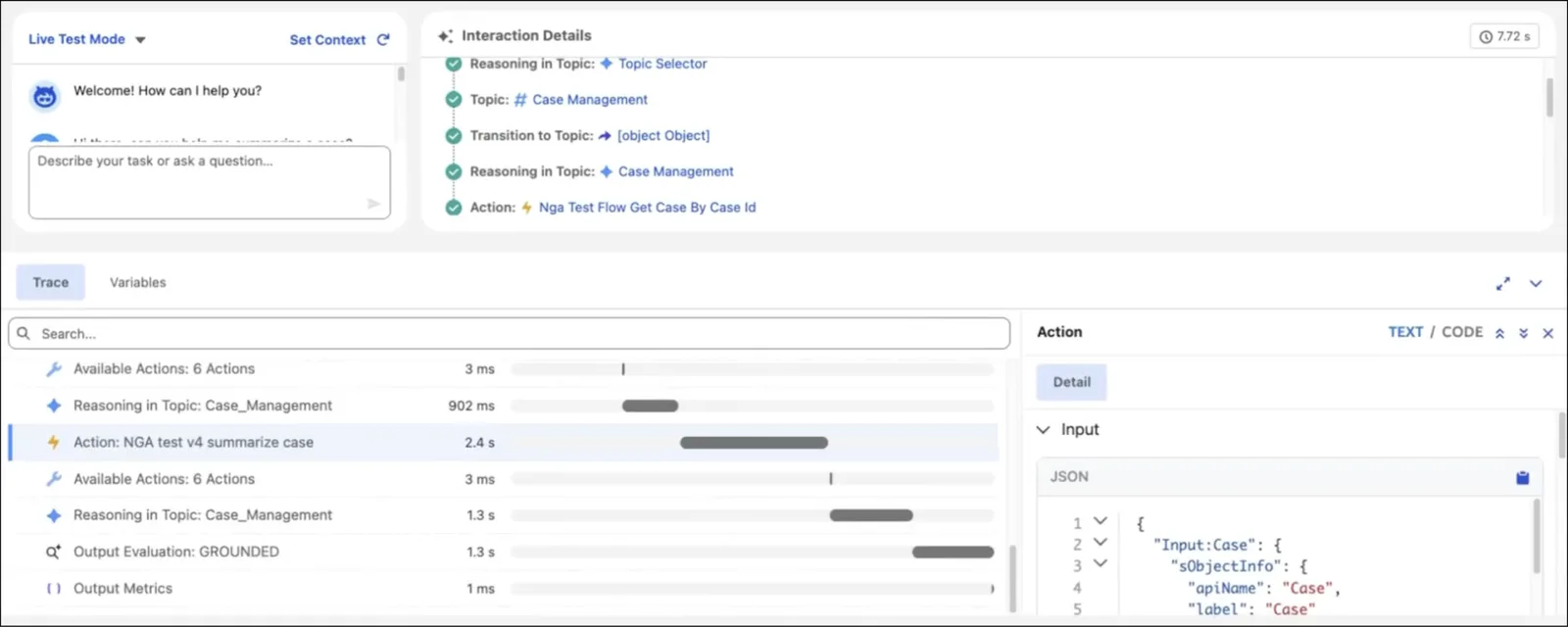
Scenario suites and a scored regression set built from real requests, rerun after every prompt, action or model change.
Phased channels, monitoring and hypercare, then answer quality and escalation reviewed against the baseline agreed in discovery, with outcomes reported in Tableau dashboards where you run them.
Apex and API actions, Lightning components and the Agent API for programmatic triggers, delivered by our Salesforce development team.
Capability coverage
The rest of this page argues about approach. This part answers the simpler question: do we cover the thing you need? Every capability depends on edition, region and general availability, and your account team and the Salesforce release notes remain the source of truth.
Who we work with
A deflection target, a cleaner pipeline, a maintainable platform and a defensible risk position pull in four directions. Naming which one you own tends to change what phase one should be. Tap the closest fit to pre-scope the conversation form at the foot of the page.

Delivery method
Seven steps we repeat on every engagement, with transparent gates and no surprise scope. Each step has an exit criterion you can fail, rather than a date. For the gate-by-gate runbook, read implementing Agentforce, phase by phase; for the Setup walkthrough, see the Agentforce implementation guide.
Stakeholders, channels, risk posture and edition checks, so the plan is built on what your org can actually run. We agree pilot success measures before anything is configured.
A shortlist ranked on value, data readiness and risk. One high-signal workflow goes first, with an out-of-scope list beside it and a quality rubric agreed up front.
One authoritative source per intent, knowledge with owners and review dates, and Data 360 where the agent needs unified customer context. Grounding and permission work usually sets the real schedule, so it starts here. See how Data 360 grounds an agent.
Topics, instructions, actions, data contracts and human handoffs, signed off by business and IT. The running user gets only what the agent needs, and irreversible steps carry an approval inside the action.
Scenario suites built from real requests, a scored regression set, load checks and human review loops in a sandbox before any production traffic.
Phased channels with monitoring live and a rollback rehearsed with operations. We expand only after the agreed measures hold and governance signs off.
Hypercare, answer quality sampled in production, escalation and handoff health reviewed against the baseline, and a backlog for the next topic or channel. Optionally continue with managed services or ongoing Salesforce administration.
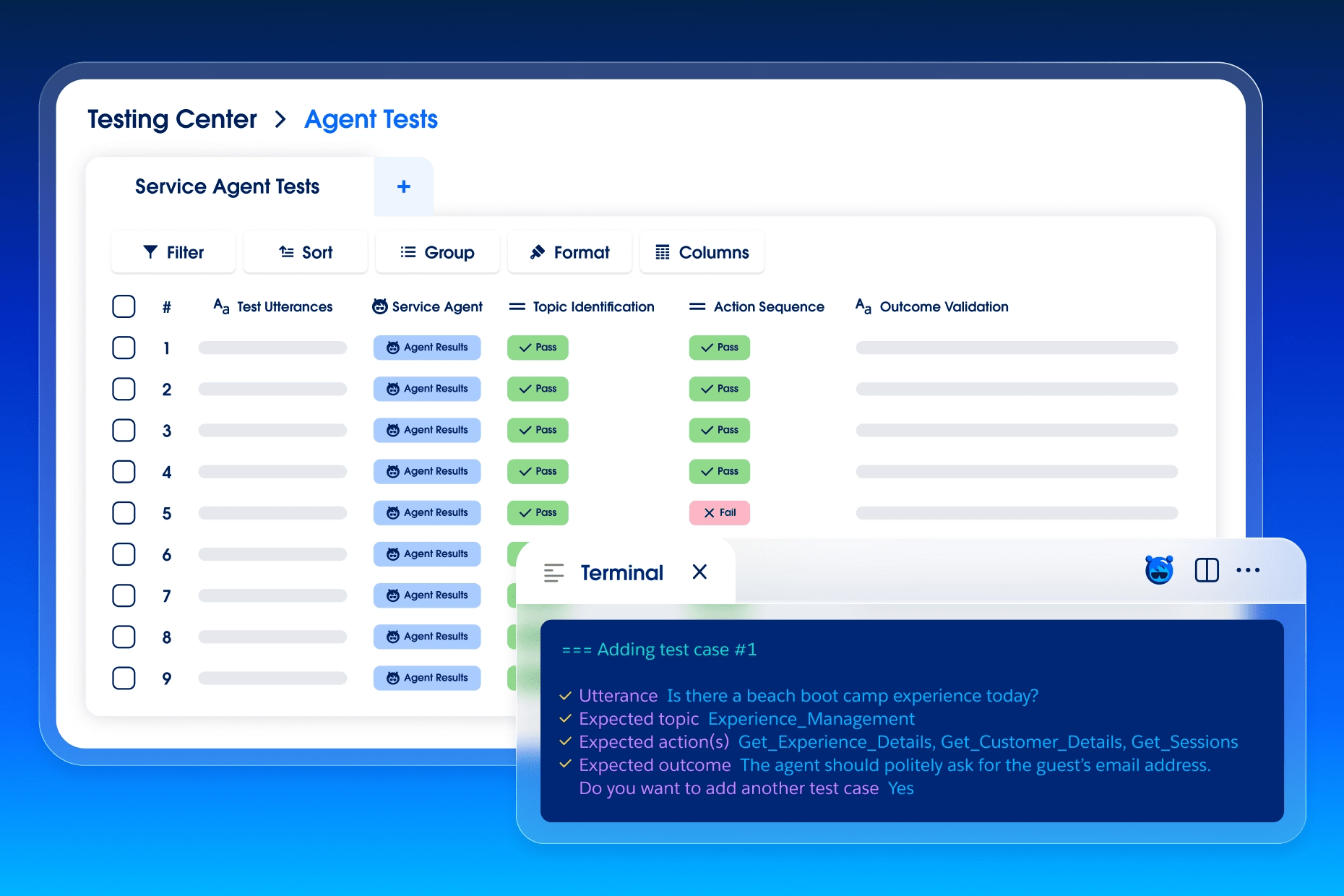
What testing looks like in practice. Every test case states the utterance, the topic we expect the agent to choose, the actions it should call and the outcome a reviewer will accept. The same set runs again after every prompt, action or model change, so drift is visible before a customer finds it.

Trust & governance
Governance for an agent is configuration you can review, not a prompt you hope holds. We decide what the agent may read, what it may change and who approves the steps that cannot be undone, then log every change to a prompt, topic or action so second line and auditors get straight answers.

Curated articles, policies and approved snippets, so retrieval stays on-brand and defensible and a wrong answer traces back to a source you can fix, not a mystery.
The agent sees what its running user can see, plus what knowledge visibility exposes. We review both paths and narrow them to the job, using permission sets and guarded actions.
Escalation triggers, context summaries and ownership rules, so automation augments staff without orphaning cases, and nothing commits money or access unsupervised.
Salesforce describes the Einstein Trust Layer as secure data retrieval, dynamic grounding, zero data retention, toxic language detection and an audit trail. It notes data masking is currently disabled for agents, so we confirm what applies to yours.
Clean records of who changed a prompt, topic or action, when and why, with owners for topics, grounding sources and evaluation sets after go-live.
Latency, topic quality and escalation summarized the way operations already reads its dashboards, and a rehearsed rollback for when answer quality drifts.
Go deeper on the security model behind an agent, or pair the work with a governed data layer through our Data 360 services.
Plan a governance workshopReference architecture
This is the diagram we bring to the first workshop, and it is read upwards. An agent cannot be accurate on sources that contradict each other. It cannot be safe with a running user built for a broader job. It cannot act reliably through actions nobody tested. That chain is why an agent approved before the data and permissions are settled usually gets rebuilt. We design for Salesforce Well-Architected outcomes and document how Agentforce, Data 360 and your CRM relate to the ERP and SaaS systems that hold the answers. Every pattern depends on edition, region and GA status; your account team and the release notes remain authoritative.
SynconAI reference topology for workshops. Aligns with Salesforce Architects diagrams language; edition and region still govern what you can configure.
SynconAI Agentforce stack
AI automation beyond agents
Not every automation problem needs an agent. Working rule-based automation should stay where it is: Flow is deterministic, testable and carries no per-run consumption cost. An agent earns its place where the input is unstructured language or the answer has to be assembled from several sources. The normal architecture uses both, with the agent interpreting the request and calling Flow, Apex and API actions for the steps that must not vary.
So an Agentforce program with us usually includes the automation and Salesforce integration work underneath it: cleaning up Flows the agent will call, exposing ERP and billing data through MuleSoft or direct APIs, and building custom actions with our Salesforce developers. Sometimes the honest recommendation is a Flow, not an agent, and we will say so.
Record-triggered and screen Flows rebuilt for clarity and performance, so the actions an agent calls behave the same way every time. See Flow best practices.
Order, billing and account status made current where the agent asks for it, through APIs, MuleSoft or Data 360, decided per intent between unified data and a live call.
Apex and API actions for logic Flow cannot express, each with a single job, its own validation and a log entry, so the blast radius of any mistake stays small.
Ways to engage
Choose how you want to start, from a focused proof to multi-agent operations. We tailor the scope after discovery, and if you are not sure, we will help you pick the right starting point.
One high-signal workflow proved in a sandbox against success measures agreed up front, ending in a read-out your steering committee can act on.
A bounded production audience with weekly steering and a rehearsed rollback. Small enough that every conversation can be read in the first weeks.
More agents, topics and channels on one operating model, with a run-state RACI and release alignment with Salesforce.
Pricing. Salesforce sets Agentforce license and consumption pricing. Our delivery runs as a one-time Technology Blueprint, a monthly delivery plan, or a fixed-scope Transformation program for significant AI implementations. Every plan and price is on our pricing page, and what an Agentforce rollout costs beyond the license explains the rest.
See plans and pricingPartnership criteria
We combine platform depth with pilot discipline, so agents do real work in your channels rather than living in slide-deck experiments. SynconAI is a Salesforce Select Partner and an OpenAI Select Partner, and delivery is architect-led: the people who scope the work ship it. Learn more about SynconAI.
We tie every service, sales and commerce story to what your org can actually run today, not to preview features on a roadmap slide.
Time-boxed pilots with measurable gates, not open-ended AI experiments. We expand channels only after the agreed measures hold.
We work where your configuration already lives, across Service Cloud, Sales Cloud, Field Service, Data 360, Flow and the integrations behind them.
Logging, approvals and a RACI for prompt and action changes your second line can defend, agreed before go-live rather than after an incident.
United States and Australia delivery hubs with shared playbooks, follow-the-sun capacity in Hyderabad, and no black-box offshore handoff.
A backlog for new agents, channels and model updates, run by the same team that built version one, not a handover to a queue that never saw discovery.
Client reviews
Client names anonymised where requested; reviews reflect typical outcomes from governed Agentforce programs with SynconAI.
Salesforce Select Partner16+ architect certificationsDelivery across USA, Sydney & India
Governed Agentforce rollout on Service Cloud
“We stopped treating Agentforce like a chatbot bolt-on. SynconAI wired topics to the same Case and Order objects our auditors already trust, and our service leads finally had one story for quality, risk, and capacity planning.”
Salesforce automation with Agentforce topics
“SynconAI helped us automate our Salesforce processes and improve visibility across our sales and service operations. Agents now escalate with full CRM context instead of starting from a blank transcript.”
Agentforce 360 pilot to production
“The pilot proved deflection and quality metrics before we expanded channels. SynconAI mapped Agentforce 360 capabilities to what our org could actually license, so we did not over-promise in steering reviews.”
Agentforce Builder and Data Cloud readiness
“Our architects needed one partner who understood both Data 360 foundations and Agentforce Builder testing patterns. SynconAI delivered sandbox-first configuration with clear RACI for prompt and topic changes after go-live.”
Frequently asked questions
Straight answers about Agentforce implementation timelines, cost, Data 360, governance, Einstein Bots, Flow and choosing an Agentforce partner.
Agentforce consulting is the work of planning, building and governing Salesforce AI agents so they do real work safely in production. In practice that means choosing the right first use case, getting the data and knowledge an agent will read into shape, designing topics, instructions, actions and guardrails, testing against real requests, rolling out in phases and measuring the result. SynconAI does that work as a certified Salesforce partner across the United States and Australia.
An Agentforce implementation covers readiness and use-case selection, data and knowledge preparation (with Data 360 where the agent needs unified customer context), a least-privilege running user, topics, instructions and actions in Agentforce Builder, the Flow, Apex and integration actions the agent calls, scored testing in Testing Center, a phased rollout with pilot exit criteria, and monitoring and tuning after go-live. SynconAI delivers each of those steps, and the step-by-step setup is set out in our Agentforce implementation guide.
Agentforce is Salesforce’s platform for building and running AI agents that use your CRM data, knowledge and governed actions to plan multi-step work, act and escalate to people with context. Salesforce now groups its AI portfolio under the Agentforce 360 name. What your org can turn on depends on product, edition, region and release, so we map Salesforce’s public roadmap to what you are licensed to run today.
It depends far more on your data and permissions than on the build. Configuring an agent is rarely the long phase; cleaning up the knowledge it will answer from and narrowing what its running user can see usually sets the real schedule. We start with a time-boxed proof of concept or pilot on one workflow, with exit criteria agreed up front, and give you a written, phased plan after discovery rather than a guess before it.
There are two separate costs. Salesforce sets the license and consumption price, and its models, including Flex Credits and per-conversation pricing, change by release, so confirm the current rate card with your account executive. Delivery is the second cost: SynconAI works through a one-time Technology Blueprint, monthly delivery plans or a fixed-scope Transformation program for significant AI implementations, all described on our pricing page. The cost most estimates miss is knowledge and data remediation.
Not for every use case. Data 360 is the current name for Data Cloud. An agent answering policy questions from Knowledge needs no data unification at all. An agent answering questions about one customer whose records live across several systems usually does, because the alternative is a live call into each system during the conversation. We decide per use case, and we deliver Data 360 programs when the agent needs that foundation.
Through configuration you can review, not through a prompt you hope holds. The agent runs as a user with least-privilege permissions, its topics and actions define what it may do, answers are grounded in approved sources, and refunds, deletions and other irreversible steps need a named human approval inside the action. Salesforce describes the Einstein Trust Layer as adding secure data retrieval, dynamic grounding, zero data retention, toxic language detection and an audit trail. We add change control, logging and a rollback plan your risk team can defend.
A traditional bot follows dialog paths someone designed in advance, so it handles the questions it was scripted for and little else. An Agentforce agent reasons over the request, picks the relevant topic, calls the actions it is permitted to use and escalates with context when the case is beyond its scope. Teams moving from bots usually keep the deterministic steps as Flows and let the agent decide when to call them.
No. Working rule-based automation should stay where it is. Flow is deterministic, testable and carries no per-run consumption cost, and replacing a working rule with a reasoning step makes it slower and less predictable. Agents earn their place where the input is unstructured language, where the paths cannot be listed in advance, or where an answer has to be assembled from several sources. The two work together: the agent decides, the Flow does.
AI automation in Salesforce combines an AI agent that understands an unstructured request with deterministic automation that carries out the steps. In practice an Agentforce agent reads the request, picks the topic and calls permitted actions, and those actions are usually Flows, Apex or API calls into other systems. SynconAI builds both sides, and keeps rule-based steps in Flow where they are cheaper and more predictable.
Common starting points are customer service on Service Cloud, sales on Sales Cloud, scheduling and technician support on Field Service, and internal agents for IT, HR and operations in Lightning, mobile and Slack. Marketing and commerce patterns are possible too. Exact attach points depend on your edition and product entitlements, which we check in discovery before anything is designed.
Ask how they test, not how they demo. A credible Agentforce partner will want to see your data and permissions before quoting, will agree pilot exit criteria up front, will build a scored test set before launch, and will name who owns the agent after go-live. Ask too whether they will tell you when Flow is the better answer. SynconAI is a Salesforce Select Partner, delivery is architect-led, and the team that builds version one stays on for the run state.
SynconAI is a Salesforce Select Partner and OpenAI Select Partner that designs, implements and runs Salesforce and Agentforce for clients in the United States and Australia. Its Agentforce consulting covers readiness, use-case selection, data and Data 360 grounding, agent design in Agentforce Builder, testing, phased rollout and managed support, delivered by certified architects who stay accountable after go-live.
Salesforce, Agentforce, Agentforce 360, Service Cloud, Sales Cloud, Data 360 and Slack are trademarks of Salesforce, Inc. SynconAI is an independent certified Salesforce consulting partner and is not created by, affiliated with, or endorsed by Salesforce, Inc. Product screenshots are reproduced for illustrative purposes; the interface varies by edition and release.
Free architect conversation
60 seconds to brief us. A certified architect replies within one business day.
 Sales Cloud
 Service Cloud
 Field Service
 Experience Cloud
 Marketing Cloud Next
 Revenue Cloud AdvancedSalesforce CPQ
 Data 360
 Financial Services Cloud
 Nonprofit Cloud
 Health Cloud
 CRM Analytics & Einstein
 Agentforce