Rules nobody can explain
Queues and skills added one exception at a time over several years. Nobody can say why a call lands where it lands, so nobody dares change it.
Salesforce call centre & help desk · Service Cloud · Salesforce Voice · Omni-Channel routing · Agentforce
Rebuilding a contact centre that has drifted, or standing up a service desk for the first time — the work is the same: design the case and knowledge model, decide where telephony lives, and make routing explainable.




Pressure we surface early
Failure modes we surface before configuration starts: routing rules nobody can explain, knowledge agents have stopped trusting, telephony bolted on through an adapter with a fixed end date, and reporting assembled by hand from three systems that disagree.

Queues and skills added one exception at a time over several years. Nobody can say why a call lands where it lands, so nobody dares change it.
Voice reaches Salesforce through an Open CTI integration that Salesforce has already deprecated and dated for end of life. The clock is running whether or not it is on a roadmap.
Content that is out of date, unowned and unreviewed. Agents keep private notes instead, and every deflection or AI plan built on top of it inherits the rot.
History sits in one system, entitlement in another, the order in a third. The agent stitches it together live while the handle time climbs.
Telephony reports one volume, Salesforce another, the workforce tool a third. Every steering meeting starts by arguing about the data instead of the operation.
A board expects AI to take volume out. Pointed at unowned knowledge and undefined intents, an agent does not fail quietly. It fails confidently, in front of a customer.
The service floor
A shift runs on cases, queues, knowledge, entitlements and SLA clocks, not on a slide claiming one platform replaced everything. We implement Service Cloud as the working surface and Omni-Channel as the routing layer, with the carrier connected through Salesforce Voice or bring your own telephony. Billing, ITSM and workforce management stay authoritative for what they own. That boundary is what keeps first-contact resolution reporting credible after go-live.
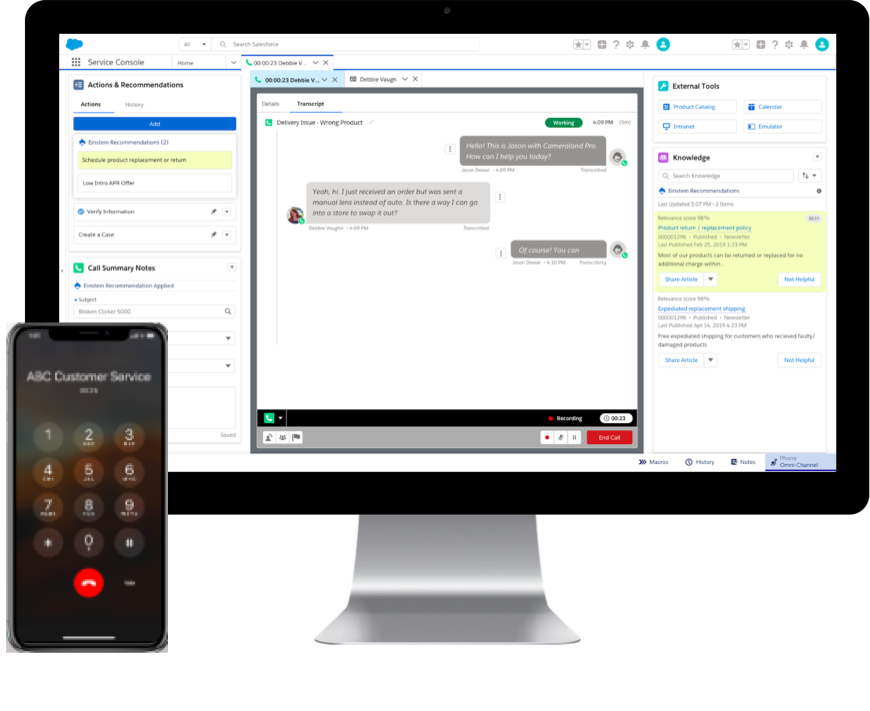
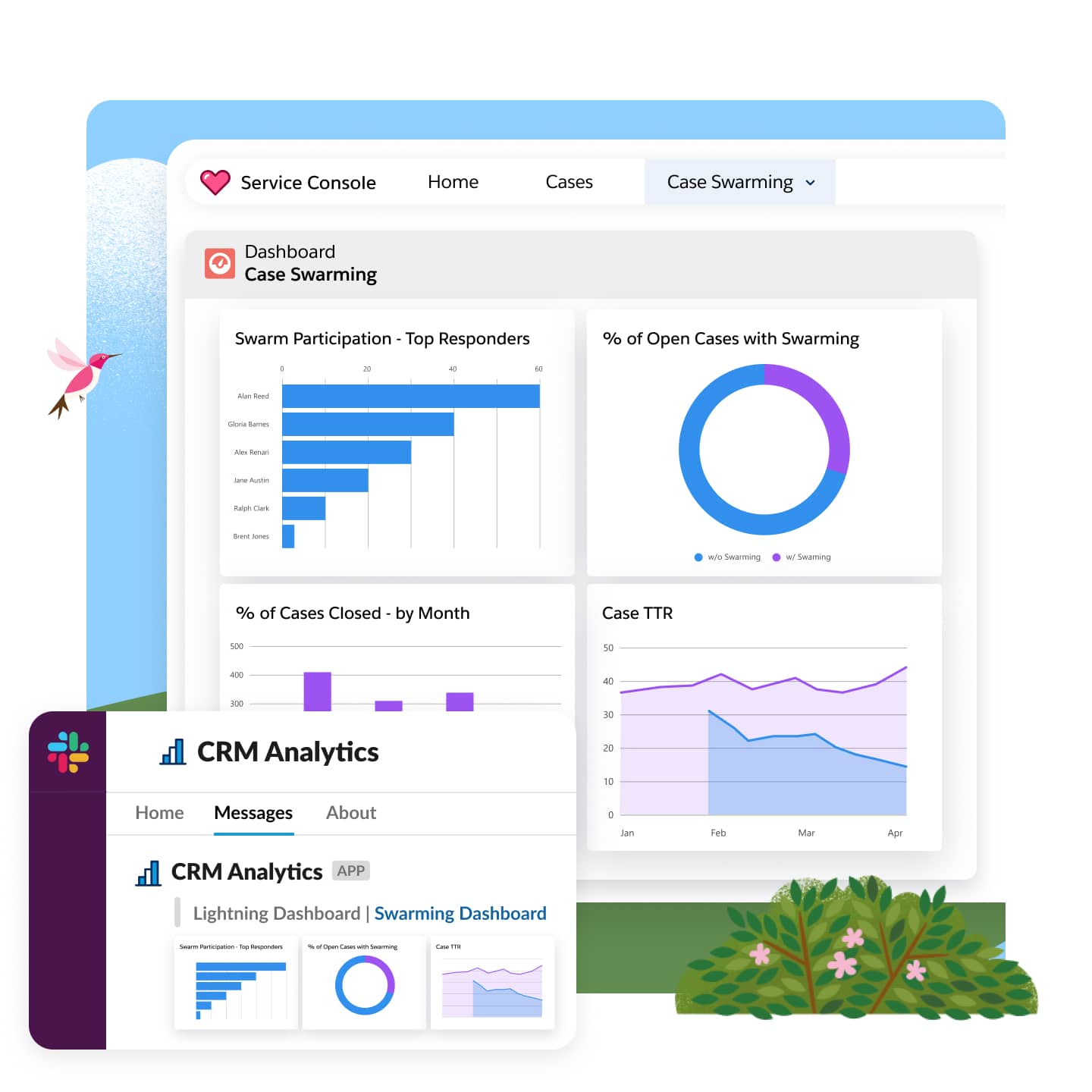
Supervision is the half most programmes underbuild. A shift lead needs live queue state, a defensible quality sample, and escalation that pulls the right expertise in deliberately rather than by shouting across the floor. Swarming works when the case stays the record and the participation is measured, not when it becomes a second inbox.
Who we design for
A support agent, a telephony owner, an internal service desk and a supervisor do not want the same thing from the same platform. The scoreboards differ too: first-contact resolution, call quality and carrier cost, time to restore, and quality coverage. Tap a group to pre-scope the conversation form.

What we actually build
These are the areas we most often wire with real integration contracts and a measured baseline before configuration scales. They reflect how service leaders, telephony owners and supervisors describe the operation, not a feature list from a product page.
The intents customers and employees actually raise, mapped to a case model, entitlements and an article set with a named owner and a review cycle. Everything downstream depends on this being right.
Skill, capacity and priority routing through Omni-Channel Flow, with overflow and after-hours handling, built so a supervisor can explain any single routing decision in one sentence.
Service Cloud Voice with bring your own telephony, native voice, or a staged exit from an Open CTI adapter. Decided on contract dates and the features you use, then written down with an owner.
Console layouts, macros, quick actions and guided flows built around the ten things an agent does all day, and handed over so an admin can change them without a developer.
Help centre, chat and Agentforce deflection scoped to the intents that genuinely have a documented answer, so contact reduction is earned rather than announced.
Live queue visibility, a defensible quality sample, and one set of numbers the operation and finance both accept, reconciled to the carrier rather than invented in a dashboard.
Scope of delivery
From operating-model clarity to run-state operations across Service Cloud, Salesforce Voice, Omni-Channel, Agentforce, and the CCaaS or carrier platform you already pay for, scoped with RACI, integration SLAs and pilot exit criteria your service leader can review.
Service programmes stall when routing ownership, the record boundary and the telephony decision stay vague. We scope Salesforce with integration SLAs, pilot gates, and change control on one sell-to-renew roadmap your steering forum can defend.

Channel mix, intent list, queue and skill design, knowledge ownership and the reporting baseline, agreed before configuration starts.
Cases, entitlements, milestones and SLA clocks, console layouts, macros and quick actions, built so supervisors can change them after we leave.
Carrier, CCaaS, ITSM, HRIS and billing feeds via MuleSoft or native patterns; grounding in Data 360 where your architecture supports it. Adjacent Data 360 programs when lineage needs hardening.
Access reviews, retention, recording and consent handling, and change control so the operation stays defensible after go-live, including agent topic ownership.
Training for agents, team leaders, QA analysts and the admins who own routing and knowledge, not a single superuser who leaves in six months.
Backlog for routing changes, knowledge review, integration health and agent quality, optionally with managed services.
Deflection, agent assist, case summary and drafted replies, scoped to approved knowledge with a named human on anything that commits. See Agentforce implementation.
Journeys
Customer service, telephony, internal support and supervision share one requirement: one queue with written rules for what stays in the carrier, the ITSM tool or billing versus what Salesforce owns. We scope phase one to how work actually arrives, not to a template that ignores your channel mix.
SynconAI journey spine for service workshops. Agentforce assists inside these stages; it does not issue credits, change entitlements or grant access on its own.
The call arrives with the customer identified, the history attached and the entitlement visible, so the agent starts on the problem instead of on verification.
A swarm raised from the console pulls the right expertise in by skill, keeps the case as the record, and returns the resolution with the SLA clock intact.
Help centre, chat and Agentforce answering the intents that genuinely have a documented answer, and escalating everything else with the transcript attached.
Employee-facing support where the scoreboard is time to restore and deflection, with the ITSM tool and the HRIS keeping the records the desk may read and write. We design to your intents and approval paths, then write the outcome back to the ticket the ITSM tool owns.
Live queue state, a defensible quality sample, and swarm participation measured, so a shift lead can staff the next hour rather than explain the last one.
A staged exit from the retiring adapter: inventory what the current integration does, pilot the replacement on one queue, rehearse the cutover, then move the floor.
See the architecture boundariesDiscuss your operating constraints
Partnership criteria
Global SIs sell a transformation narrative. Carrier partners sell their own platform. SynconAI sells architect-led service design: a baseline before changes, a telephony recommendation with no commission attached, routing a supervisor can explain, and runbooks the operation can run after hypercare. Learn more about our Salesforce consulting partner approach.
We do not resell telephony, so keeping RingCentral, Amazon Connect, Genesys or Five9 is a real recommendation when it is the right one. The trade-off gets written down either way.
A migration plan with an owner and a date rather than a line in a risk register. Salesforce has set the end of life; the only variable is whether you move on your terms.
Skill and capacity models kept simple enough to maintain. We change one dimension at a time against a baseline, so you can prove which change did what.
Deflection targets mean nothing on content nobody owns. We fix the article model and the review cycle first, then scope what an agent is allowed to answer.
Triage, knowledge, summary and drafted replies. Anything that credits, entitles or grants access stops at a named approver your risk forum can defend.
Time-boxed pilots measured on first-contact resolution, handle time, misroute rate or deflection, against a baseline captured before we started.
Check edition-honest scopingBook a service architecture review
Reference architecture
CIOs and enterprise architects need one diagram showing where Salesforce ends and the carrier, the ITSM tool, the HRIS and billing begin. Salesforce owns the case, the knowledge, the routing decision and the record of what was resolved. The carrier still carries the call, whether that is Salesforce Voice, bring your own telephony, or a staged move to native voice as Open CTI winds down. We design for Salesforce Well-Architected outcomes: Trusted, Easy, and Adaptable. We document how Salesforce objects, Data 360, and MuleSoft-led integrations relate to billing, project, telephony, and document systems so finance and IT share the same contract language. Every pattern depends on edition, region, and GA status; your account executive and release notes remain authoritative.
SynconAI reference topology for service workshops. Aligns with Salesforce Architects diagrams language; edition and region still govern what you can configure.
SynconAI service topology
Governed AI
Deflection and agent assist, not an unsupervised actor on a live call
Accounts, cases, work orders, and service history still live on your CRM data model; Agentforce is how Salesforce surfaces governed assistants on top. We fix the knowledge model first, then scope agents your risk committee can name: intent triage, retrieval from approved articles, case summary, drafted replies and after-call support, case summarisation for coordinators, and internal SOP copilots. Model outputs that issue a credit, change an entitlement or grant access require human validation before they reach a client. Purchase decisions should follow capabilities that are GA in your edition and region. Details on our Agentforce consulting page.
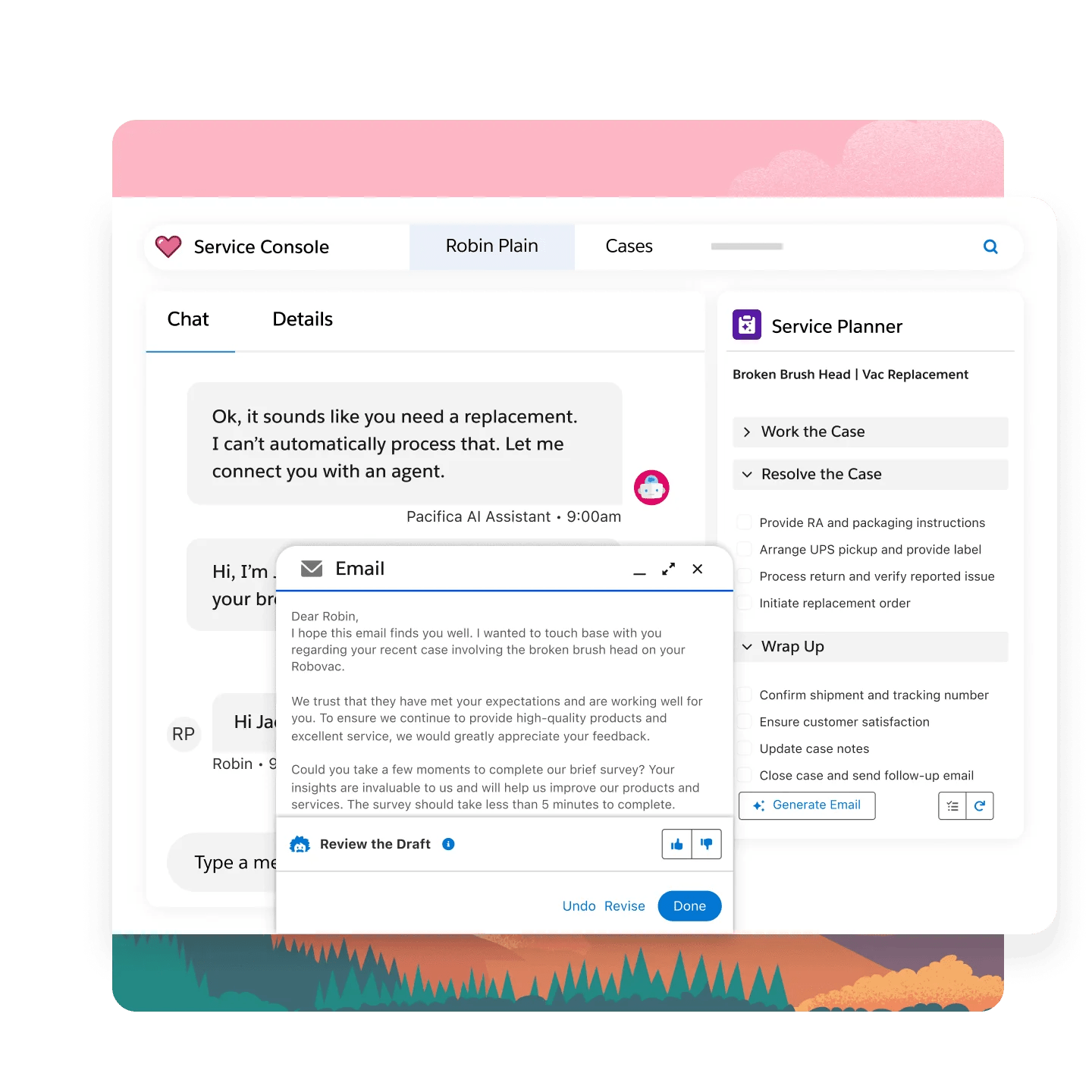
Classify what the customer actually wants, answer the intents that have a documented answer, and escalate the rest with the transcript already attached.
Retrieve approved articles and summarise a long case or call for the agent picking it up, so nobody reads twenty updates to find the one that matters.
Draft the case note, the reply or the after-call summary, then stop at the approval so a person decides what actually reaches the customer and the record.
Delivery method
Six beats on every engagement: transparent gates from discovery through operate. Service leaders get a roadmap, a RACI, and pilot exit criteria tied to first-contact resolution, handle time or misroute rate, measured against the baseline we captured before touching anything. Same method as our broader Salesforce consulting practice.
Baseline the operation: volumes by channel and intent, misroutes, transfers, handle time and SLA attainment. Inventory the carrier, ITSM, HRIS and billing. Agree pilot success measures with service leadership, delivery, and finance in the room.
Case and knowledge model, queue and skill design, entitlement and SLA clocks, the telephony decision, and integration contracts signed by business and IT before build starts. CRM versus carrier and ITSM ownership written down.
Sandbox-first Service Cloud, Omni-Channel routing, console and Voice wiring where scoped, plus MuleSoft or native carrier and ITSM syncs. Reusable test assets your admins can extend after go-live.
Scenario runs for routing, escalation and after-hours, agent evaluation sets, and portal status. UAT with delivery coordinators and contact-centre leads before production traffic hits live queues or crews.
One queue first, then by team or channel, avoiding peak and period close. Monitoring live, cutover rehearsed, and rollback owned by a named person on the day.
Hypercare on the queue and SLA readouts, routing change backlog, knowledge review cycle, integration health and agent answer quality. Optionally continue with managed services or ongoing Salesforce administration.
Book a service architecture review

Client reviews
Verbatim reviews from SynconAI Salesforce and Agentforce engagements across the United States, Australia and globally. Anonymised clients are labelled by sector.
Salesforce Select Partner16+ architect certificationsDelivery across USA, Sydney & India
Simply Outstanding
“SynconAI Consulting are Simply the Best in the Business When it comes to Salesforce implementation and AI-powered solutions, SynconAI are in a league of their own. Their expertise, dedication, and ability to deliver results that truly move the needle sets them apart from every other consulting partner we've worked with. What they achieved with our Sales Cloud, Service Cloud, and custom Agentforce agent has completely transformed how we operate streamlining our pipelines and our customer service, and automating tasks that used to consume hours of our team's time. They don't just implement technology they transform businesses. If you want the best, you work with their team.”
“I had a very urgent deadline for our project reporting to be delivered and needed to build the module, dashboard and output reports in Salesforce. SynconAI were very responsive - they met with me online, responded to my emails quickly and took calls - whatever was needed to progress the work quickly. We are thrilled with the outcome and will continue to work with SynconAI in the future to continue to build our Salesforce capability and platform.”
“The team at SynconAI were fantastic, and promptly delivered on each project. They were able to guide us through every stage and made sure we were satisfied with the outcomes on multiple scopes of work.”
“They have been great and helping us transform out business by bringing what I conceptualize to life. Great at translating process/workflow needs into a solution. Been a pleasure work with and they're a critical part of our team and will be instrumental into bringing about my vision.”
“Working with SynconAI was a seamless and highly professional experience from start to finish. They took the time to deeply understand our business processes before designing and implementing a Salesforce solution tailored specifically to our operational needs. The team demonstrated strong technical expertise across Salesforce configuration, automation, integrations, reporting, and user experience design.”
Frequently asked questions
Straight answers about Service Cloud, Salesforce Voice, Omni-Channel routing, Agentforce deflection, telephony choices and the Open CTI deadline, across the USA and Australia.
Design the service operating model, then build it. That means the case model and record boundary, Omni-Channel routing rules, queue and skill design, telephony integration, knowledge, entitlements and SLA clocks, supervisor and QA tooling, and the reporting layer. Configuration is the last step, not the first. Most contact centre programmes fail on routing design and knowledge ownership rather than on product capability.
Yes. Salesforce has published an Open CTI end of life of 28 February 2028. It is already deprecated, no new features are being added, and it is unavailable for newly created Agentforce Service orgs. If your telephony sits in Salesforce through an Open CTI adapter, that integration has a fixed shelf life and you need a migration plan to Salesforce Voice. Confirm the timing and your entitlements with your Salesforce account team and the release notes.
Agentforce Contact Center is the native Salesforce contact centre that became generally available on 23 February 2026, unifying voice, digital channels, CRM data and AI agents in one system. Whether you need it depends on your current CCaaS contract, your routing complexity and your appetite for consolidation. Plenty of organisations are better served keeping their existing carrier and integrating properly. We help you compare honestly rather than assume the newest option is the right one.
Usually yes. Service Cloud Voice supports bring your own telephony, so providers such as Amazon Connect, Genesys and Five9 can remain your voice infrastructure while agents get the native Salesforce experience. The decision is commercial as much as technical: contract dates, routing features you actually use, and how much of the estate you want on one vendor. We document the trade-off rather than pushing a migration.
The customer contact centre optimises for handle time, first-contact resolution and SLA attainment against external entitlements. The internal IT or HR help desk optimises for time to restore, deflection and employee experience, and it usually has to integrate with an ITSM tool and the HRIS. The platform is often the same; the routing rules, knowledge model, and definition of done are not. We scope them separately.
By deflecting the questions that have a documented answer and escalating everything else with the transcript attached. We scope topics and actions to approved knowledge, put a named human on anything that issues a credit, changes an entitlement or grants access, and set an evaluation baseline before it touches a live queue. Agents that are grounded in messy knowledge do not fail quietly; they fail confidently in front of a customer.
Amazon Connect, Genesys, Five9 and RingCentral are trademarks of their respective owners. SynconAI is an independent Salesforce consulting partner: we advise on licensing and work alongside your Salesforce account executive, and we design, build and run what goes on top of it.
Free architect conversation
60 seconds to brief us. A certified architect replies within one business day.
 Sales Cloud
 Service Cloud
 Field Service
 Experience Cloud
 Marketing Cloud Next
 Revenue Cloud AdvancedSalesforce CPQ
 Data 360
 Financial Services Cloud
 Nonprofit Cloud
 Health Cloud
 CRM Analytics & Einstein
 Agentforce