Salesforce for medium business · governance · visibility · automation · certified partner

Nobody broke your Salesforce org. Nobody was ever given the job of saying no, and three years of reasonable requests did the rest.

  • The first release removes things. Fields nobody populates, automation that fires and changes nothing, reports opened once in a year. People notice that in week one in a way they never notice an addition
  • One named owner with the authority to refuse. Not three people with admin rights, which is the arrangement that produced the sprawl in the first place
  • The API gap, before it stalls a project. Salesforce states plainly that Additional API Calls does not enable API access in Professional Edition, and that you must order the Web Services API product instead
  • Somewhere to work that is not production. Teams edit live because there is nowhere else, which is a licensing decision that quietly became an engineering one

At this size the platform is not the constraint. The org grew a field per request, its numbers get re-done in a spreadsheet, and the first real integration just met an edition question nobody priced. All three share one root, and it is not Salesforce.

  • You keep the written assessment either way
  • Certified Salesforce partner, not a reseller
  • Named team on your business hours

Proven Success With

Pressure we surface early

Every one of these decisions was made by somebody sensible

Worth saying out loud, because most teams arrive slightly embarrassed. A field was added because a director asked. An automation was built because a project needed it. Repeat across several teams for three years and you get an org nobody dares change. None of that is carelessness.

An administrator working at a computer.
Pressure point: the person who will fix this is usually already in the building and already knows what needs doing. What they lack is a mandate and somewhere to work that is not production.Photo: Pexels.
Ownership

Three people have admin, nobody has the job

This is the root of nearly everything else on this page. Requests arrive and get honoured because refusing is not anybody role. The absence of that role is the single strongest predictor of the state of an org at this size.

Sprawl

Sixty fields, half of them never filled in

The page layout stopped being usable somewhere around year two. People fill in the required ones with whatever makes the save button work, so the reporting built on those fields is describing compliance rather than reality.

Automation

Nobody dares touch the Opportunity object

A Workflow Rule, a Process Builder and two Flows all fire on it in an order nobody has mapped. So the object becomes frozen, and everything that needed to change there gets built somewhere less appropriate instead.

Environment

Changes go straight into production

Not recklessness. There is nowhere else to work, and sandbox availability is an edition question. A policy telling people to stop will lose to a workaround that is faster, every time.

Trust

The numbers get corrected before they are quoted

Somebody exports to a spreadsheet, adjusts, and that is the version leadership sees. The size of that adjustment is the most honest measurement you have of how much the platform is trusted.

Integration

The project stalled on a licence SKU

Professional Edition has no API by default, and the add-on most teams order first does not enable it. So a piece of work everyone assumed was small becomes a commercial conversation nobody budgeted for.

See what actually fixes this

The edition wall

The most expensive mistake at this size is ordering the wrong API product

API access is included by default in Enterprise, Unlimited, Developer and Performance. Professional can buy it, and the SKU is where this goes wrong: Salesforce states that Additional API Calls does not enable API access for Professional Edition, and that you must order the Web Services API product instead.

The failure is silent: the order goes through, the invoice is correct, the integration still cannot authenticate, and two sprints go into suspecting the middleware. Salesforce documents which editions include API access and your account team remains authoritative on what your agreement contains.

Active validation rules cap at 20 per object below Enterprise against 200 above it. Invisible at small scale, and one of the first ceilings a growing business hits without understanding why.

Changing configuration directly in production is almost always a sandbox availability problem rather than recklessness. Allocations differ sharply by edition, so where a team develops is a licensing decision that became an engineering one.


SynconAI edition-pressure map for mid-market workshops. Read it upward: each rung describes the thing that pushed an organisation off the one below, rather than a feature comparison.

What we actually build

The six patterns behind almost every mid-market engagement

Written the way revenue operations, admins and IT describe the problem rather than as a feature list. Most engagements start with the first two, because an org nobody has measured is one nobody can safely change.

Org health assessment

Measured, not described

Field completion, automation inventory, duplicate scores and report usage. The findings are usually less alarming and more actionable than the team expects.

Rationalisation

The first release removes

Fields, layouts, validation and reports cut back to what people actually use. This is the change with the fastest visible effect and the one nobody else offers.

Automation consolidation

Off the retiring tooling

Workflow Rules and Process Builder mapped and migrated, the dead retired, and the rest rebuilt so an administrator can safely change it without a specialist.

Ownership and change control

What stops it recurring

A named owner with authority, a written request path, and a release rhythm. Without this the clean-up is temporary and everybody knows it.

Integration, with the edition settled

Before a sprint goes into it

Finance, ERP and marketing joined, with the API question answered first because on Professional Edition that is a commercial conversation, not a technical one.

Reporting that reconciles

No spreadsheet correction

Definitions agreed with the people who own the numbers, then a small report set. The test is whether anyone still adjusts the figure before quoting it upward.

Scope your phase-one backlog

Scope of delivery

What we deliver for scaling teams

From a measured org assessment through to run-state support across Sales Cloud, Service Cloud, Flow and Agentforce, scoped with named owners, a measured baseline, and the edition question settled before anything is built on top.

A clean-up without an owner is a temporary result everybody can see is temporary. We have watched orgs rationalised beautifully and back to the same state in two years, because the cause was left in place.

Colleagues comparing figures on a report together.
What run-state looks like: objects people are willing to change, a report set small enough to maintain, and a number that reaches the board without being adjusted on the way.Photo: Pexels.

Org health assessment

Fields populated against required, automation mapped with trigger order, duplicates scored, reports ranked by usage, and an edition fit check in both directions. Yours whether or not you engage us.

Rationalisation

Fields, page layouts, validation rules and reports cut back to what people genuinely use, with the baseline measured first so the improvement is demonstrable.

Automation rebuild

Migration off Workflow Rules and Process Builder, consolidation onto Flow, error handling, and a register so the next person to change one is not guessing.

Integration

Finance, ERP and marketing systems joined with the edition consequence stated first. Larger estates move to MuleSoft integration when point-to-point stops scaling.

Environments and release

Somewhere to develop that is not production, a promotion path quicker than the workaround, and preview testing so three releases a year stay routine.

Managed services

A named team for the run-state backlog and releases, or cover for an admin who needs capacity rather than replacing, optionally as managed services.

Agentforce, after the hygiene

Scoped once the records are worth grounding on, with a named human on anything that commits. See Agentforce services.

Book a free org assessment

The work

What a mid-market engagement actually consists of

Not a phase plan. These are the pieces we get asked for, and most engagements are three or four of them. The order matters more here than the contents: measuring before removing, and naming an owner before adding, are what stop the result being temporary.

  1. ReadMeasured, so the improvement afterwards is demonstrable rather than asserted
  2. RemoveThe first release takes things away, which people notice immediately
  3. OwnOne person with authority, before anything new is built on top
  4. RebuildAutomation an admin can edit, and somewhere to work that is not production

SynconAI engagement spine for mid-market workshops. Agentforce sits after all four, not before, and nothing contractual or financial completes without a named human.

Unfreezing the object nobody dares change

A Workflow Rule, a Process Builder and two Flows firing in an unmapped order. We document what runs, retire what changes nothing, and consolidate the rest so the object stops blocking everything routed around it.

Cutting the record back

Every required field tested against one question: does answering this help somebody do their job, or only help somebody report? If it is the second, it becomes optional, derived or gone.

Closing the spreadsheet gap

Finding the adjustment made between the report and the number quoted upward, then fixing the definition that causes it. That gap is the most honest measure of trust you have.

Getting off production edits

An environment strategy your edition supports and a promotion path faster than the workaround, because a policy slower than the shortcut will not be followed by anyone under deadline.

The integration that stalled

Diagnosing whether the blocker is technical or a licence SKU, because on Professional Edition it is usually the second and no amount of middleware debugging will resolve it.

Giving the admin a mandate

Frequently the person who can fix this already works there and knows exactly what to do. What they need is authority, cover for the backlog, and somewhere to work. That is a smaller engagement than a rebuild.

Tell us which of these you need

Who we work with

Four people who all describe the same problem differently

RevOps calls it reporting nobody trusts. The admin calls it a backlog with no sandbox. IT calls it an edition wall. One problem, four symptoms: nobody was given the job of holding the org. Tap the closest group to pre-scope the form.

A cross-functional team working through a problem together.
Operating cue: the fix needs the person who approves change and the person who does the work in the same room. Assessments that go only to leadership produce agreement and no movement.Photo: Pexels.

Book a free org assessment

Governed AI

Agentforce once the definitions are settled, not before

Assistance inside the process, not an unsupervised decision maker

Your records stay on your data model; Agentforce is how Salesforce surfaces governed assistants on top of them. The useful scope here is narrow: briefing somebody before a call, summarising a long history, and suggesting a next step against criteria you have now written down. Anything touching price, discount or a commitment to a customer stops at a named approver.

Availability follows your edition and region. Details on our Agentforce services page.

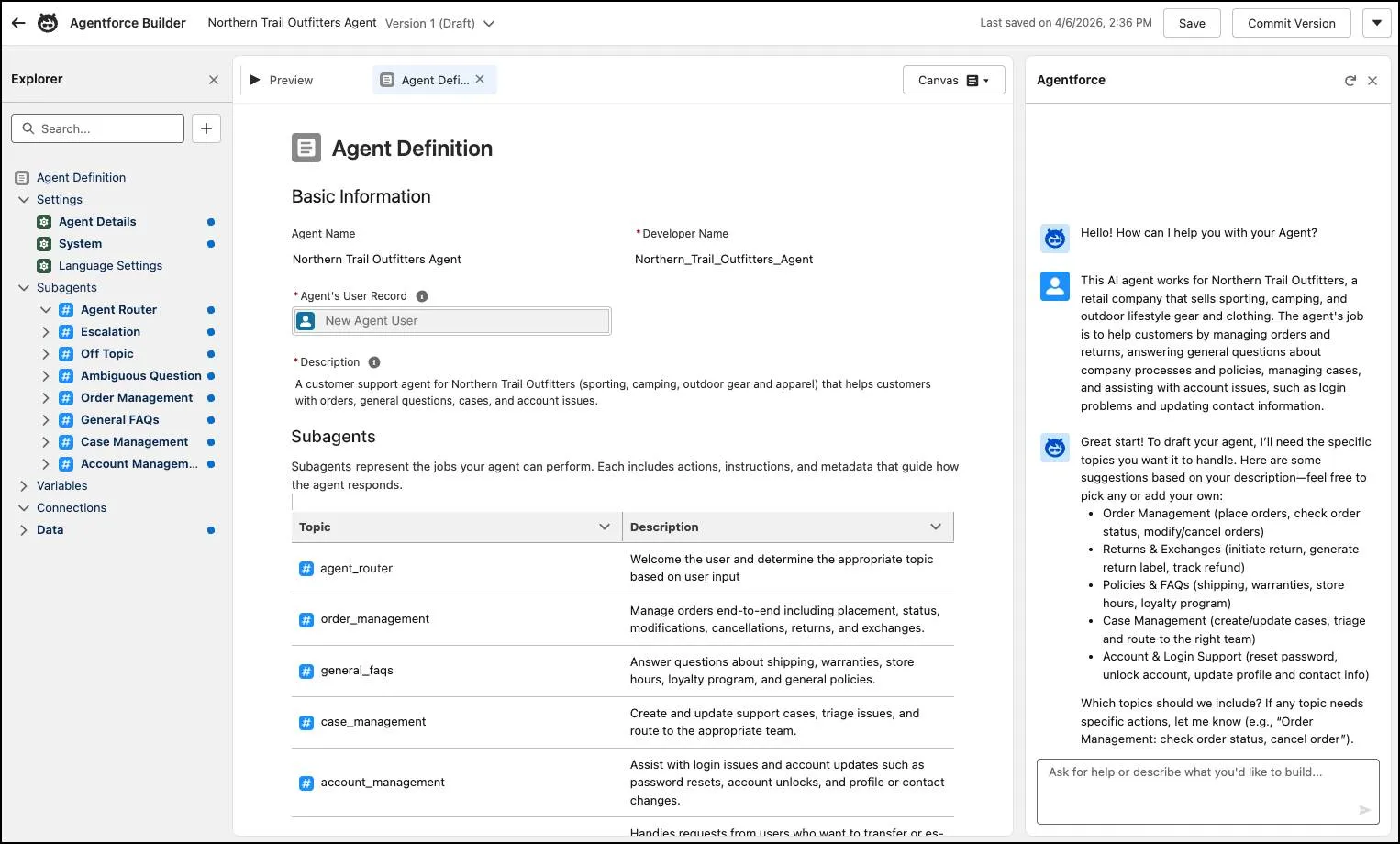
Agentforce agent configuration showing topics, instructions, and the actions an agent is permitted to take.
Where the boundary is set: topics, grounding and permitted actions are configuration, not a prompt. That is what makes a refusal to commit a price enforceable rather than hoped for.Screenshot © Salesforce; product UI may vary by edition and release. See Agentforce.

Brief before the call

What the records already know about an account, gathered before a meeting rather than assembled from twenty minutes of tab switching that usually does not happen.

Summarise and suggest the next step

A long history condensed, and a next action proposed against the exit criteria you agreed. That only works because those criteria now exist in writing.

Draft, then hand off

The record update or the follow-up drafted and stopped at an approval, so a person decides what reaches the record and what reaches the customer.

Ask whether your data is ready

Honest scoping

We will tell you when you are on a higher edition than the work needs

That direction of advice is rarer than it should be, and occasionally it is the finding. We are a consulting partner rather than a licence reseller, so no margin rides on what you buy, and we map the work against the edition in both directions.

Check the three forcing questions

Does anything need to integrate, do you need more than 20 active validation rules on any object, and do you need somewhere to develop that is not production. Those three decide the edition far more reliably than a seat count does.

Get the API SKU right

API access is included by default in Enterprise, Unlimited, Developer and Performance. Professional can buy it, and the SKU is where this goes wrong: Salesforce states that Additional API Calls does not enable API access for Professional Edition, and that you must order the Web Services API product instead.

Audit what you already own

Agreements accumulate entitlements nobody switched on, particularly after a renewal or an upgrade. Worth checking before anybody quotes you for new capability, because occasionally it changes the size of the purchase.

If you do not have a Salesforce account executive yet, we will make the introduction. The FAQ covers what we can and cannot do on licensing. Adjacent needs such as Data 360 work share the same change-control ownership so nothing becomes a governance island.

Have us check your edition fit

Partnership criteria

Why scaling teams choose SynconAI

Most partners are paid to build, which makes removal a strange thing to propose and an owner with veto power a slightly threatening idea. Our first release is usually a removal and our first deliverable is usually a mandate for somebody who already works there. Learn more about our Salesforce consulting partner approach.

We measure before we propose

Assessment first

Field completion, automation inventory, duplicate rates and report usage. You keep the document whether or not you engage us, and it usually shows a smaller job than the team feared.

Our first release removes

Not adds

People have ignored additions for years. Something disappearing from a page layout they hate is noticed the same afternoon, and it is what buys the credibility for everything after it.

We back your admin rather than replacing them

Mandate and cover

The person who can fix this usually already works there and knows what to do. What they lack is authority, capacity and somewhere to work. That is a smaller engagement and a better outcome.

We insist on the hard conversation

Definitions

What a stage means and whether a number may be adjusted are commercial decisions. We put them in front of whoever owns the number, because configuration cannot settle a disagreement.

Delivery geography

US · AU · worldwide

Hubs in Delaware, Sydney and Hyderabad, a named team on your business hours, and travel onsite for discovery, go-lives and executive sessions.

Long-term operator

After hypercare

The same architects for the run-state backlog, the releases and the reporting changes, not a handover to a queue that never saw discovery.

Book a free org assessment

Delivery method

How we deliver mid-market engagements

Six beats with transparent gates. The unusual one is third: the owner is named before anything new is built. Appointed afterwards they inherit a tidy org and no mandate; appointed before, they own the removal decisions too. Same method as our Salesforce consulting practice.

Mid-market engagement: Read · Remove · Own · Rebuild · Connect · Run

  1. Read

    Fields populated against required, every automation on the core objects mapped with its trigger order, duplicates scored, reports ranked by usage, and the size of the spreadsheet adjustment measured. You keep the write-up either way.

  2. Remove

    Fields nobody populates, automation that fires and changes nothing, validation people route around and reports nobody opens. Staged, measured, and deliberately the first thing anyone sees.

  3. Own

    One named owner with the authority to refuse, a written request path, and the two-question test before a field is added. Agreed before anything new is built, not after.

  4. Rebuild

    Automation consolidated off Workflow Rules and Process Builder, error handling added, and an environment strategy so people stop editing production because there is finally somewhere else to work.

  5. Connect

    Integration with the edition question settled first, least-privilege integration users, and reconciliation so a failed sync is noticed by a person rather than by a customer.

  6. Run

    Hypercare, the ongoing backlog, three releases a year absorbed as decisions, and a quarterly check that the field list and report set have not started growing again. Optionally continue with managed services or ongoing Salesforce administration.

Salesforce Partner

Client reviews

What clients say about working with our architects

Verbatim reviews from SynconAI Salesforce and Agentforce engagements across the United States, Australia and globally. Anonymised clients are labelled by sector.

5.0 average · 5 client reviews

 Salesforce Select Partner16+ architect certificationsDelivery across USA, Sydney & India

Simply Outstanding

“SynconAI Consulting are Simply the Best in the Business When it comes to Salesforce implementation and AI-powered solutions, SynconAI are in a league of their own. Their expertise, dedication, and ability to deliver results that truly move the needle sets them apart from every other consulting partner we've worked with. What they achieved with our Sales Cloud, Service Cloud, and custom Agentforce agent has completely transformed how we operate streamlining our pipelines and our customer service, and automating tasks that used to consume hours of our team's time. They don't just implement technology they transform businesses. If you want the best, you work with their team.”

Sales CloudService CloudAgentforce
Jack BennettConsumer Goods & Retail · United States

“I had a very urgent deadline for our project reporting to be delivered and needed to build the module, dashboard and output reports in Salesforce. SynconAI were very responsive - they met with me online, responded to my emails quickly and took calls - whatever was needed to progress the work quickly. We are thrilled with the outcome and will continue to work with SynconAI in the future to continue to build our Salesforce capability and platform.”

Sales CloudService CloudNonprofit Cloud
Salesforce Managed ServicesAustraliaSalesforce Verified

“The team at SynconAI were fantastic, and promptly delivered on each project. They were able to guide us through every stage and made sure we were satisfied with the outcomes on multiple scopes of work.”

Sales CloudSlackFlowAgentforceMuleSoft
ManufacturingAustraliaSalesforce Verified

“They have been great and helping us transform out business by bringing what I conceptualize to life. Great at translating process/workflow needs into a solution. Been a pleasure work with and they're a critical part of our team and will be instrumental into bringing about my vision.”

Sales CloudFinancial Services CloudArchitectureAI
Financial ServicesUnited StatesSalesforce Verified

“Working with SynconAI was a seamless and highly professional experience from start to finish. They took the time to deeply understand our business processes before designing and implementing a Salesforce solution tailored specifically to our operational needs. The team demonstrated strong technical expertise across Salesforce configuration, automation, integrations, reporting, and user experience design.”

SalesforceExperience CloudCustom DevelopmentAutomationReporting
Salesforce ImplementationSalesforce Verified

Frequently asked questions

Salesforce for medium business, answered honestly.

Straight answers about why the org drifted, what a clean-up actually removes, the Professional Edition API gap that stalls integrations, who should own the org internally, and how to absorb three releases a year without losing a quarter to them.

Almost certainly the API gap, and it is the most expensive surprise at this size. API access is included by default in Enterprise, Unlimited, Developer and Performance. Professional Edition can buy it, but Salesforce is explicit that the Additional API Calls product does not enable API access for Professional Edition and that you must order the Web Services API product instead. Teams order the first one because the name sounds right, see nothing change, and lose weeks blaming the middleware. If you are on Professional and anything needs to connect, settle that before another sprint goes into it.

The same way every org this size does, and it is worth saying plainly because people assume it reflects badly on them. A request arrived, somebody with admin rights obliged, and nobody had the job of saying no. Repeat for three years across several teams and you get a record with sixty fields, four automations firing in an undocumented order on the same object, and a report library nobody has pruned. That is the absence of a role rather than carelessness. The fix is mostly removal plus one named owner, and it is a smaller engagement than the rebuild people brace for.

It depends on three things and none of them is headcount. Does anything need to integrate, because API access is included by default only from Enterprise upward. Do you need more than 20 active validation rules on any single object, because that is where the lower editions cap against 200 in Enterprise. And do you need somewhere to develop that is not production, because sandbox allocations differ sharply by edition. If none of those bite, staying is legitimate and we will say so. If two of them bite, the conversation is usually already overdue.

It is a risk, but it is usually a symptom rather than a habit. Teams work in production because there is nowhere else to work, and sandbox availability is an edition question. So the useful response is not a policy telling people to stop, it is giving them a place to go and a promotion path that is quicker than the workaround. We set up the environment strategy your edition supports, put the critical paths under test during preview windows, and make the safe route the fast route. Policies that are slower than the workaround are not followed.

Fields nobody populates, automations that fire but change nothing, validation rules that people route around, reports that have not been opened in a year, and page layout sections that exist because somebody asked in 2022. Every required field is tested against one question: does answering this help someone do their job, or only help someone report? If it is the second, it becomes optional, derived or gone. We measure field completion, duplicate rates and report usage before touching anything, so the improvement afterwards is demonstrable rather than asserted.

One person, named, whose job description includes it. Not three people with admin rights, which is the arrangement most organisations at this size drift into and the one that produced the sprawl in the first place. That owner does not need to be a full-time administrator: at this size it is often an operations or revenue operations lead who approves changes and holds the roadmap, with us doing the build. What matters is that when somebody asks for a new field there is a person whose job it is to ask what it is for.

Salesforce, Flow, Process Builder, Workflow Rules and Agentforce are trademarks of Salesforce, Inc. SynconAI is an independent certified Salesforce consulting partner and is not created by, affiliated with, or endorsed by Salesforce, Inc. Editions, allocations, entitlements and pricing are set by Salesforce and change; the Salesforce Help documentation and your account team remain authoritative.

Free architect conversation

Talk to an architect, not a sales rep.

60 seconds to brief us. A certified architect replies within one business day.

What do you need to get under control?

Pick the closest fit. The org health assessment is free and you keep the written findings either way.

Which clouds or systems are in scope?

Optional. Choose any that apply, or skip ahead.

Where does your org stand today?

Optional. A few sentences is plenty: what is working, what is stuck, and what you want to be true. Or skip ahead and tell us on the call.

Who should the architect reach?

A certified architect will reply to these details.

Takes about 30–60 seconds · No obligation · Architect replies within one business day

Protected by reCAPTCHA. Google's Privacy Policy and Terms apply.

Free org assessmentCallWhatsApp

Solutions, built
for the future

Sales CloudSales Cloud
Service CloudService Cloud
Field ServiceField Service
Experience CloudExperience Cloud
Marketing Cloud NextMarketing Cloud Next
Revenue Cloud AdvancedRevenue Cloud Advanced
Salesforce CPQSalesforce CPQ
Data 360Data 360
Financial Services CloudFinancial Services Cloud
Nonprofit CloudNonprofit Cloud
Health CloudHealth Cloud
CRM Analytics & EinsteinCRM Analytics & Einstein
AgentforceAgentforce