
Sold an edition for a company you are not
Headcount bands are how quotes get built and they tell you nothing. Starter has no user cap. What decides fit is whether Salesforce can hold the things your business talks about, and nobody asked you that.
Salesforce for small business · practical setup · no unnecessary overhead · certified partner
Most small businesses that gave up on Salesforce were sold an edition and a project shaped for a company four times their size. The licences got paid, five percent got used, and the conclusion was that CRM does not suit them. It usually did. The sizing did not.









Pressure we surface early
The pattern is predictable. An edition gets chosen from a headcount band. The implementation arrives with phases and a workstream. The launch is complete, unnavigable and unmaintainable. Six months later everyone is back in the spreadsheet and the conclusion is that CRM does not suit this business.

Headcount bands are how quotes get built and they tell you nothing. Starter has no user cap. What decides fit is whether Salesforce can hold the things your business talks about, and nobody asked you that.
Discovery phases, a steering group and a workstream for adoption. That process is genuinely right for a thousand users. Applied here it costs more than the licences and produces something nobody can navigate.
Ask a busy person for information that helps reporting rather than their own work and you will get whatever makes the save button work. The real deal stays in their head, and the data you report on is fiction.
The build assumed an administrator that does not exist here. So the first thing that needs changing does not get changed, then the second, and within a year the org has quietly stopped matching how you work.
Duplicates, three things in one column and dates stored as text, imported faithfully. Now the customer list is worse than the spreadsheet was, and nobody trusts a single report built on it.
An edition bought to cover a growth story that has not happened, with features nobody has switched on. Editions move up far more easily than a small business budget recovers from being over-sized.
The noun test
One question sizes you, and nobody asks it: does your business talk about a thing Salesforce does not ship with? Accounts, contacts, leads, opportunities and cases come as standard. Jobs, projects, policies, properties, matters and shipments do not, and Starter allows zero custom objects.
Headcount is a red herring. Starter carries no user cap, which surprises people. Going from six people to sixteen does not force you off it, and that removes the usual reason to over-buy.
The softer ceiling is 25 custom fields per object. Generous for a disciplined record, tight once every team has added three fields nobody fills in, which makes it a useful forcing function.
Record types are not available in Starter. So two parts of the business needing the same object to behave differently is the third thing that moves you up a rung.
Allocations change, so treat this as the shape of the question rather than a contract; Salesforce publishes the current Starter allocations, and your account team remains authoritative. The same three questions applied across all sizes are on our Salesforce for SMBs page.
SynconAI sizing ladder for small business conversations. Stop at the first rung that can hold your business; everything above it is capability you would be renting and not configuring this year.
Which rung holds your business
The work
Not a phase plan. These are the pieces we get asked for, and most engagements are two or three of them. A first release containing everything below is a first release nobody will adopt, which is the failure mode at this size.
SynconAI engagement spine for small business builds. Agentforce comes after all four, never before, and nothing contractual or financial completes without a named human.
Send us the proposal and the edition on it. We will tell you where it is oversized, where an add-on is genuinely needed, and what it does not cover. Free, and at this size it regularly saves more than our fee.
The customer list, the pipeline tab and the version somebody keeps locally, brought into one place. The value is mostly the cleaning: merged duplicates, separated columns, and dates that are actually dates.
The info@ address turned into cases with an owner and a status, so requests stop depending on who happens to read them and nothing quietly falls through when somebody is away.
The reminders, chaser emails and status updates people do by hand today, automated in Flow and kept simple enough that one person can still understand them next year.
A handful that answer the questions you genuinely ask, and nothing else. A library of two hundred reports is a maintenance cost, not an asset, at any size and especially at this one.
Training aimed at whoever will own it, documentation they can maintain, and us reachable for the awkward questions rather than gone the day after go-live.
What we actually build
Written the way owners and operations leads describe the problem rather than as a feature list. Most engagements are two or three of these. If someone is proposing all six at once for a company your size, ask what is in it.
The noun test, the integration question, and a straight read on any quote you have been given. Free, and it is the highest-value twenty minutes of the whole engagement.
Sales process, case handling and the shortest record that still supports reporting. Deliberately less than you were sold, because adoption is the only thing that matters at this size.
Duplicates merged, dead records left behind, columns that were three things separated out. Importing faithfully is the mistake; the cleaning is the value.
The chasers, reminders and status updates done by hand today. Simple enough that one non-specialist can still understand and change it a year from now.
The questions you genuinely ask, answered. Everything else is maintenance you would be paying for and nobody would be reading.
Training for whoever owns it and documentation they can maintain. Where nobody internal can hold it, we stay reachable rather than disappearing at go-live.
Scope of delivery
From a free sizing conversation through to handover across Salesforce for small business, Sales Cloud, Service Cloud and Flow, scoped so one person can maintain what we leave behind.
A partner who never tells a small business to buy less is not advising, they are quoting. We are a consulting partner rather than a reseller, so recommending a cheaper edition costs us nothing except margin we never had.

The noun test, the integration question, what your spreadsheets would become, and a straight read on any proposal you already hold. Twenty minutes, no obligation, and you keep the answer.
Sales process, case handling, the shortest record that still supports reporting, and a first release small enough to learn in an afternoon.
Spreadsheets, a shared inbox or a lighter CRM brought across with deduplication, a tested rollback and a cutover timed so nobody loses a week.
Flow taking the follow-ups and reminders, built simply enough that a non-specialist can change it later without breaking something.
Aimed at the person who will own it rather than at a room, with documentation short enough that it stays current.
Where nobody internal can hold it, a few hours a month rather than a full engagement, optionally as managed services.
Custom objects, record types or integration when a ceiling is genuinely reached. See Salesforce for medium businesses.
Who we work with
That should be an advantage and usually is not, because nobody puts the sizing question in front of them before the contract. Tap the group closest to you to pre-scope the conversation form.
Governed AI
Useful at small scale, and easy to switch on too early
Your records stay on your data model; Agentforce is how Salesforce surfaces governed assistants on top of them. What makes it worth having here is narrow: it absorbs the follow-up work that gets skipped when everyone is full. What it must never do is commit anything. Price, discount and anything that changes an account go to a named person, set in configuration rather than asked for in a prompt.
Availability follows your edition and region. Details on our Agentforce consulting page.
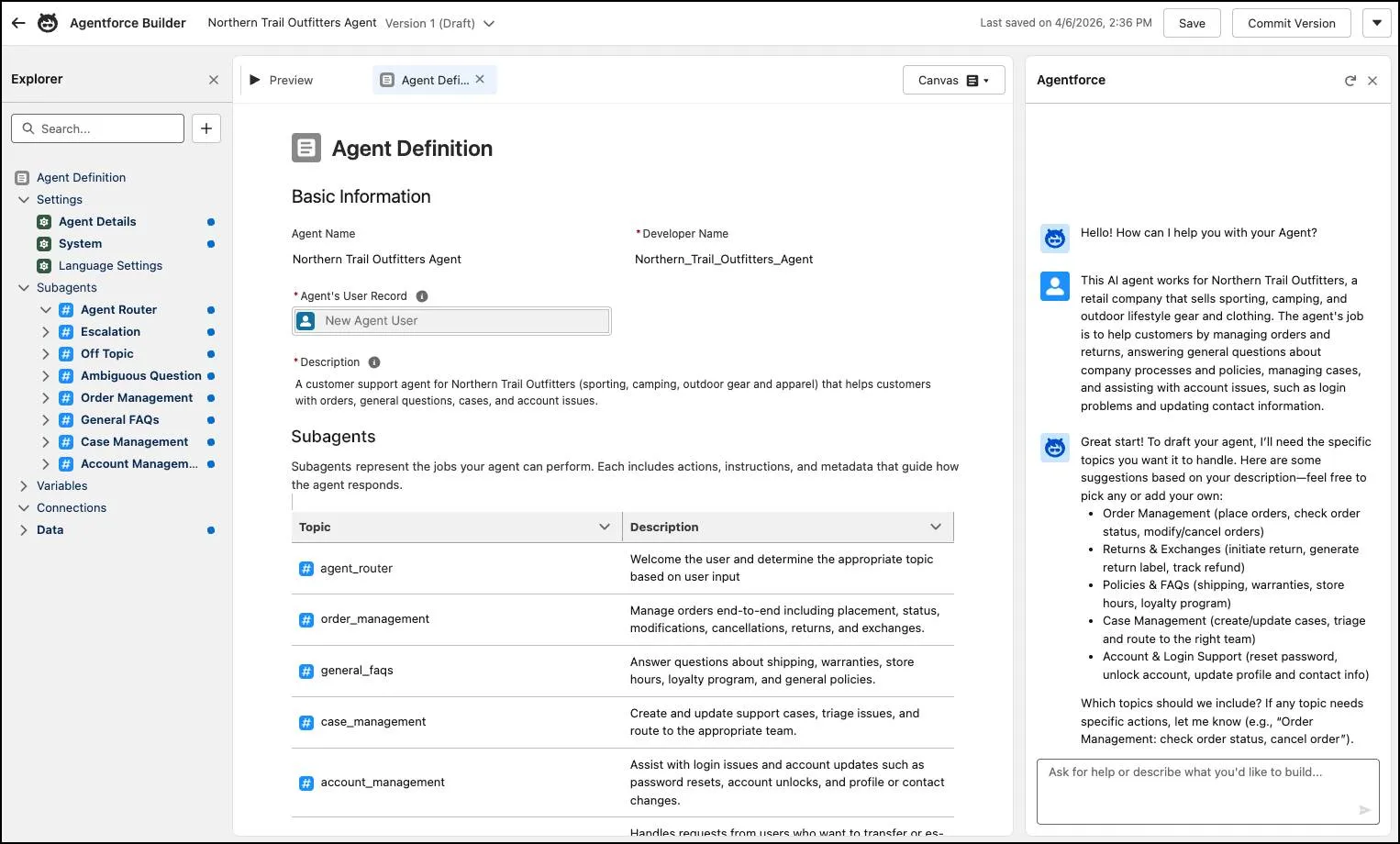
Fourteen emails condensed into what was agreed and what is outstanding, so whoever picks it up next does not have to read the lot. This is the task that silently does not happen at small scale.
A reply written and waiting for somebody to approve and send, rather than sitting in a mental queue until Friday. A person still decides what reaches the customer.
Anything touching price, discount, contract terms or an account change stops at a named person. Set in configuration, so it still holds when the agent is trying hard to be helpful.
Honest scoping
None of that justifies a multi-quarter programme. A small business build should be live in weeks and end with a named person who can maintain it. A partner quoting phases and workstreams for a company of eleven is quoting their own process.
We are a consulting partner rather than a licence reseller, so no margin rides on what you buy. What we bring is the mapping between the work you need and the rung that supports it.
Capability you will not configure for three years is capability you are renting. Editions move up easily; a small business budget recovers from being over-sized far less easily, so we size for the work actually in front of you.
If anything will need to connect to Salesforce in the next year, say so before you sign. API access is an edition question, and it is much cheaper to answer at the quote than as a change request in month nine.
Two different costs that get quoted as one number. Knowing the split tells you whether you are paying for software or for a method, and at this size the method is usually where the over-sizing hides.
If you do not have a Salesforce account executive yet, we will make the introduction. The FAQ covers what we can and cannot do on licensing. When you do outgrow this tier, the next set of questions is on our medium business page.
Partnership criteria
Most partners are built for enterprise work and take small projects at the edges, which is why the method arrives unchanged and the invoice surprises everyone. We do run enterprise programmes, and that is precisely why we can tell you which parts of one you do not need. Learn more about our Salesforce consulting partner approach.
Structure decides the rung, and it often lands below the quote. Saying so costs us margin we never had, because we are a consulting partner rather than a reseller.
Send us the proposal in front of you. You get a written read on where it is oversized and what it does not cover, with no obligation and no catch.
A release people learn in an afternoon gets used. A complete one gets worked around. Adding later is cheap; recovering from a launch nobody adopted is not.
If nobody internal can maintain it, that changes what we build rather than being noted as a risk. Fewer moving parts, and us reachable afterwards.
Hubs in Delaware, Sydney and Hyderabad, with a named person on your business hours rather than a ticket queue in a timezone you are asleep in.
Admin-on-call rather than a support contract. What kills small orgs is a question nobody could answer, so the change never got made.
Delivery method
Six short beats, measured in weeks. The two that people find unusual are the first and the last: sizing happens before anything is signed, and we plan the handover before we plan the build. Both are cheap at the right moment and very expensive to retrofit. Same method as our broader Salesforce consulting practice, cut down to fit.
The noun test, the integration question, and a straight read on any quote you hold. Twenty minutes, free, and it occasionally ends with us telling you to wait a year.
Every field tested against whether answering it helps somebody do their job. The shortest record that still supports the reporting you asked for, agreed before anything is configured.
Spreadsheets and inboxes brought across with duplicates merged, dead records left behind and columns separated, plus a tested rollback and a cutover timed so nobody loses a week.
Live in weeks with a first release deliberately smaller than you expect, plus the automation that takes a job away from somebody in week one so adoption has a reason to happen.
Training aimed at the person who will own it, documentation that fits on a page, and a written answer to who decides whether a new field gets added.
On evidence, and only when something is genuinely in the way. Where you have nobody internal, we stay reachable as admin-on-call rather than disappearing at go-live.

Client reviews
Verbatim reviews from SynconAI Salesforce and Agentforce engagements across the United States, Australia and globally. Anonymised clients are labelled by sector.
Salesforce Select Partner23+ Salesforce certificationsDelivery across USA, Sydney & India
Simply Outstanding
“SynconAI Consulting are Simply the Best in the Business When it comes to Salesforce implementation and AI-powered solutions, SynconAI are in a league of their own. Their expertise, dedication, and ability to deliver results that truly move the needle sets them apart from every other consulting partner we've worked with. What they achieved with our Sales Cloud, Service Cloud, and custom Agentforce agent has completely transformed how we operate streamlining our pipelines and our customer service, and automating tasks that used to consume hours of our team's time. They don't just implement technology they transform businesses. If you want the best, you work with their team.”
“I had a very urgent deadline for our project reporting to be delivered and needed to build the module, dashboard and output reports in Salesforce. SynconAI were very responsive - they met with me online, responded to my emails quickly and took calls - whatever was needed to progress the work quickly. We are thrilled with the outcome and will continue to work with SynconAI in the future to continue to build our Salesforce capability and platform.”
“The team at SynconAI were fantastic, and promptly delivered on each project. They were able to guide us through every stage and made sure we were satisfied with the outcomes on multiple scopes of work.”
“They have been great and helping us transform out business by bringing what I conceptualize to life. Great at translating process/workflow needs into a solution. Been a pleasure work with and they're a critical part of our team and will be instrumental into bringing about my vision.”
“Working with SynconAI was a seamless and highly professional experience from start to finish. They took the time to deeply understand our business processes before designing and implementing a Salesforce solution tailored specifically to our operational needs. The team demonstrated strong technical expertise across Salesforce configuration, automation, integrations, reporting, and user experience design.”
Frequently asked questions
Straight answers about whether Starter can hold your business, what actually forces an edition change, how long a small implementation should really take, what happens if nobody internal can run it, and when a lighter tool is the better answer.
Ask one question and you will usually know. Does your business talk about a thing Salesforce does not already have? Accounts, contacts, leads, opportunities and cases come as standard. Jobs, projects, policies, properties, matters, shipments and inspections do not, and Starter allows zero custom objects, so it cannot hold any of them. If your world is customers and deals and support requests, Starter is a genuinely clean place to start. If you have already described a business process to us involving a noun Salesforce does not ship with, we will tell you Starter will not hold it rather than let you discover that in month three.
Not because of headcount. Starter carries no user cap, so going from six people to sixteen does not force you off it, which surprises most people and removes the usual reason to over-buy. What moves you up a rung is structural: needing a custom object, needing record types because two teams want the same object to behave differently, or bumping into 25 custom fields per object. Those are all things you can see coming, and none of them arrives just because you hired.
Weeks. If someone is quoting phases, workstreams and a steering group for a company of eleven, they are quoting their own process rather than your project. Our first release is deliberately small: the objects you use, the shortest opportunity and case record that still supports the reporting you need, automation for the admin nobody enjoys, and a handful of reports. Everything else waits for evidence. The failure mode at this size is never under-building, it is launching something so complete that nobody can navigate it and nobody left can maintain it.
It is a design constraint rather than a blocker, and it is much better to say it out loud before the build than after. We size what gets built to what your actual capacity can maintain, which usually means less automation and fewer moving parts than a larger company would get. Then either we train the person who will hold it, or we stay reachable as admin-on-call. What does not work is the common arrangement where three people have admin rights and nobody has the job, because that is the org we get asked to rescue two years later.
Something simpler is sometimes the right answer and we would rather say so early. Salesforce earns its cost when more than one person needs the same customer record, when your process is hard for one person to hold in their head, when there is a compliance or audit obligation, or when systems will need to connect. A handful of people with a linear sales process and one person who knows every customer by name may be better served by a lighter tool for another year or two. Moving later is not the catastrophe it gets described as: clean records in a simple tool migrate in days. We are a consulting partner rather than a reseller, so nothing about that answer changes what we earn.
Send us the quote and we will read it. Sometimes Enterprise is genuinely correct, usually because something has to integrate and API access is included by default in Enterprise but not in the editions below it. Often it is not, and the proposal was sized from a headcount band rather than from what the business needs to model. Either way you will get a written answer and it costs you nothing. We have no margin riding on the outcome, which is the whole reason the answer is worth having.
Salesforce, Starter Suite, Pro Suite, Flow and Agentforce are trademarks of Salesforce, Inc. SynconAI is an independent certified Salesforce consulting partner and is not created by, affiliated with, or endorsed by Salesforce, Inc. Editions, allocations, entitlements and pricing are set by Salesforce and change; the Salesforce Help allocation pages and your account team remain authoritative.
Free architect conversation
60 seconds to brief us. A certified architect replies within one business day.
 Sales Cloud
 Service Cloud
 Field Service
 Experience Cloud
 Marketing Cloud Next
 Revenue Cloud AdvancedSalesforce CPQ
 Data 360
 Financial Services Cloud
 Nonprofit Cloud
 Health Cloud
 CRM Analytics & Einstein
 Agentforce