
A brochure with a login
The test is whether a customer can complete their top task without contacting you. If the answer needs a caveat, what you launched is a publishing surface. Traffic will look fine and the case queue will not move at all.
Salesforce Experience Cloud consulting · customer & partner portals · Aura to LWR · licensing metered · certified partner
Most people buying Experience Cloud consulting are not buying a first portal. You have one. It gets traffic and almost no completed tasks. We start with what visitors are actually trying to do, because everything else is downstream of that.








Pressure we surface early
What we find in nearly every site: navigation organised by department rather than task, help articles written for people who already know the answer, search that returns nothing for the terms customers type, and a sharing model widened three times to make single pages work.

The test is whether a customer can complete their top task without contacting you. If the answer needs a caveat, what you launched is a publishing surface. Traffic will look fine and the case queue will not move at all.
Every empty search is a customer telling you exactly what content is missing, in their own words. In most orgs that report is not published to anyone, so the same gap costs you calls every week for years.
A visitor who searched, found nothing and closed the tab is recorded as deflected in most reporting. So the metric improves while the experience gets worse, and the number gets quoted in a board pack.
A portal is your org exposed to the internet. External sharing settings, sharing sets and guest user access get loosened under delivery pressure, and the person who did it has usually moved on before anyone reviews it.
Portals do not fail at launch, they decay. Prices change, processes change, a product is renamed, and the article stays. Six months later support is telling customers to ignore what the site says.
Ground an agent on articles nobody has reviewed and it will state last year's returns policy to a customer with total confidence. The content problem does not become smaller when you put a chat window in front of it.
Journeys
We take them from your case reasons and site search terms, not a stakeholder workshop — the two lists are rarely the same. Then we build those few journeys so a person can actually finish.
SynconAI journey spine for Experience Cloud workshops. Agentforce assists inside these steps; nothing contractual, financial or account-changing completes without a named human.
A form that asks only what is needed to route and resolve, prefilled from the record where possible, with the case list and detail views giving a real status rather than a reference number and silence.
The single highest-volume question in most portals, and the one most often missing. Surfacing live status from the record removes more calls than any amount of additional help content.
Data categories mapped to how customers describe problems, synonyms for the words they use instead of yours, promoted results for the top few, and empty searches published as a ranked backlog.
Address changes, contact updates, users added and removed, and permissions managed by the customer's own administrator, which is also how you stop those requests arriving as cases.
Onboarding that a partner can complete in one sitting, deal registration quicker than sending an email, and channel content shared by tier so enablement stops arriving as attachments.
When self-service cannot finish, the handover carries what the person already tried. Nobody should have to explain their problem twice because the portal and the console do not talk. See our Service Cloud consulting.
What we actually build
These are the areas we most often rebuild, described the way service leaders, channel teams and platform owners describe the problem rather than as a feature list copied from a product page. Most engagements start with two of them.
The handful of tasks that carry your volume, written in the language customers search with, and handed to a named owner with a review rhythm attached.
Case creation, live order and application status, and knowledge that surfaces at the moment of need, built so the task completes in the portal rather than in a phone call afterwards.
Onboarding a partner can finish in one sitting, registration faster than sending an email, and tiered content so enablement stops being a distribution list of attachments.
The external sharing model, sharing sets and guest user access designed deliberately, with self-registration and single sign-on that does not lose people between the email and the site.
Public content that search engines can actually read, pages that load on a phone on a bad connection, and empty site searches published as a ranked content backlog.
Switched on once the content is worth grounding on, scoped to what it may answer, with a named human on anything contractual, financial or account-changing.
Scope of delivery
From a written read of the site through to run-state support across Experience Cloud, Lightning Web Runtime, Service Cloud, Agentforce and Data 360, scoped with named owners, a baseline and pilot exit criteria your leadership team can review.
Experience Cloud programmes stall when nobody has decided which tasks the portal is for, who owns the content afterwards, and which licence model the audience actually fits. We settle those three before the build, and put the answers on one roadmap your leadership team can defend.
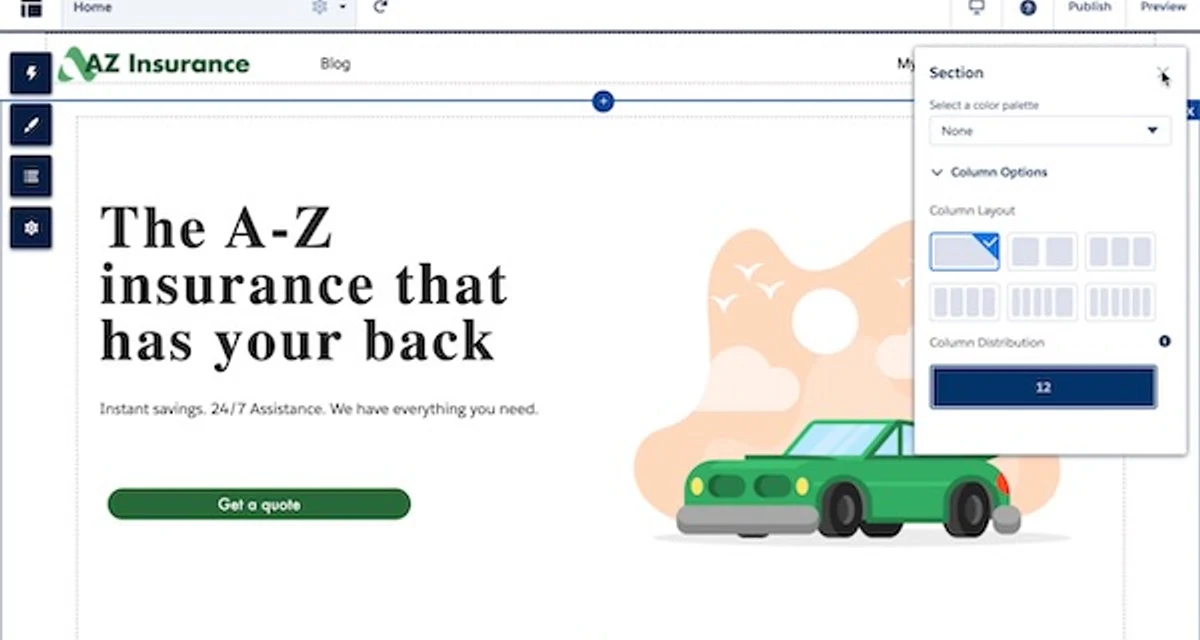
Top tasks against what the site supports, empty searches ranked by demand, the sharing model tested from outside, Aura components counted, and login behaviour metered before the backlog commits.
The few journeys that carry your volume, designed to complete, with content written in the words customers use and an owner named before launch rather than after the first stale article.
LWR sites, custom Lightning Web Components, branding and multi-language, plus Aura to LWR migration costed honestly as a refactor and redesign rather than sold as a deadline.
External sharing settings, sharing sets, guest user access and object permissions reviewed deliberately, then tested from the outside as an unauthenticated visitor and as a low-privilege portal user.
Training the people who will maintain the site after we leave, so routine content changes do not queue behind a release, and so the review rhythm survives a change of staff.
A named team for the run-state backlog, releases and content changes, optionally as managed services.
Grounded on reviewed content, scoped to what it may answer, gated on anything contractual. See Agentforce implementation.
Aura, LWR and the honest read
No retirement date has been published for Aura Experience Cloud sites, so nobody is switching your portal off. Moving to LWR is a decision about performance, SEO and where Salesforce is investing, not a countdown. Anyone selling you the migration on a deadline is inventing one. We will often still recommend the move, because Lightning Web Runtime is generally faster and considerably better for public content that needs to be found in search. But you deserve the cost attached to it before you agree.
Aura components are not supported in LWR. Moving an Aura site means refactoring every custom component to Lightning Web Components, and the guidance from Salesforce is to avoid a one-to-one port and redesign around LWR patterns instead. Tooling assists with the component conversion; it does not remove the rebuild. So the honest number is a refactor and a redesign, not a template switch, and the useful part of that is the licence it gives you to delete the pages nobody visits. One item genuinely does carry a date: One thing is dated: Experience Delivery, the beta hosting infrastructure for LWR sites, is discontinued as of Winter 2027. Sites still on it migrate to standard LWR automatically when republished, and an unpublished site keeps working but can degrade over time.
Read the stack beside this upwards: nothing on a higher layer is worth building until the layer below it is settled, which is why an agent programme approved before the content is reviewed usually gets rebuilt. We design for Salesforce Well-Architected outcomes (Trusted, Easy and Adaptable). Every pattern depends on edition, region and GA status; your account team and the release notes remain authoritative.
SynconAI reference topology for workshops. Aligns with Salesforce Architects diagrams language; edition, licence type and region still govern what you can configure.
SynconAI Experience Cloud stack
Governed AI
Help finding and finishing, not an unsupervised representative
Cases, orders, accounts and knowledge stay on your data model; Agentforce is how Salesforce surfaces governed assistants on top of them. We review the content it will be grounded on first, then scope agents using topics, actions and instructions your service and legal teams can read out loud: answering from reviewed knowledge, checking a status the person is entitled to see, guiding someone through a form, and escalating cleanly with what they already tried. Anything touching price, contract terms, entitlement decisions or an account change stops at a named approver. Availability follows your edition and region. Details on our Agentforce consulting page.
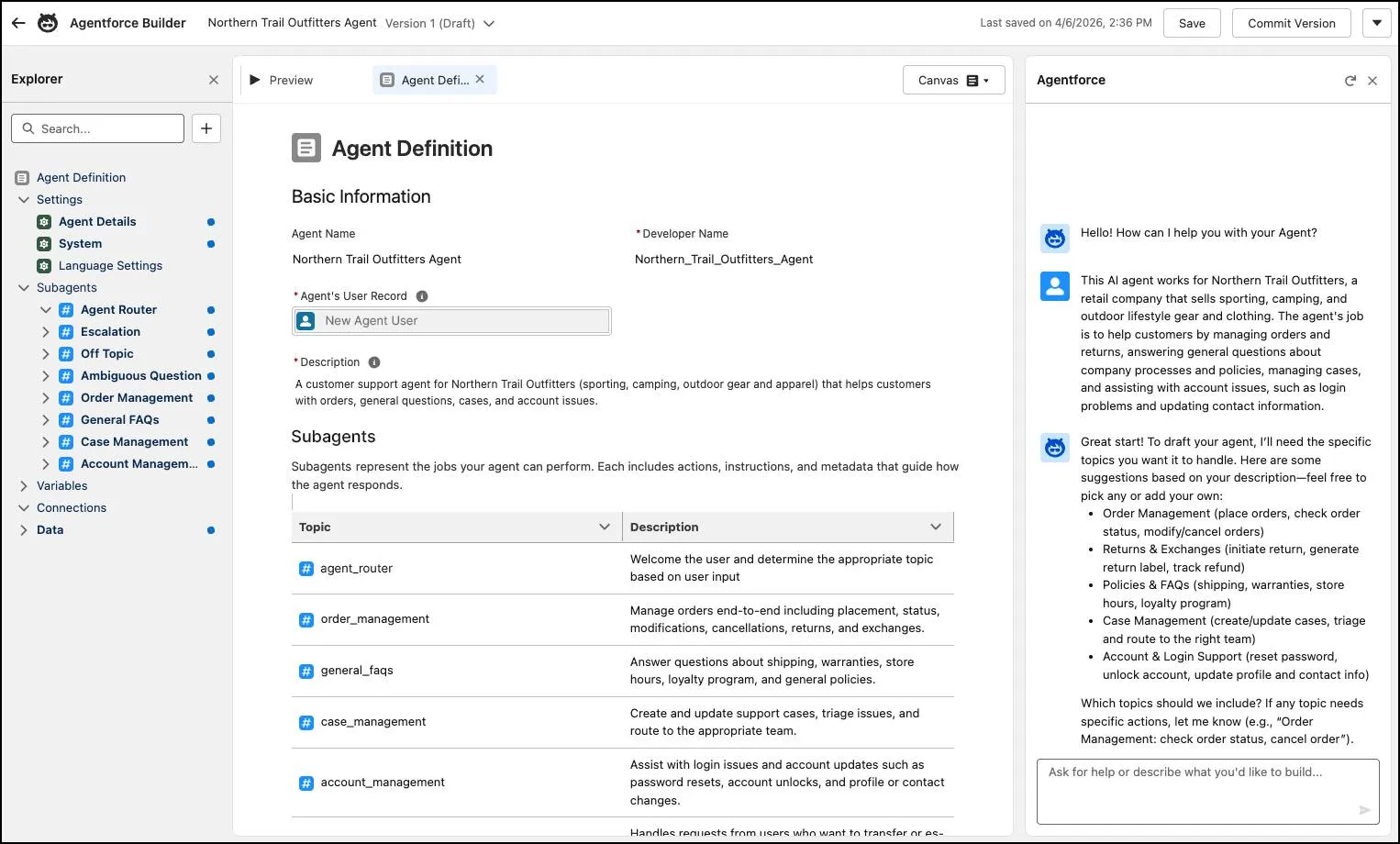
Grounded on knowledge somebody owns and has read this quarter, with the sources visible, so an answer can be checked rather than taken on trust.
Walk a person through the form, prefill what the record already knows, and surface the status they are entitled to see, because finishing the task is the point rather than explaining it.
When the agent cannot finish, the handover into Service Cloud carries the conversation, so nobody has to explain the problem a second time to a human.
Who we work with
Service wants case volume down, the channel team wants deal registration, platform owns the sharing model, digital owns search. Each is right, and between them the content belongs to nobody. Tap the closest group to pre-scope the form.

Honest scoping
The licensing decision costs more than the build. Member-based bills per provisioned user; login-based bills against a monthly pool. Above roughly four logins a month a member licence is usually cheaper, but the honest answer is normally a hybrid. We are a certified Salesforce consulting partner rather than a licence reseller, which means we have no margin riding on what you buy and every reason to right-size it. Salesforce owns the contract and the pricing, and your account team remains authoritative on entitlements and packaging.
Metering one real quarter of logins settles the member-versus-login argument faster than any list-price comparison, because it replaces an assumption about how often people will visit with a measurement of how often they did. It also surfaces the audiences nobody expected to be frequent visitors, which is where most of the modelling error usually sits.
Daily users on member licences, occasional users on a login pool. The argument is usually framed as a choice between the two models, and framing it that way is what produces the expensive answer.
Login-based volumes are rarely flat. Renewal season, a compliance deadline or a statement run concentrates a month of logins into three days, and a pool sized on the average will not survive that.
If you do not have a Salesforce account executive yet, we will make the introduction. The FAQ covers what we can and cannot do on licensing. Adjacent needs such as Data 360 work share the same change-control ownership so nothing becomes a governance island.
Partnership criteria
Digital agencies sell a redesign, so the answer is always a new site. Platform partners sell a migration, so the answer is always LWR. We do neither by default: we read what people are actually trying to finish, and roughly half the time the answer is a content and journey fix on the portal you already own. Learn more about our Salesforce consulting partner approach.
Top tasks, empty searches, what the sharing model exposes, and how the licence mix compares with real logins. You keep the document whether or not you engage us, and it often shows less needs rebuilding than expected.
No retirement date has been published for Aura sites. If we recommend LWR it will be on performance and public search grounds with the refactor costed, never on urgency we manufactured to close the work.
A portal of six pages somebody keeps true beats forty that nobody has read since launch. Deleting pages is usually the highest-value hour of the engagement, and the one nobody else offers.
What an unauthenticated visitor and a low-privilege portal user can genuinely reach, checked rather than assumed. It is your org on the internet, and it deserves that level of attention.
Hubs in Delaware, Sydney and Hyderabad, a named team on your business hours, and travel onsite for discovery, go-lives and executive sessions.
The same architects for the run-state backlog, the releases and the content changes, not a handover to a generic queue that never saw discovery.
Delivery method
Six beats, transparent gates, no surprise scope. The unusual one is second: we meter a real quarter of login behaviour before anything is designed, because here the licence model often costs more than the build. Same method as our broaderSalesforce consulting practice.
Case reasons, call drivers and site search terms ranked by volume, so the top-task list comes from what people already did rather than from what a stakeholder session produced. You keep the write-up either way.
A real quarter of login behaviour by audience, modelled against member and login licensing, including the seasonal spike. This decides a number that is difficult to change once the contract is signed.
The few journeys that carry the volume, designed to complete, with the external sharing model decided deliberately at the same time rather than widened later under delivery pressure.
LWR where it earns it, custom Lightning Web Components only where standard ones genuinely will not do, content structured for public search, and everything tested on a phone on a slow connection.
Task completion and abandonment measured against the baseline, the sharing model tested from outside as a stranger and as a portal user, and a rehearsed rollback with a named owner.
Hypercare, a named content owner with a review rhythm, empty searches worked as a backlog, and three releases a year absorbed as decisions. Optionally continue with managed services or ongoing Salesforce administration.

Client reviews
Verbatim reviews from SynconAI Salesforce and Agentforce engagements across the United States, Australia and globally. Anonymised clients are labelled by sector.
Salesforce Select Partner16+ architect certificationsDelivery across USA, Sydney & India
Simply Outstanding
“SynconAI Consulting are Simply the Best in the Business When it comes to Salesforce implementation and AI-powered solutions, SynconAI are in a league of their own. Their expertise, dedication, and ability to deliver results that truly move the needle sets them apart from every other consulting partner we've worked with. What they achieved with our Sales Cloud, Service Cloud, and custom Agentforce agent has completely transformed how we operate streamlining our pipelines and our customer service, and automating tasks that used to consume hours of our team's time. They don't just implement technology they transform businesses. If you want the best, you work with their team.”
“I had a very urgent deadline for our project reporting to be delivered and needed to build the module, dashboard and output reports in Salesforce. SynconAI were very responsive - they met with me online, responded to my emails quickly and took calls - whatever was needed to progress the work quickly. We are thrilled with the outcome and will continue to work with SynconAI in the future to continue to build our Salesforce capability and platform.”
“The team at SynconAI were fantastic, and promptly delivered on each project. They were able to guide us through every stage and made sure we were satisfied with the outcomes on multiple scopes of work.”
“They have been great and helping us transform out business by bringing what I conceptualize to life. Great at translating process/workflow needs into a solution. Been a pleasure work with and they're a critical part of our team and will be instrumental into bringing about my vision.”
“Working with SynconAI was a seamless and highly professional experience from start to finish. They took the time to deeply understand our business processes before designing and implementing a Salesforce solution tailored specifically to our operational needs. The team demonstrated strong technical expertise across Salesforce configuration, automation, integrations, reporting, and user experience design.”
Frequently asked questions
Straight answers about the Aura to LWR question and the deadline that does not exist, what a migration really costs, member versus login licensing, sharing and guest access, how deflection gets flattered, and where we work.
No, and this is worth being precise about because it gets sold as urgent. No retirement date has been published for Aura Experience Cloud sites, so nobody is switching your portal off and there is no countdown. LWR is where the platform investment is going, and it is generally faster and better for public SEO, so a move is often the right call on merit. But it should be a decision about performance and roadmap on your calendar, not a response to a deadline somebody invented in a slide.
Harder than a template switch, because Aura components are not supported in LWR at all. Every custom component has to be refactored to a Lightning Web Component, and the guidance from Salesforce is to avoid a one-to-one port and redesign around LWR patterns instead. There is tooling that assists with the component conversion, and it genuinely helps, but it does not remove the rebuild. We scope it as a redesign informed by the existing site, which is also the moment to drop the pages nobody visits.
Only if you opted into it. Experience Delivery was a beta hosting infrastructure for LWR sites, and it is discontinued as of Winter 2027. Sites still on it are migrated to the standard LWR infrastructure automatically when you next republish. If you have a published site on it and never republish, it keeps working, but performance can degrade over time. It is a small item, and it is the one genuinely dated thing in this area.
Usually both, split by audience, and the decision is worth more than the build. Member-based bills per provisioned user; login-based bills against a monthly pool of logins. The widely used rule of thumb is that anyone logging in more than about four times a month tends to be cheaper on a member licence, but a rule of thumb is not evidence. Metering one real quarter of login behaviour settles it faster than any list-price comparison, because it replaces a guess about how often people will visit with a record of how often they did.
Usually it was designed around what the business wanted to publish rather than what people came to do. The test is simple: can a user finish their top task without contacting you? If the answer needs a caveat, the portal is a brochure with a login. We start from your case reasons and your site search terms, pick the few journeys that carry the volume, and build those to actually complete. Everything else can wait, and some of it should never be built.
Task completion first, then deflection paired with abandonment. Deflection on its own is easy to flatter: a visitor who searched, found nothing and gave up counts as deflected in most reporting. We publish abandonment beside it and treat search-with-no-result as a content backlog ranked by demand. Beyond that: login frequency by audience, which also feeds the licensing decision, and how many portal sessions still end in a case.
Salesforce, Experience Cloud, Lightning Web Runtime, Experience Builder, Service Cloud, Agentforce and Data 360 are trademarks of Salesforce, Inc. SynconAI is an independent certified Salesforce consulting partner and is not created by, affiliated with, or endorsed by Salesforce, Inc. Retirement dates, packaging and licence entitlements are set by Salesforce; the release notes and your account team remain authoritative. Product screenshots are reproduced for illustrative purposes; the interface varies by edition and release.
Free architect conversation
60 seconds to brief us. A certified architect replies within one business day.
 Sales Cloud
 Service Cloud
 Field Service
 Experience Cloud
 Marketing Cloud Next
 Revenue Cloud AdvancedSalesforce CPQ
 Data 360
 Financial Services Cloud
 Nonprofit Cloud
 Health Cloud
 CRM Analytics & Einstein
 Agentforce