





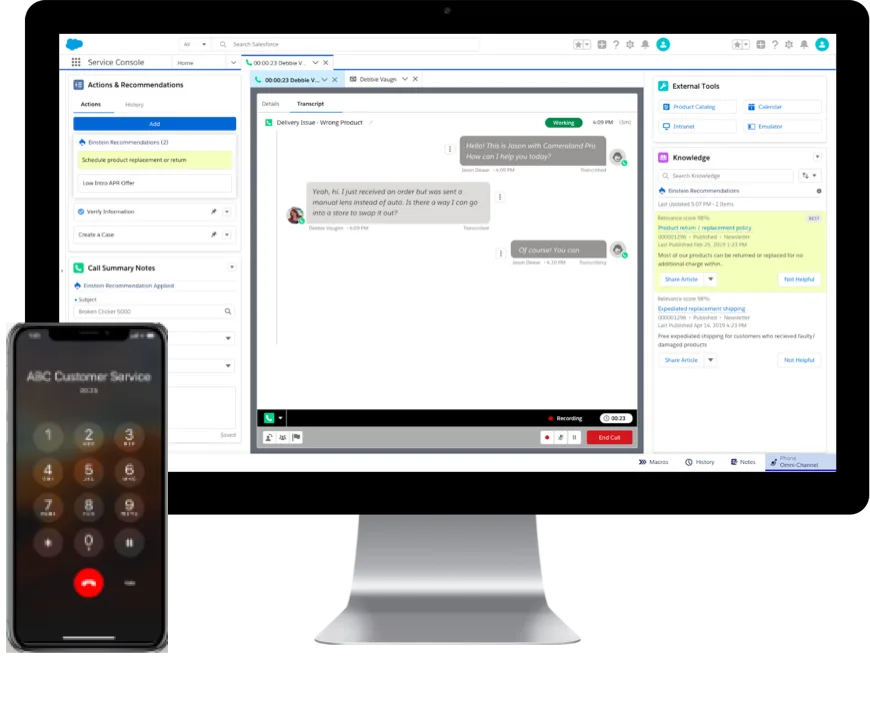
Service Cloud is the Salesforce platform your support team works in: cases, knowledge articles and the agent console.
Salesforce Service Cloud consulting · case & knowledge model · Omni-Channel · Agentforce · certified partner
Deflection is up. So is the number of people giving up. Most dashboards cannot tell those two apart, so the target gets hit either way.
- A case model built around the customer problem, not around which team wanted its own queue, so reporting can finally answer what people contact you about
- Knowledge your agents actually trust: owned, reviewed, and small enough to be right, because an agent who answers from memory is also an agent whose articles an AI cannot safely learn from
- Omni-Channel routing on skills and capacity modeled honestly, so queues balance outcomes rather than appearances
- Agentforce grounded on knowledge worth grounding on, with a named human in front of refunds, credits, access and anything contractual
A customer who searches, finds nothing and leaves counts as deflected in almost every dashboard. That is how deflection climbs while satisfaction falls. We report abandonment beside it and turn failed searches into the articles worth writing.
Proven Success With
16+ architect-level certifications · 5.0 from 5 client reviews

















Watch: the 2-minute overview
Service that knows every customer, on every channel
One case from first contact to closed: how we model why customers get in touch, route each request to the right agent, keep knowledge current and put Agentforce to work with a person approving.
New to Service Cloud?
What is Service Cloud?
Omni-Channel routes each phone call, email, chat or message to an agent with the right skill and free capacity.
Experience Cloud adds a self-service help center, and Agentforce can answer customers from your reviewed knowledge.
Pressure we surface early
Forty case record types, and still nobody can say why people are calling
What we find in almost every org: record types multiplied so each team gets its own queue, a knowledge base written once for launch, agents answering from memory after being burned by a stale article, and a deflection number nobody has stress-tested.

A model built around teams, not customers
Record types and reasons multiplied to give each group its own queue. The test is whether you can answer "what do customers contact us about" from your own reporting. If you cannot, the model is not doing its job.
Articles nobody trusts any more
Written once for a launch, never reviewed, so an agent gets burned answering from one and never opens it again. After that the knowledge base is decorative, and it is also what your AI agent would be reading.
Giving up counts as success
A customer who searches, fails and leaves is indistinguishable from one who found the answer, in almost every dashboard. That is how the target gets hit while satisfaction quietly falls.
Queues balanced on the wrong thing
Skills recorded aspirationally and capacity set by negotiation rather than observation. The board looks even, the outcomes are not, and the same three people absorb the difficult work.
Context three tabs away
Everything an agent needs exists somewhere in the org, spread across related lists nobody scrolls to. The handle time you are trying to reduce is mostly navigation.
A confident wrong answer, to a customer
An agent grounded on stale or contradictory articles inherits all of it and says it with total confidence to someone outside your company. That is materially worse than an unanswered question.
Journeys
Every case is one of about six journeys. Yours are probably on this list
Service buyers recognize their problem by contact reason rather than by feature, so this is the fastest way to check whether we are describing your queue. Phase one is normally scoped around the two journeys that dominate your volume, which we take from your own case history rather than from a workshop.
- ArriveA contact lands on the right channel, categorized on the way in
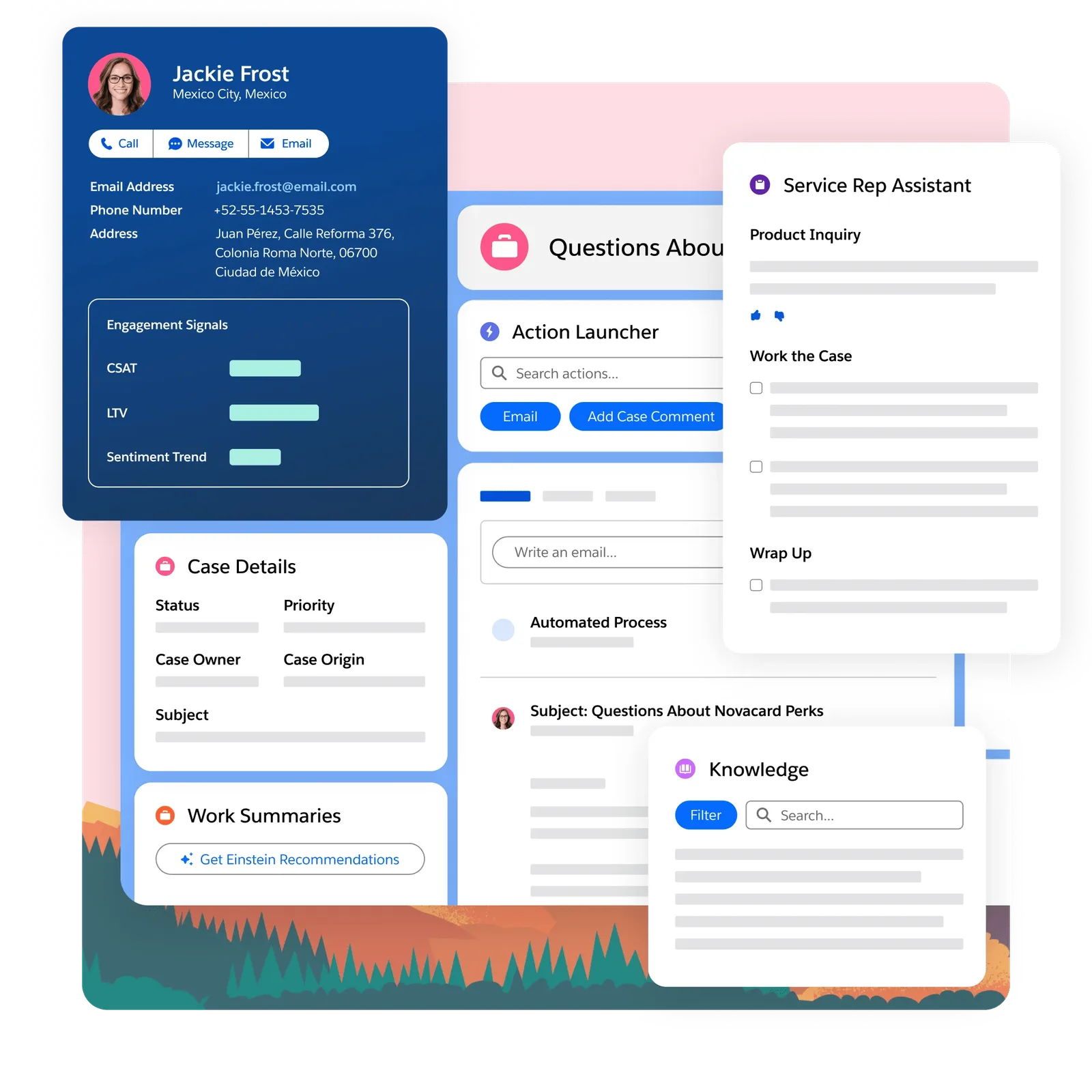
- UnderstandThe agent sees history and entitlement without opening three tabs
- RouteSkills and capacity modeled honestly, so it reaches someone who can fix it
- ResolveAnswered once, written back, and the reason counted so it can be reduced
SynconAI journey spine for Service Cloud workshops. Agentforce assists inside these stages; refunds, credits, access and contractual language stop at a named human.
"Where is my order / claim / application?"
Almost always the highest-volume reason and almost always the most deflectable, because the answer already exists in a system. It becomes a self-service journey only when the status is genuinely current, which is an integration decision.
"This is wrong and I want it fixed"
Corrections, credits and refunds. The journey people try hardest to automate and the one where a wrong AI answer costs the most. We design it so an agent can draft and a human approves.
"I cannot get in"
Access, password and permission requests, high in volume and low in value. Genuine self-service territory, provided identity verification is designed properly rather than bolted on.
"It is broken"
Technical faults that need diagnosis, escalation and sometimes a site visit. The journey where knowledge quality shows up most directly in first-contact resolution.
"How do I…?"
Guidance and how-to. Enormously deflectable, and the clearest case for measuring search-with-no-result: what people looked for and did not find is the article backlog, already prioritized.
"I want to escalate"
The journey most orgs never design, so it happens by whoever shouts. Milestones, escalation paths and a named owner on breach, matching what you actually promised the customer.
What we actually build
The six patterns behind almost every Service Cloud engagement
These reflect how service leaders describe the problem rather than a feature list copied from a product page. Most engagements start with two of them, and the first is nearly always the case model, because everything else inherits it.
Case model & taxonomy
Record types · reasons · subjectsBuilt around what customers contact you about rather than around the org chart, so reporting can finally answer why the volume is what it is.
Knowledge agents trust
Owners · review cycle · deletionWritten for the person answering rather than for a launch, with an owner and a review date on every article, because stale knowledge is worse than none.
Service console design
Fewer clicks · context visibleA layout that gets to the answer in fewer steps, with history and entitlement in front of the agent instead of three tabs away.
Omni-Channel routing
Skills · capacity · priorityModeled on how the team actually works, so routing balances outcomes rather than appearances and the difficult work stops landing on the same three people.
Self-service & deflection
Help centre · honest measurementA help center that answers the top contact reasons, reported with abandonment alongside deflection so the number cannot be gamed into meaninglessness.
Agentforce for service
Grounding · scope · human gatesGrounded on curated knowledge, scoped to what it may answer, with a named human on refunds, credits, access and anything contractual.
Scope of delivery
What we deliver on Salesforce Service Cloud
From a written read of your case history through to run-state support across Service Cloud, Knowledge, Omni-Channel, Experience Cloud, Agentforce and Data 360, scoped with named owners, a measured baseline and pilot exit criteria your service leadership can review.
A service program is only as good as the two things underneath it: what a case is, and whether an agent believes the article in front of them. Fix those and most of the rest follows. Skip them and nothing does.
Case history read & discovery
Contact reasons ranked from real cases, the taxonomy mapped against the volume that uses it, knowledge scored for staleness, and an honest plan check with your Salesforce account team.
Case model & entitlements
Record types, reasons, milestones and escalation paths that reflect the customer problem and the promise you actually made, rather than the shape of the support team.
Knowledge program
Article ownership, a review cycle, a deletion pass, and templates written for the person answering. The foundation both your agents and any AI agent depend on.
Integration & self-service
Order, billing and account status surfaced where the customer asks, through Experience Cloud or MuleSoft. Adjacent Data 360 programs when the profile needs hardening first.
Enablement & adoption
Training built around what changed, for agents, team leaders and the knowledge owners who have to keep the base alive after we leave.
Managed services
A named team for the run-state backlog, releases and reporting changes, optionally as managed services.
Agentforce & digital labor
Grounded answers, case summarization and drafted replies, scoped so nothing commits a refund or a promise unsupervised. See Agentforce implementation.
Who we work with
Four people care about this, and they are measured on different things
A deflection target, a balanced queue, a trusted article and a safe AI rollout are four different jobs pulling in four directions. Naming which one you own tends to change what phase one should be. Tap the closest fit to pre-scope the conversation form at the foot of the page.

Which project is this, actually
Service Cloud, or a contact center engagement? They are not the same project
Buyers land on both of our pages and the distinction is worth making before anyone quotes. This page is about the model underneath: what a case is, how it is categorized, what an agent sees, what a customer can self-serve, and how an AI answer stays safe. Get that wrong and no amount of telephony rescues it.
Our call center and help desk page is about the layer on top: telephony, contact center operations, voice, and the queue as an operation. Most organizations eventually need both. They are different projects with different risks and different people in the room, and it is much cheaper to know which one you are buying now than in month three.
Governed AI
Agentforce answering customers, inside a boundary you wrote
Assistance on the case, not an unsupervised decision-maker
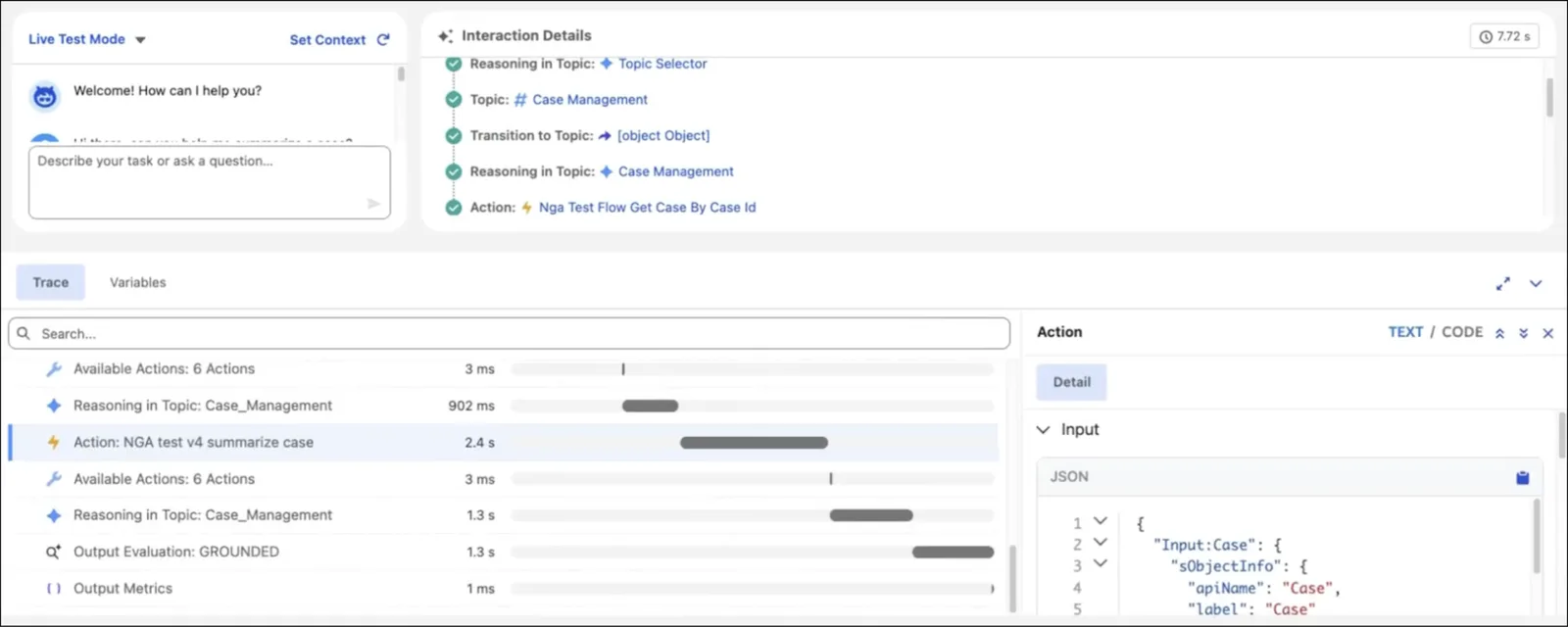
Cases, entitlements and contacts stay on your data model; Agentforce is how Salesforce surfaces governed assistants on top of them. We curate the knowledge first, then scope agents using subagents (formerly topics), actions and instructions your service leadership and risk team can read out loud: answering from reviewed articles, summarizing a long case, drafting a reply, and proposing the next step. Anything touching a refund, a credit, account access or contractual language stops at a named approver. Availability follows your edition and region. Details on our Agentforce consulting page.
Answer & cite
Respond from reviewed articles with the source shown, so a customer and an agent can both check it, and so a wrong answer is traceable to a fixable article rather than to a mystery.
Summarize the case
Compress a long history before a transfer or an escalation, so the next person starts with the situation rather than with forty minutes of reading and a fresh apology to the customer.
Draft & hand off
Draft the reply or the case note, then stop. A person decides what reaches the customer, and everything touching money, access or a promise routes to a named approver by design.
Delivery method
How we deliver Service Cloud engagements
Six beats we repeat on every engagement, with transparent gates and no surprise scope. Sponsors get a written assessment, named owners and pilot exit criteria rather than a never-ending slide. Same method as our broader Salesforce consulting practice.
Listen
Contact reasons ranked from real case history, the taxonomy mapped against the volume that uses it, knowledge scored for age and ownership, and time on the floor watching how agents actually answer. You keep the write-up either way.
Model
A case taxonomy built around the customer problem, entitlements and escalation matched to what was actually promised, and the boundary of what an AI agent may address, all agreed before anything is configured.
Equip
Console layout rebuilt around the journeys that dominate your volume, knowledge culled and rewritten for the person answering, and routing modeled on real skills and capacity.
Test
Scenario runs on real historical cases rather than clean invented ones, agent evaluation sets where AI is in scope, and an escalation path proven end to end before anything reaches a customer.
Deflect
Self-service launched on the top reasons, deflection and abandonment reported together from day one, and searches that returned nothing fed straight back into the article backlog.
Run
Hypercare, the knowledge review cycle running on its own, agent answer quality sampled in production, and three releases a year absorbed as decisions. Optionally continue with managed services or ongoing Salesforce administration.

Cost and timing
What it costs and how long it takes
The review is free
A 60-minute architecture review of your Service Cloud setup, with a written plan you keep.
A fixed-scope proposal first
Before any work starts you get a written proposal: a fixed-scope project with milestones, or a monthly plan. You approve it, or you do not.
Timing follows scope
How long it takes depends on what is in scope. The proposal states the milestones, so you see the timeline before you commit.
Client reviews
What clients say about working with our architects
Verbatim reviews from SynconAI Salesforce and Agentforce engagements across the United States, Australia and globally. Anonymized clients are labeled by sector.
Salesforce Select Partner16+ architect certificationsDelivery across USA, Sydney & India
Simply Outstanding
“SynconAI Consulting are Simply the Best in the Business When it comes to Salesforce implementation and AI-powered solutions, SynconAI are in a league of their own. Their expertise, dedication, and ability to deliver results that truly move the needle sets them apart from every other consulting partner we've worked with. What they achieved with our Sales Cloud, Service Cloud, and custom Agentforce agent has completely transformed how we operate streamlining our pipelines and our customer service, and automating tasks that used to consume hours of our team's time. They don't just implement technology they transform businesses. If you want the best, you work with their team.”
Sales CloudService CloudAgentforce
Jack BennettConsumer Goods & Retail · United States
“I had a very urgent deadline for our project reporting to be delivered and needed to build the module, dashboard and output reports in Salesforce. SynconAI were very responsive - they met with me online, responded to my emails quickly and took calls - whatever was needed to progress the work quickly. We are thrilled with the outcome and will continue to work with SynconAI in the future to continue to build our Salesforce capability and platform.”
Sales CloudService CloudNonprofit Cloud
Salesforce Managed ServicesAustraliaSalesforce Verified
“The team at SynconAI were fantastic, and promptly delivered on each project. They were able to guide us through every stage and made sure we were satisfied with the outcomes on multiple scopes of work.”
Sales CloudSlackFlowAgentforceMuleSoft
ManufacturingAustraliaSalesforce Verified
“They have been great and helping us transform out business by bringing what I conceptualize to life. Great at translating process/workflow needs into a solution. Been a pleasure work with and they're a critical part of our team and will be instrumental into bringing about my vision.”
Sales CloudFinancial Services CloudArchitectureAI
Financial ServicesUnited StatesSalesforce Verified
“Working with SynconAI was a seamless and highly professional experience from start to finish. They took the time to deeply understand our business processes before designing and implementing a Salesforce solution tailored specifically to our operational needs. The team demonstrated strong technical expertise across Salesforce configuration, automation, integrations, reporting, and user experience design.”
SalesforceExperience CloudCustom DevelopmentAutomationReporting
Salesforce ImplementationSalesforce Verified
Read next
Our insights on Service Cloud

Guide11 min
A case model you can still report on in three years
Why a taxonomy built from what the business wants to report fails, why the catch-all value destroys the dataset, and how to migrate a live taxonomy without losing historical comparability.
SynconAI Architecture Team6 Apr 2026

Playbook10 min
Omni-Channel routing built on capacity you actually measured
How to design Omni-Channel from measured capacity rather than assumed capacity: work item weighting, queues that model skill, when skills-based routing is over-engineering, and why the overflow path deserves designing first.
SynconAI Delivery Team9 Apr 2026

Architecture9 min
Agentforce and Service Cloud: what actually connects to what
A reference architecture for Agentforce on Service Cloud: how channels reach the agent, what it can read at each hop, where the case object sits, and how escalation carries context to a human.
SynconAI Architecture Team22 Jan 2026
Frequently asked questions
Service Cloud, answered honestly.
Straight answers about deflection targets, case taxonomy, knowledge that agents trust, Omni-Channel routing, Agentforce readiness, licensing and where we work.
This page is about the case and knowledge model: what a case is, how it is categorised, what agents see, what customers can self-serve and how an AI answer stays safe. The call centre page is about the layer on top: telephony, Omni-Channel routing, voice and the contact centre operation itself. Most organisations need both, but they are different projects with different risks, and it is worth knowing which one you are actually buying before anyone quotes for it.
Deflection is the most requested and most gamed metric in service. In most dashboards, a customer who searches, fails to find an answer and gives up is counted as deflected, which is indistinguishable from a customer who found what they needed. That is how deflection rises while satisfaction falls. We report abandonment alongside deflection and look at what people searched for before leaving, because that list is the actual backlog of articles worth writing.
By making it worth trusting, which is an ownership problem rather than a content problem. Articles written once for a launch and never revised go stale, agents get burned answering from them, and after that they answer from memory permanently. Every article needs an owner and a review cycle, and the fastest starting point is usually to delete aggressively: a small base that is right beats a large one that is sometimes right. It also matters more than it used to, because Agentforce reads the same articles.
The knowledge has to be curated and the boundary has to be explicit. An agent grounded on stale or contradictory articles will give a customer a confident wrong answer, which is materially worse than no answer. We scope what it may address, ground it on reviewed content, make it show its sources, and put a named human in front of anything touching refunds, credits, access or contractual language. Then we watch answer quality in production, because that is where drift appears rather than in the demo.
Usually a symptom rather than the disease. Record types tend to multiply because each team wanted its own queue, so the taxonomy ends up describing the org chart instead of the customer problem. The test is whether you can answer "what do customers contact us about" from your own reporting. If you cannot, the model is not doing its job, and consolidating it is normally the highest-value thing on the list.
First-contact resolution, reopen rate, backlog ageing, deflection paired with abandonment, and contact reasons trending over time. That last one is the one people skip and the most useful: if the same reason keeps climbing, the fix usually is not in service at all, it is in the product or the billing process that keeps generating the contact.
Salesforce, Service Cloud, Experience Cloud, Agentforce and Data 360 are trademarks of Salesforce, Inc. SynconAI is an independent certified Salesforce consulting partner and is not created by, affiliated with, or endorsed by Salesforce, Inc. Product screenshots are reproduced for illustrative purposes; the interface varies by edition and release.
Free architect conversation
Talk to an architect, not a sales rep.
60 seconds to brief us. A certified architect replies within one business day.