





Agentforce is Salesforce’s platform for AI agents that work inside your CRM, for customers or for your own staff.
Salesforce Select Partner · OpenAI Select Partner · Architect-led
Agentforce consulting for AI agents that do real work. With guardrails, a rollout plan and value you can measure.
Most Agentforce pilots that stall are a data, permission or ownership problem that looked like an AI problem. Our Agentforce implementation fixes those first, so your Salesforce Agentforce rollout reaches production and stays accountable after launch.
Watch the 2-minute overview
Or start small: a 3-day readiness check, a 7-day Agent Pilot or a 14-day Launch Program.
- 20+Enterprise implementations
- 15+Years of team experience
- 30+Salesforce certifications
- 5.0/5Client satisfaction (CSAT)
Proven Success With
30+ Salesforce certifications · 5.0/5 CSAT

Watch: the 2-minute overview
An agent is only as good as what it can find
Data, permissions and ownership first, then the agent: how we pick one workflow, ground it on your knowledge and Data 360, keep a person approving anything irreversible, and keep it measured after go-live.
New to Agentforce?
What is Agentforce?
An agent reads your records and knowledge, then takes only the actions you allow, such as updating a case or booking an appointment.
When a request goes beyond its rules, it hands the conversation to a person, with a summary of what it found.
What Agentforce is for
What is Agentforce consulting?
Salesforce AI agents that reason, act and hand off, inside a boundary you wrote
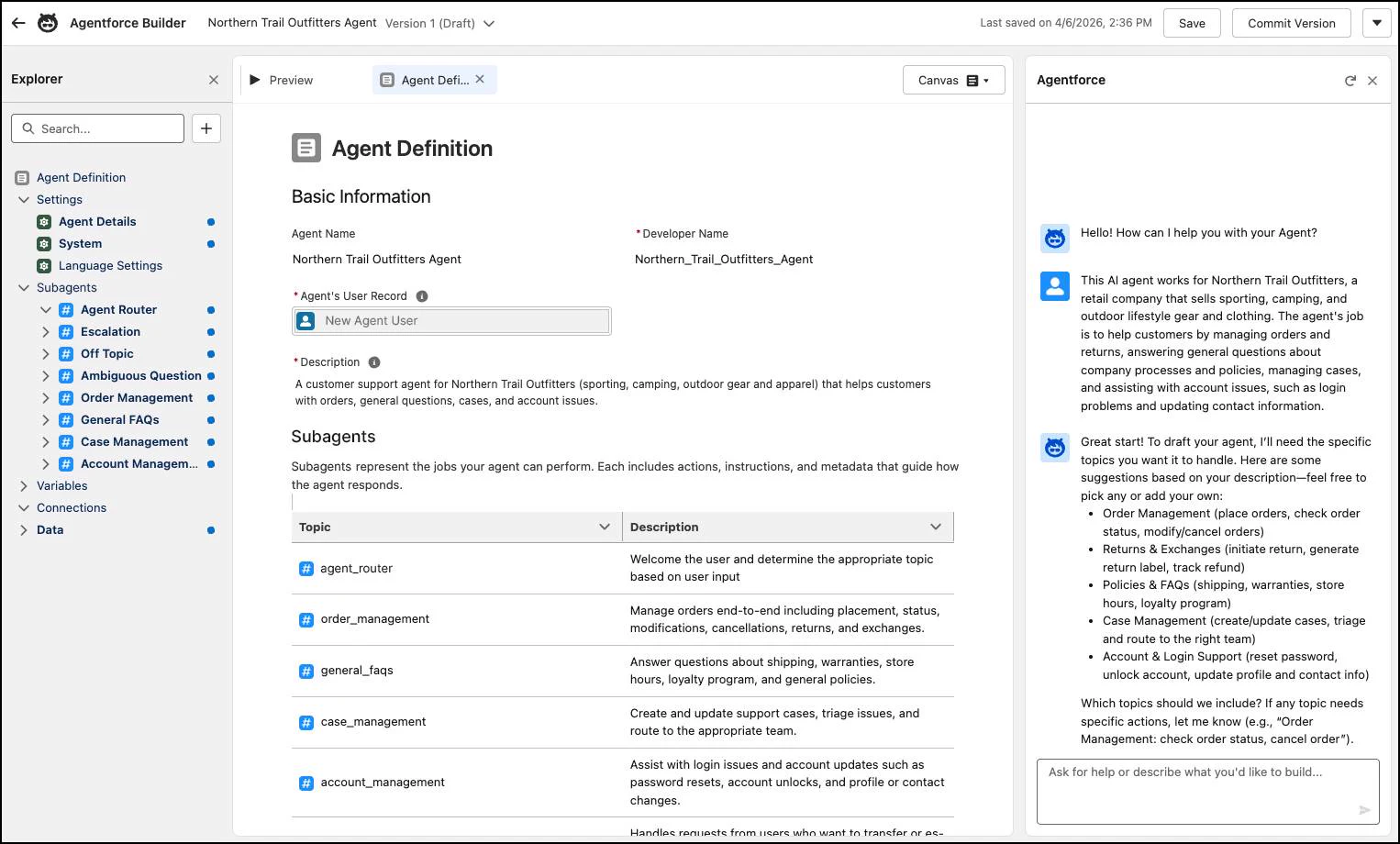
Agentforce consulting and Agentforce implementation is the work of planning, building and governing Salesforce AI agents so they do real work safely in production: choosing the first use case, preparing the data and knowledge the agent reads, configuring subagents (formerly called topics), actions and guardrails in Agentforce Builder, testing against real requests, and rolling out in phases with measures agreed up front.
Salesforce groups its AI portfolio under the Agentforce 360 name, and what you can switch on depends on edition, region and release. The Agentforce implementation guide walks through the setup.
Agentforce consulting at SynconAI: key facts
- Who
- SynconAI, a Salesforce Select Partner and OpenAI Select Partner
- Where
- Agentforce consulting and implementation for clients in the United States and Australia
- What
- Readiness, use-case selection, Data 360 grounding, Agentforce Builder subagents and actions, Testing Center, rollout and run-state support
- How it starts
- One use case, built in a sandbox, piloted with exit criteria agreed before launch
- AI automation
- The agent decides; Flow, Apex and API actions do the steps that must not vary
- Client rating
- 5.0 out of 5 from four Agentforce client reviews
Pressure we surface early
Why do Agentforce pilots stall before they reach production?
The demo works because the demo data is clean. Production is where these six show up, usually all at once.
- 01 · Grounding
Sources that contradict each other
Old articles, three versions of a policy and fields nobody described. The agent repeats all of it with confidence.
- 02 · Permissions
A running user built for a human job
The agent borrows access built for a much broader role, so it can see far more than the job needs.
- 03 · Scope
No out-of-scope list
Without a list of what to refuse, the agent tries to answer everything.
- 04 · Testing
Nothing to compare against
No scored test set, so when quality drifts after a change, nobody can show it or prove the fix.
- 05 · Ownership
Nobody owns it after launch
Without a named owner for subagents, sources and tests, the first person to spot a problem is a customer.
- 06 · Licensing
Demoed on features you cannot run yet
Preview features are not entitlements. We check edition, region and availability before the steering review.
Agentforce use cases by function
Salesforce AI agents for service, sales, field and internal teams
The best first use cases are bounded, rich in feedback and cheap to get wrong. Phase one is normally one workflow from this chart, chosen on value, data readiness and risk.
- AskA customer or employee asks in plain language, in the channel they already use
- GroundThe agent picks the subagent and retrieves from approved knowledge and CRM data
- ActIt calls only the actions its subagent allows, each one logged and permissioned
- Hand offAnything beyond policy goes to a named person, with a summary of what it found
One Agentforce platform, one agent per job
Customer service agents
Triage, case updates, summaries and drafted replies on Service Cloud, with a clean handoff when a case exceeds policy.
Sales and pipeline agents
Meeting prep, follow-up and qualification on Sales Cloud. More in Agentforce for sales teams.
Field service agents
Booking and rescheduling, technician prep and job summaries on Salesforce Field Service.
IT service desk agents
Access requests, how-to questions and ticket triage, answered from approved runbooks.
HR and employee agents
Policy, leave and onboarding answers in Lightning, mobile or Slack. Often the safest place to start.
Internal operations agents
Lookups, order status and back-office requests, with Flow actions for the fixed steps.
Refunds, credits, access changes and contractual language always stop at a named person. Industry patterns for financial services, healthcare, manufacturing, retail, communications and call centers. More in Agentforce use cases that survive a business case.
Agentforce programs
Start with a proof, a pilot or a program to scale
Four fixed-length programs, from a 3-day readiness check to a 14-day launch. Start at readiness, or go straight to the 7-day Agent Pilot if your data is in shape. If you are not sure where to start, we will help you pick.
- 3 days
Agentforce Readiness
We check your data, knowledge, permissions and licenses against the use cases you have in mind, and tell you what has to be fixed before an agent can go near a customer.
- Data and knowledge check
- Permission and security review
- Edition and license fit
- Fix list ranked by effort
- 5 days
Agentforce Roadmap
We rank your use cases on value, data readiness and risk, choose the first workflow, and plan the build, the guardrails and the measures that decide go or no-go.
- Ranked use case shortlist
- First workflow chosen
- Guardrails and success measures
- Build and rollout plan
- 7 daysRecommended start
Agent Pilot
One working agent built in your sandbox on your own data and tested against real requests, so you see it work before anything goes live.
- One agent built in Agentforce Builder
- Grounded in your data and knowledge
- Tested against a scored set of real requests
- Demo and go or no-go read-out
- 14 days
Launch Program
We take the pilot agent live to a first group of users, with guardrails, human handoff, monitoring and a rehearsed rollback, and stay close through hypercare.
- Live to a first group of users
- Guardrails and human handoff
- Monitoring and rollback plan
- Hypercare after go-live
After launch: more agents, subagents and channels on one operating model, with release alignment with Salesforce and run-state support from our managed services team.
Pricing. Salesforce sets Agentforce license and consumption pricing. Our delivery runs as a one-time Technology Blueprint, a monthly delivery plan, or a fixed-scope Transformation program for significant AI implementations. Every plan and price is on our pricing page, and what an Agentforce rollout costs beyond the license explains the rest.
See plans and pricingAgentforce consulting services
What we deliver, from readiness to run-state
Grounding, quality gates, governance and change on one roadmap, across Service Cloud, Sales Cloud, Field Service and the integrations behind them.
Consulting & readiness
Use cases · editions · data checksA use-case shortlist ranked on value, data readiness and risk.
Implementation & customization
Subagents · instructions · actionsSubagents, instructions and actions, built sandbox-first in Agentforce Builder.
Integration & data
Data 360 · ERP · SaaSSecure calls to ERP and SaaS, and Data 360 programs where the agent needs them.
Governance & trust
Permissions · approvals · auditHandoff and approval rules, with change control on every prompt and action.
Training & adoption
Role-based enablementYour team learns to tune instructions and read a trace before we step back.
Managed run-state
Regression · drift · releasesRegression checks and drift monitoring through our Salesforce managed services.
Scope of delivery
Agentforce implementation services, scoped with named owners
From a written readiness read to run-state support across Agentforce, Data 360, Service Cloud, Sales Cloud, Field Service and the integrations that hold the answers. Every line has a named owner and exit criteria your leadership can review.
Book an Agentforce discovery callReadiness & discovery
Stakeholders, channels, risk and what your editions let you run today.
Use-case selection
One high-signal workflow first, with an out-of-scope list beside it.
Data readiness & grounding
One authoritative source per intent, with owners and review dates.
Subagents, actions & guardrails
Single-job actions, a least-privilege running user and approval on anything irreversible.
Testing & evaluation
A scored regression set built from real requests, rerun after every change.
Rollout & measurement
Phased channels and hypercare, with results in Tableau dashboards.
Custom actions & development
Apex and API actions and Lightning components from our Salesforce development team.
Who we work with
Four people own an Agentforce rollout, and they are measured on different things
Naming which one you are tends to change what phase one should be. Pick yours and we will pre-fill the form below.
Delivery method
How does an Agentforce implementation run with SynconAI?
Seven steps on every engagement. Each one has an exit criterion you can fail, not a date. The runbook is in implementing Agentforce, phase by phase, and the Setup walkthrough in the Agentforce implementation guide.
- 01
Discover
Stakeholders, channels, risk and edition checks. Success measures agreed first.
- 02
Select the use case
One high-signal workflow, an out-of-scope list and a quality rubric.
- 03
Data readiness with Data 360
One source per intent, owned knowledge, and Data 360 grounding where needed.
- 04
Subagents, actions and guardrails
A least-privilege running user and approval inside every irreversible action.
- 05
Test
A scored set of real requests, run in a sandbox before production.
- 06
Roll out
Phased channels, live monitoring and a rehearsed rollback.
- 07
Measure and operate
Quality checked against the baseline, then optional managed services or administration.
Trust & governance
Governed Salesforce AI agents your risk team can defend
Governance for an agent is configuration you can review, not a prompt you hope holds. We decide what the agent may read, what it may change and who approves the steps that cannot be undone.
Go deeper on the security model behind an agent, or pair it with our Data 360 services.
Plan a governance workshopGrounding you can cite
Approved sources only, so a wrong answer traces back to something you can fix.
Least-privilege permissions
The running user and knowledge visibility, both narrowed to the job.
Human approval
Nothing commits money or access without a named person.
Einstein Trust Layer
As Salesforce describes it. Data masking is currently off for agents, so we confirm what applies.
Audit-ready change control
Who changed which prompt, subagent or action, when and why.
Monitoring & rollback
Quality and escalation on your dashboards, and a rehearsed rollback.
AI automation beyond agents
Salesforce AI automation: the agent decides, Flow and integration do the work
Working rule-based automation should stay where it is: Flow is deterministic, testable and has no per-run cost. The agent reads the request and decides; Flow, Apex and API actions do the steps that must not vary. Sometimes the honest answer is a Flow, not an agent.
Customer
Agent decides
Flow, Apex and API do
Your systems
1 “Where is my order?”2 Picks the order subagent3 Flow: get order by number4 ERP returns the status5 Writes a grounded answer6 “It ships Thursday.”Flow automation
Flows the agent calls, rebuilt to behave the same way every time. See Flow best practices.
Integration
Order, billing and account data through Salesforce integration, MuleSoft or Data 360.
Custom actions
Apex and API actions from our Salesforce developers, each with one job and a log entry.
Cost and timing
What it costs and how long it takes
The review is free
A 60-minute architecture review of your Agentforce setup, with a written plan you keep.
A fixed-scope proposal first
Before any work starts you get a written proposal: a fixed-scope project with milestones, or a monthly plan. You approve it, or you do not.
Timing follows scope
How long it takes depends on what is in scope. The proposal states the milestones, so you see the timeline before you commit.
Client stories
Agentforce work we have delivered
Real engagements, described by industry. Each story covers the starting position, what we built and how we delivered it, end to end.
 Financial ServicesAI screens the deals. An analyst makes the call.Sales Cloud, Agentforce, Data 360 and Prompt Builder for a private equity advisory firm: AI ranking and scoring with a person approving every match.Sales Cloud · Agentforce · Data 360 · Prompt BuilderRead the story
 Consumer Goods & RetailFrom sandbox to a governed AI agent in production.Agentforce for a consumer products brand: configured and tested in a sandbox, secured on least privilege, and deployed to production deliberately.Agentforce · Einstein · Salesforce Platform · Permission SetsRead the story
Client reviews
What clients say about our Agentforce work
Client names anonymized where requested; reviews reflect typical outcomes from governed Agentforce programs with SynconAI.
Salesforce Select Partner30+ Salesforce certificationsDelivery from Delaware & Sydney, worldwide
Governed Agentforce rollout on Service Cloud
“We stopped treating Agentforce like a chatbot bolt-on. SynconAI wired topics to the same Case and Order objects our auditors already trust, and our service leads finally had one story for quality, risk, and capacity planning.”
VP Service OperationsEnterprise technology · United States · September 2025 · via SynconAI Testimonials
Salesforce automation with Agentforce topics
“SynconAI helped us automate our Salesforce processes and improve visibility across our sales and service operations. Agents now escalate with full CRM context instead of starting from a blank transcript.”
Operations ManagerB2B SaaS · Australia · June 2025 · via Clutch
Agentforce 360 pilot to production
“The pilot proved deflection and quality metrics before we expanded channels. SynconAI mapped Agentforce 360 capabilities to what our org could actually license, so we did not over-promise in steering reviews.”
Director of Customer ExperienceRetail & consumer · United States · November 2024 · via LinkedIn
Agentforce Builder and Data Cloud readiness
“Our architects needed one partner who understood both Data 360 foundations and Agentforce Builder testing patterns. SynconAI delivered sandbox-first configuration with clear RACI for prompt and topic changes after go-live.”
CRM ArchitectProfessional services · APAC · March 2025 · via GoodFirms
Read next
Our insights on Agentforce

Architecture15 min
What separates an Agentforce rollout that is still running in six months
The five readiness dimensions that decide whether an Agentforce deployment survives contact with real customers: scope, grounding, permissions, escalation and evaluation. A framework you can score your own rollout against before you commit a budget.
SynconAI Architecture Team5 Jan 2026

Analysis9 min
Agentforce use cases that survive a business case
A scoring matrix for Agentforce use cases across value, data readiness and failure cost, including the popular ones that consistently fail to justify themselves.
SynconAI Architecture Team12 Jan 2026

Architecture15 min
The security model behind an agent: permissions, grounding and blast radius
Your sharing model is the AI security boundary. How the running user decides everything, why composition changes exposure without changing permissions, and a pre-launch checklist for customer-facing agents.
SynconAI Architecture Team2 Feb 2026
Frequently asked questions
Agentforce consulting, answered honestly.
Straight answers about Agentforce implementation timelines, cost, Data 360, governance, Einstein Bots, Flow and choosing an Agentforce partner.
Agentforce consulting is the work of planning, building and governing Salesforce AI agents so they do real work safely in production. In practice that means choosing the right first use case, getting the data and knowledge an agent will read into shape, designing topics, instructions, actions and guardrails, testing against real requests, rolling out in phases and measuring the result. SynconAI does that work as a certified Salesforce partner across the United States and Australia.
An Agentforce implementation covers readiness and use-case selection, data and knowledge preparation (with Data 360 where the agent needs unified customer context), a least-privilege running user, topics, instructions and actions in Agentforce Builder, the Flow, Apex and integration actions the agent calls, scored testing in Testing Center, a phased rollout with pilot exit criteria, and monitoring and tuning after go-live. SynconAI delivers each of those steps, and the step-by-step setup is set out in our Agentforce implementation guide.
Agentforce is Salesforce’s platform for building and running AI agents that use your CRM data, knowledge and governed actions to plan multi-step work, act and escalate to people with context. Salesforce now groups its AI portfolio under the Agentforce 360 name. What your org can turn on depends on product, edition, region and release, so we map Salesforce’s public roadmap to what you are licensed to run today.
It depends far more on your data and permissions than on the build. Configuring an agent is rarely the long phase; cleaning up the knowledge it will answer from and narrowing what its running user can see usually sets the real schedule. We start with a time-boxed proof of concept or pilot on one workflow, with exit criteria agreed up front, and give you a written, phased plan after discovery rather than a guess before it.
There are two separate costs. Salesforce sets the license and consumption price, and its models, including Flex Credits and per-conversation pricing, change by release, so confirm the current rate card with your account executive. Delivery is the second cost: SynconAI works through a one-time Technology Blueprint, monthly delivery plans or a fixed-scope Transformation program for significant AI implementations, all described on our pricing page. The cost most estimates miss is knowledge and data remediation.
Not for every use case. Data 360 is the current name for Data Cloud. An agent answering policy questions from Knowledge needs no data unification at all. An agent answering questions about one customer whose records live across several systems usually does, because the alternative is a live call into each system during the conversation. We decide per use case, and we deliver Data 360 programs when the agent needs that foundation.
Through configuration you can review, not through a prompt you hope holds. The agent runs as a user with least-privilege permissions, its topics and actions define what it may do, answers are grounded in approved sources, and refunds, deletions and other irreversible steps need a named human approval inside the action. Salesforce describes the Einstein Trust Layer as adding secure data retrieval, dynamic grounding, zero data retention, toxic language detection and an audit trail. We add change control, logging and a rollback plan your risk team can defend.
A traditional bot follows dialog paths someone designed in advance, so it handles the questions it was scripted for and little else. An Agentforce agent reasons over the request, picks the relevant topic, calls the actions it is permitted to use and escalates with context when the case is beyond its scope. Teams moving from bots usually keep the deterministic steps as Flows and let the agent decide when to call them.
No. Working rule-based automation should stay where it is. Flow is deterministic, testable and carries no per-run consumption cost, and replacing a working rule with a reasoning step makes it slower and less predictable. Agents earn their place where the input is unstructured language, where the paths cannot be listed in advance, or where an answer has to be assembled from several sources. The two work together: the agent decides, the Flow does.
AI automation in Salesforce combines an AI agent that understands an unstructured request with deterministic automation that carries out the steps. In practice an Agentforce agent reads the request, picks the topic and calls permitted actions, and those actions are usually Flows, Apex or API calls into other systems. SynconAI builds both sides, and keeps rule-based steps in Flow where they are cheaper and more predictable.
Common starting points are customer service on Service Cloud, sales on Sales Cloud, scheduling and technician support on Field Service, and internal agents for IT, HR and operations in Lightning, mobile and Slack. Marketing and commerce patterns are possible too. Exact attach points depend on your edition and product entitlements, which we check in discovery before anything is designed.
Ask how they test, not how they demo. A credible Agentforce partner will want to see your data and permissions before quoting, will agree pilot exit criteria up front, will build a scored test set before launch, and will name who owns the agent after go-live. Ask too whether they will tell you when Flow is the better answer. SynconAI is a Salesforce Select Partner, delivery is architect-led, and the team that builds version one stays on for the run state.
SynconAI is a Salesforce Select Partner and OpenAI Select Partner that designs, implements and runs Salesforce and Agentforce for clients in the United States and Australia. Its Agentforce consulting covers readiness, use-case selection, data and Data 360 grounding, agent design in Agentforce Builder, testing, phased rollout and managed support, delivered by certified architects who stay accountable after go-live.
Salesforce, Agentforce, Agentforce 360, Service Cloud, Sales Cloud, Data 360 and Slack are trademarks of Salesforce, Inc. SynconAI is an independent certified Salesforce consulting partner and is not created by, affiliated with, or endorsed by Salesforce, Inc. Product screenshots are reproduced for illustrative purposes; the interface varies by edition and release.
Free architect conversation
Talk to an architect, not a sales rep.
60 seconds to brief us. A certified architect replies within one business day.