
 Dreamforce 2026Dreamforce 2026 keynote: everything announced, and what actually mattersThe complete verified roundup of Dreamforce 2026: AIforce, Koa, the Enterprise AI Harness, Headless 360, the seven new agents, Agent Fabric, and the Google Cloud and AWS partnerships.
Insights
Written by the architects and consultants doing the delivery. Opinionated where we have earned it, specific where it matters, and free of the release recap you can already read on the vendor site.
Dreamforce 2026 keynote: everything announced, and what actually mattersAIforce, Koa, the Enterprise AI Harness, Headless 360, seven job-ready agents, Agent Fabric, and partnerships with both Google Cloud and AWS. The complete verified roundup, sorted by what changes your architecture and what does not.Read the piece From Lead Capture to a Scalable Sales PipelineHow a fragmented lead intake becomes one governed pipeline: routing that holds under volume, stage definitions tied to buyer-verifiable evidence, and a forecast nobody has to rebuild by hand.
Also new
Articles
Latest · 61 articles, 15 case studies, 4 news analyses and 340 guides
Dreamforce 2026Dreamforce 2026 keynote: everything announced, and what actually mattersThe complete verified roundup of Dreamforce 2026: AIforce, Koa, the Enterprise AI Harness, Headless 360, the seven new agents, Agent Fabric, and the Google Cloud and AWS partnerships.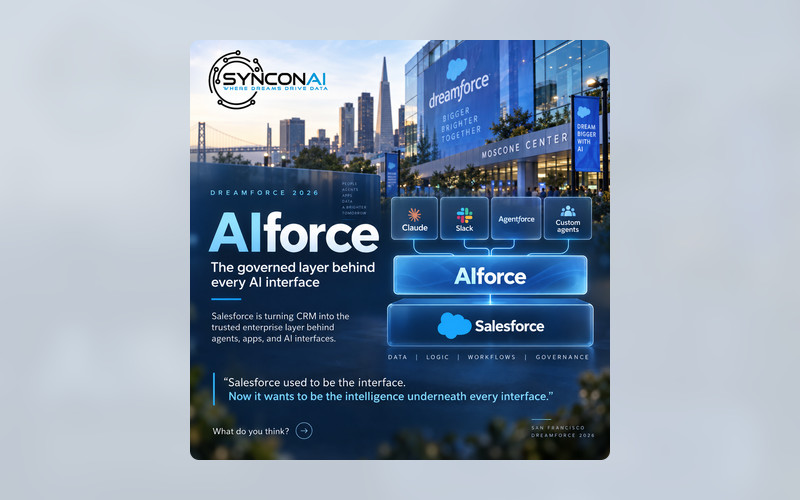 Dreamforce 2026Salesforce AIforce explained: what a live interface layer means for your orgSalesforce unveiled AIforce at Dreamforce 2026, launching with Claudeforce, Slackforce and Agentforce Coworker. What it is, what it changes, and what has to be true in your org first.
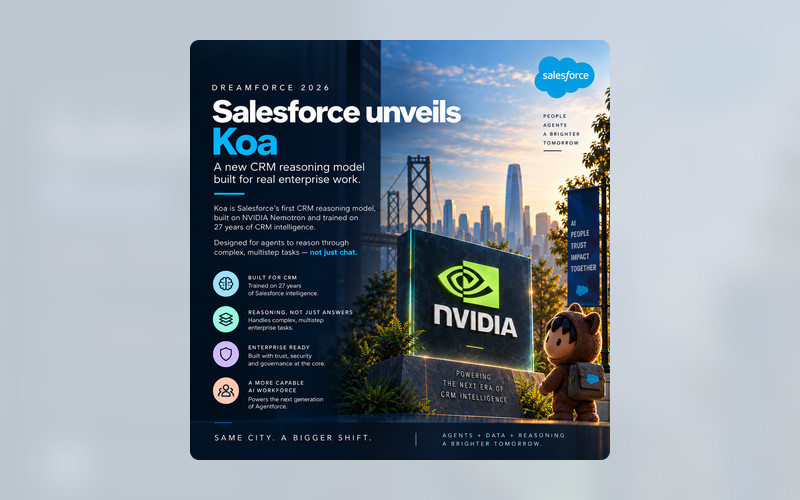 Dreamforce 2026Salesforce Koa explained: what the new CRM reasoning model actually changesSalesforce announced Koa at Dreamforce 2026: a CRM reasoning model built on NVIDIA Nemotron. What it is, what it is not, and what has to be true in your org first.
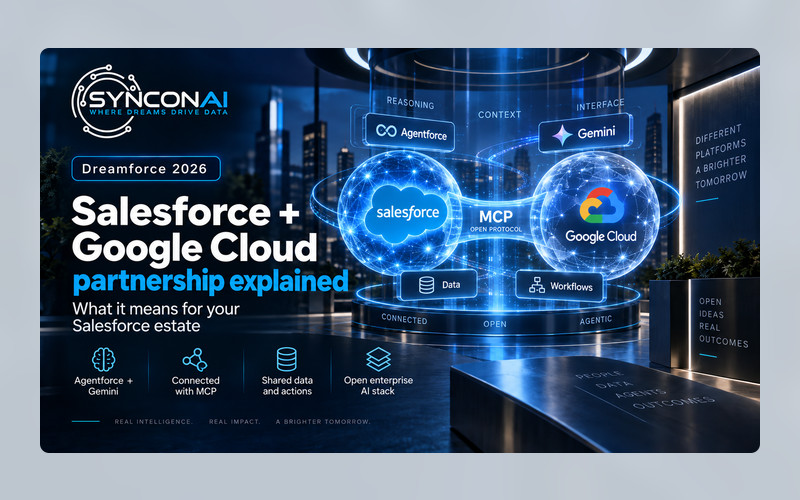 Dreamforce 2026The Salesforce and Google Cloud partnership: what it means for your Salesforce estateSalesforce and Google Cloud connected Agentforce and Gemini Enterprise through MCP. What the announcement says, and why the three-layer split matters more than the partnership.
Announcement6 min
SynconAI named an OpenAI Select Partner
The designation recognises consultancies delivering production AI work for enterprise clients. It formalises how SynconAI already builds: AI treated as a system to be architected, governed and operated, not a model dropped into an existing process.
SynconAI Architecture Team4 Sept 2026

News analysis10 min
Claudeforce: what actually changes for the people who run the org
Salesforce and Anthropic announced Claudeforce on 26 August 2026. What the sources actually state, what nobody has published yet, and what to do in your org before the beta reaches you.
SynconAI Agentforce Practice28 Aug 2026

Field note11 min
Flow or Apex? Write the decision down before you build
Most orgs do not have a Flow problem or an Apex problem. They have an undocumented-decision problem. Here is the decision record we make teams write before either one gets built.
SynconAI Architecture Team18 Aug 2026

Playbook11 min
The grounding checklist we run before an agent talks to a customer
Twelve pre-flight checks we run before an AI agent is allowed near a real customer, each with the failure it catches and the fix. A go or no-go list, not a readiness score.
SynconAI Agentforce Practice11 Aug 2026

Decision guide12 min
Eight questions to answer before you move off Salesforce CPQ
Eight decision-stage questions to settle before a Salesforce CPQ migration is scoped, each with what a good answer sounds like and what a bad one sounds like.
SynconAI Revenue Practice4 Aug 2026

Architecture11 min
Pick the integration pattern before you pick the middleware
Tool selection is the loudest part of an integration project and the least consequential. The pattern decides whether the thing survives its second year.
SynconAI Data & Integration Practice28 July 2026

Org health11 min
Permission set debt: how orgs quietly lose track of who can see what
Access sprawl is the most common form of org debt and the least visible until an audit. How it accumulates, how to measure it, and a repeatable way to clean it up without breaking Monday.
SynconAI Delivery Team21 July 2026

Architecture11 min
The data model decisions you cannot cheaply undo
Seven Salesforce data model decisions that are expensive or impossible to reverse later, what each one actually costs to unwind, and the cheaper question available before the first data load.
SynconAI Architecture Team14 July 2026

Industry playbook12 min
What actually changes when the org belongs to a bank
A regulated organisation changes the data model, the access design, the pace of release and the definition of done. What a bank, an insurer, a hospital and a utility all do to a Salesforce delivery, and what to plan for before the first workshop.
SynconAI Delivery Team7 July 2026

How we work11 min
How to triage a Salesforce release in thirty minutes
A repeatable thirty-minute method for turning Salesforce release notes into a short, org-specific action list: the preparation that makes it possible, the four buckets every item lands in, and what to test in the preview window.
SynconAI Delivery Team30 June 2026

Delivery20 min
How to choose a Salesforce partner, and how to tell before you sign
Evaluating a Salesforce partner on evidence rather than credentials: what AppExchange really tells you, the questions that separate delivery from a pitch, and the contract terms that matter.
SynconAI Delivery Team25 June 2026

Operations12 min
Managed services or an in-house admin: how to decide honestly
A decision framework for Salesforce managed services against hiring in-house: the variables that actually decide it, the real failure modes on both sides, and the hybrid most organisations end up needing.
SynconAI Delivery Team22 June 2026

Security16 min
Who can see what: designing the Salesforce access model on purpose
Salesforce decides record visibility in a fixed order. Understanding that order is the difference between fixing access and layering more of it on top, and it is where audits go wrong.
SynconAI Architecture Team18 June 2026

Engineering12 min
Why your Salesforce org feels slow, and what actually fixes it
Page load, list views, reports and large data volumes: where Salesforce slowness actually comes from, how to measure it before changing anything, and what to fix first.
SynconAI Architecture Team15 June 2026

Operations11 min
A technical debt audit you can run on your own org
An ordered technical debt audit for a Salesforce org: what to inspect in each area, what a bad result actually looks like, and the question that decides whether the debt is worth paying down.
SynconAI Delivery Team11 June 2026

Delivery13 min
Salesforce implementation mistakes, ranked by what they cost to undo
Ten Salesforce implementation mistakes ranked by reversal cost rather than by how bad they look, with the cheaper decision that was available earlier in each case.
SynconAI Delivery Team8 June 2026

Architecture11 min
A working catalogue of Salesforce integration patterns
Each Salesforce integration pattern characterised by what it assumes about the far side, how it behaves under volume, the consistency it gives, and the condition that rules it out.
SynconAI Architecture Team4 June 2026

Engineering14 min
Salesforce API integrations that survive contact with production
The code-level and contract-level decisions behind a durable Salesforce integration: API family, authentication failure modes, limits as design constraint, idempotency, retries, partial failure and versioning.
SynconAI Architecture Team1 June 2026

Architecture11 min
API-led connectivity applied to a Salesforce estate
System, process and experience APIs mapped onto real Salesforce objects: how to scope a System API, where business logic is allowed to sit, and when the third layer is unnecessary.
SynconAI Architecture Team28 May 2026

Architecture10 min
Integration at programme level: ownership before technology
The integration decisions taken above the project line: attribute-level ownership, who funds an interface for its life, the register of what already connects, and portfolio sequencing.
SynconAI Architecture Team25 May 2026

Field note11 min
Flow mistakes that only surface under load
The Flow mistakes that survive testing: correctness faults organised by the condition that exposes each one, with the production symptom, the cheap confirmation test, and the fix.
SynconAI Delivery Team21 May 2026

Analysis10 min
Flow or Apex: the criteria applied to ten real requirements
The Flow or Apex criteria applied to ten real requirements: where each one crosses into code, where volume moves the line, and where the honest answer is neither tool.
SynconAI Architecture Team18 May 2026

Guide11 min
Why your flow is slow
A measurement-first guide to Salesforce Flow performance: how to tell a slow flow from a slow transaction, the faults that actually cost time, and the evidence for each.
SynconAI Architecture Team14 May 2026

Architecture11 min
Flow in a large org: conventions that hold at a hundred flows
Naming, ownership, one record-triggered flow per object, entry criteria, ordering and a deprecation path: the Flow conventions that still work once the estate outgrows the person who built it.
SynconAI Architecture Team11 May 2026

Field note11 min
Where Revenue Cloud implementations go wrong
The symptoms Revenue Cloud programmes present when they are in trouble, the lifecycle stage each cause actually lives in, and the first move that confirms or eliminates it.
SynconAI Delivery Team7 May 2026

Playbook11 min
The migration itself: sequencing a move off CPQ
A delivery playbook for a Salesforce CPQ to Revenue Cloud migration: scope splitting, the catalogue rebuild, price rule intent, parallel running, cutover timing and in-flight quotes.
SynconAI Delivery Team4 May 2026

Analysis11 min
Revenue Cloud and CPQ across the whole lifecycle
CPQ covers configure, price and quote. Revenue lifecycle thinking runs through contract, order, billing and recognition too. A stage-by-stage comparison, and how to locate where your own complexity sits.
SynconAI Architecture Team30 Apr 2026

Architecture11 min
Revenue Cloud: the decisions that set the shape of everything after
The Revenue Cloud decisions that constrain everything after them: what a product is, which prices are calculated rather than negotiated, bundle depth, and how amendments behave.
SynconAI Architecture Team27 Apr 2026

Analysis8 min
Experience Cloud or build your own?
Build or configure, argued over five years rather than one. The line items teams omit, the three cases where a custom portal genuinely wins, and what you own the day you build your own.
SynconAI Architecture Team23 Apr 2026

Playbook11 min
Portals people actually finish tasks on
Task completion is the only portal metric worth optimising. How to find the real top tasks, why traffic misleads, where login loses people, and the honest deflection test.
SynconAI Delivery Team20 Apr 2026

Architecture12 min
Experience Cloud projects fail on the sharing model, not the theme
External users are a different sharing problem from internal users. Licence types, sharing sets, the guest user, and the external access design checklist to settle before anyone picks a theme.
SynconAI Architecture Team16 Apr 2026

Playbook12 min
Customer service automations that earned their place
Worked service automation examples by case lifecycle stage: what each replaces in the agent workflow, the trade accepted, and the automations we removed again.
SynconAI Delivery Team13 Apr 2026

Playbook10 min
Omni-Channel routing built on capacity you actually measured
How to design Omni-Channel from measured capacity rather than assumed capacity: work item weighting, queues that model skill, when skills-based routing is over-engineering, and why the overflow path deserves designing first.
SynconAI Delivery Team9 Apr 2026

Guide11 min
A case model you can still report on in three years
Why a taxonomy built from what the business wants to report fails, why the catch-all value destroys the dataset, and how to migrate a live taxonomy without losing historical comparability.
SynconAI Architecture Team6 Apr 2026

Guide11 min
Service automation that does not bury the agent in noise
Design principles for Service Cloud automation: what should decide, what should only notify, why notification rots, and how to retire rules faster than they accrete.
SynconAI Delivery Team2 Apr 2026

Playbook11 min
Pipeline automation, stage by stage
Worked pipeline automation examples by stage: what each one does, what it costs in flexibility, and the automations we have taken back out again.
SynconAI Delivery Team30 Mar 2026

Guide12 min
Opportunity stages that mean something in a forecast
Opportunity stages defined on buyer evidence: exit criteria per stage, what to do with probability percentages, close-date slippage, and changing a stage model safely.
SynconAI Architecture Team26 Mar 2026

Guide11 min
Lead management that survives the marketing handover
Lifecycle stages both departments would define the same way, the lead-to-account boundary, routing that holds under volume, and a recycling path for the leads you rejected.
SynconAI Architecture Team23 Mar 2026

Field note12 min
Adoption is not a training problem
A diagnostic for low Sales Cloud adoption: the six causes behind it, the signal each one leaves in the org, and the intervention that actually fits.
SynconAI Delivery Team19 Mar 2026

Guide11 min
Sales Cloud automation that reps do not work around
Design principles for Sales Cloud automation: who each rule actually serves, the anti-patterns that produce workarounds, and where automation should stop.
SynconAI Delivery Team16 Mar 2026

Analysis11 min
Personalisation with an agent in the loop
Where generated marketing content needs a human gate, and why the answer follows from how reversible the channel is rather than from how good the model has become.
SynconAI Architecture Team12 Mar 2026

Guide11 min
Marketing automation that does not become unmaintainable
Why marketing estates become untouchable rather than broken, and the governance that prevents it: naming, ownership, parameterisation, centralised suppression and a retirement policy.
SynconAI Delivery Team9 Mar 2026

Playbook15 min
Implementing Marketing Cloud Next without rebuilding it in year two
A sequencing playbook for Marketing Cloud Next: the six early decisions that determine whether the estate is still workable at eighteen months, ordered by what is expensive to revisit.
SynconAI Delivery Team5 Mar 2026

Decision guide8 min
Growth or Advanced? Reading the Marketing Cloud Next edition boundary before you buy
Growth Edition is published per org rather than per user, which takes headcount out of the argument. What is left is a capability threshold, and a short list of questions about your own operation that finds it.
SynconAI Delivery Team2 Mar 2026

Analysis10 min
Marketing Cloud Next and Engagement: which one you are actually being sold
Marketing Cloud Next and Marketing Cloud Engagement are separate platforms that coexist under the Agentforce Marketing brand. What each is, who each suits, and why a move between them is a migration.
SynconAI Architecture Team26 Feb 2026

Field note11 min
Where Data 360 programmes stall
The six places Data 360 programmes stall once they are already underway, the observable signal for each one, and the recovery order that works: freeze scope, restore one narrow profile, then widen.
SynconAI Delivery Team23 Feb 2026

Architecture9 min
How data becomes grounding: Data 360 underneath an agent
The path from source system to agent answer, and the four points along it where grounding quality is actually decided. Written for teams who have tried to fix a wrong answer with a better prompt.
SynconAI Architecture Team19 Feb 2026

Analysis7 min
Data 360 or a data warehouse? They are not competing for the same job
A warehouse is built for analysis and Data 360 is built for activation. Where each fits, what breaks when you swap them, and why Zero Copy made keeping both cheaper than it used to be.
SynconAI Architecture Team16 Feb 2026

Analysis11 min
Data 360 use cases, and the data each one actually demands
A prerequisite list rather than a wish list: realistic Data 360 use cases mapped to the source systems and the specific data quality each one demands before it works.
SynconAI Architecture Team12 Feb 2026

Architecture11 min
Getting Data 360 right the first time: the decisions made before ingestion
The five Data 360 decisions that are cheap before the first connector runs and expensive afterwards: scope of unification, identity resolution match rules, source of truth per attribute, copy versus reference, and ownership.
SynconAI Architecture Team9 Feb 2026

Field note11 min
Ten Agentforce mistakes and what each one looks like in production
A symptom-first diagnostic for Agentforce deployments: ten distinct implementation failures, the observable behaviour each one produces, and how to confirm which one you actually have.
SynconAI Delivery Team5 Feb 2026

Architecture15 min
The security model behind an agent: permissions, grounding and blast radius
Your sharing model is the AI security boundary. How the running user decides everything, why composition changes exposure without changing permissions, and a pre-launch checklist for customer-facing agents.
SynconAI Architecture Team2 Feb 2026

Analysis10 min
Agentforce for sales: where it helps, and where reps quietly ignore it
A fourth test for sales AI candidates beyond value, data readiness and error cost: workflow fit. What genuinely helps reps, what they route around, and why review is not a control.
SynconAI Delivery Team29 Jan 2026

Playbook9 min
Deflection that does not cost you the customer
How to measure service automation honestly, why deflection alone is a vanity metric, and an escalation design framework covering triggers, routing and carried context.
SynconAI Delivery Team26 Jan 2026

Architecture9 min
Agentforce and Service Cloud: what actually connects to what
A reference architecture for Agentforce on Service Cloud: how channels reach the agent, what it can read at each hop, where the case object sits, and how escalation carries context to a human.
SynconAI Architecture Team22 Jan 2026

Decision guide9 min
What an Agentforce rollout costs beyond the licence
The three published Agentforce buying models explained, plus a cost model covering the grounding, permission and evaluation work that usually exceeds consumption spend in year one.
SynconAI Delivery Team19 Jan 2026

Analysis7 min
Agentforce or Flow? Where deterministic automation still wins
A decision table separating work that belongs in deterministic automation from work that justifies an agent, and why most of what happens in a Salesforce org should stay in Flow.
SynconAI Architecture Team15 Jan 2026

Analysis9 min
Agentforce use cases that survive a business case
A scoring matrix for Agentforce use cases across value, data readiness and failure cost, including the popular ones that consistently fail to justify themselves.
SynconAI Architecture Team12 Jan 2026

Playbook12 min
Implementing Agentforce: the sequence, and the gate between each step
A phase-by-phase Agentforce implementation runbook with explicit entry and exit criteria for each gate, written for the team who has to deliver it rather than the one buying it.
SynconAI Delivery Team8 Jan 2026

Architecture15 min
What separates an Agentforce rollout that is still running in six months
The five readiness dimensions that decide whether an Agentforce deployment survives contact with real customers: scope, grounding, permissions, escalation and evaluation. A framework you can score your own rollout against before you commit a budget.
SynconAI Architecture Team5 Jan 2026

Guide14 min
Agentforce implementation guide: how to implement Agentforce, step by step
A complete Agentforce implementation guide: features, use cases, best practices, the Einstein Trust Layer, and a step-by-step Setup walkthrough for your first agent.
SynconAI Agentforce Practice28 Feb 2025
 AgentforceBest practices for managing automated workflows in AgentforcePut known-answer steps in Flow or Apex. The agent chooses the action, stops when the record is done, and hands consequential work to a person.
 AgentforceHow to measure the ROI of a Salesforce Agentforce implementationMeasure containment that stayed resolved, handle time on the rest, escalation quality, and the Agentforce meter you bought. A vendor deflection rate is not your number.
 AgentforceCommon challenges when migrating to Agentforce and how to solve themBot intents do not map one to one. The hard parts are grounding, the running user, and moving one channel while the old bot keeps the ambiguous subagents.
 AgentforceUse cases for Agentforce in healthcare patient managementAppointments, eligibility status, and logistics only. No diagnosis and no clinical advice. The agent reads what that user may see, then hands off.
 AgentforceHow to build custom copilots using Agentforce BuilderA custom copilot is a subagent, instructions, and a small action library in Agent Builder. Test the plan the agent proposes, not only the final sentence.
 AgentforceHow to transition from Einstein Bots to Agentforce seamlesslyA bot is a dialog tree. Service Agent is not. Keep the bot on narrow paths until the topic is grounded, then move one channel.
 AgentforceHow Agentforce reduces operational costs for call centersCall centre cost moves to exceptions, supervision, and the meter. If the agent closes cases that reopen, operational cost went up.
 AgentforceHow to align sales and service teams using Agentforce dataShare one Account timeline and a handoff payload. Do not build one agent for sales and service. Stage changes need a rule, not a guess.
 AgentforceCase studies of successful enterprise Agentforce deploymentsRead a deployment story for the baseline, the scope, who staffed it, and what was refused. No invented results. See the case studies page.
 AgentforceHow Data Cloud improves the accuracy of Einstein AI predictionsData 360, formerly Data Cloud, does not fix a score by adding rows. Identity resolution and feature hygiene change the history. Grounding Agentforce is a separate job.
 AgentforceHow to use Agentforce to triage inbound field service requestsTriage work type, required skill, and urgency, then pass a complete work order. The Field Service scheduling optimizer assigns the person and the time.
 AgentforceHow to write effective prompts for Salesforce Einstein and AgentforceWrite the prompt as subagent instructions: objects, action, stop, and refusals. A longer user sentence will not repair bad grounding.
 Data CloudBest practices for real-time data streaming in Salesforce Data CloudStream events a person is waiting on. Batch the history. In Data 360, streaming every row is a bill, not an architecture.
 Data CloudHow to use Data Cloud segments for targeted Google Ads campaignsA Data 360 segment for ads is only as lawful as its consent. Match rate is measured after activation. It is not a promise.
 Data CloudHow to integrate external AWS data lakes with Salesforce Data CloudCopy an AWS lake into Data 360 and you duplicate governance. Zero-copy federation leaves the lake as the store. You still model it.
 Data CloudWhy enterprise businesses are switching from legacy CDPs to Data CloudSwitching CDP means identity becomes keys, not a golden record. You also lose campaign history and definitions. Plan both.
 Data CloudHow to build predictive audience segments in Data CloudA predictive segment needs an outcome you already recorded. Without that history you have a rule. A calculated attribute is not a model.
 Data CloudHow to calculate the total cost of ownership of Salesforce Data CloudData 360 cost sits in consumption, identity processing, activation, and add-ons. The sticker licence is the small line. No price here.
 Data CloudBest data visualization tools to pair with Salesforce Data CloudData 360 names Tableau and Tableau Next. Tableau Next does not replace Tableau. Use the tool the asker already opens.
 Data CloudHow to audit data quality before a Data Cloud migrationBefore ingest, count blank keys, conflicting emails, missing consent, and non-person rows. Data 360 will unify the rubbish faithfully.
 Data CloudHow to implement consent management across Salesforce Data CloudModel consent in Data 360 and carry it into every activation. If two systems disagree, the stricter flag stands until a person resolves it.
 Data CloudHow to leverage Data Cloud for B2B account-based marketingIn Data 360, B2B means the account and the buying group. A segment of emails is a list, not an account plan.
 Data CloudComparison of Snowflake vs Salesforce Data Cloud for enterprise analyticsSnowflake keeps and models history. Data 360 meets CRM identity, segments, and agents. Zero copy is why you often keep both.
 Data CloudHow to launch a proof of concept for Data Cloud in under 30 daysA 30-day Data 360 proof is one object, one match rule, one activation, an owner, and a kill criterion. Not the whole enterprise.
 Data CloudHow to map existing CRM data to Salesforce Data CloudMap CRM data to the Data 360 model on purpose. Dumping every custom field makes later segments harder. Start with filter keys.
 Data CloudHow to resolve duplicate records using Data Cloud identity resolutionData 360 identity resolution points a unified profile at source records. It does not merge, delete, or override them.
 Field ServiceHow to optimize technician routing with Field Service LightningThe optimizer is only as honest as duration, skill, and territory. Fix those records before you buy another map.
 Field ServiceHow to manage contractor scheduling in Field Service LightningContractors are capacity with skills, hours, and a territory. Give them their own access. Do not lend them an employee login.
 Field ServiceBest practices for dispatching emergency work orders in Field Service LightningAn emergency has to be allowed to break the optimised day. Give it a different priority from planned work, and a rule for what gets bumped.
 Field ServiceHow to integrate IoT data with Salesforce Field Service LightningTurn a sensor reading into a work order only after a threshold you set, and only for an asset under contract. Do not page anyone for a blip.
 Field ServiceHow to reduce technician travel time using FSL optimizationThe optimizer already includes travel. Shape the territory, set the first job, and put the real drive in the duration. No percentage is promised.
 Field ServiceUsing Field Service Lightning for heavy equipment manufacturingHeavy equipment work is the asset, the parts, and often more than one day. Maintenance plans stop you reinventing the job per serial number.
 Field ServiceHow to track technician performance metrics in SalesforceTrack first-time fix, travel, and utilisation against available hours. A job count rewards the wrong behaviour. Define the metric before the report.
 Field ServiceHow to handle multi-day scheduling in Field Service LightningA multi-day job is a dependency. If day two needs a part day one finds, the later days have to be allowed to move.
 Field ServiceBest third-party mapping integrations for Salesforce Field ServiceSkip the ranked list of map vendors. Add a third-party map only for a gap the console and the mobile app do not cover, and test it offline.
 Field ServiceHow to automate customer appointment reminders in FSLAppointment Assistant is the name Salesforce publishes here. Confirm the appointment window, then send the reminder. An open window creates calls.
 Field ServiceHow to manage return merchandise authorizations (RMA) via FSLA return and a repair visit are different records. Keep parcel state off the work-order status. Send a technician only when a person must go.
 Field ServiceHow to implement Field Service Lightning for telecommunications companiesTerritories should follow the network and the contractor patches, not sales regions. Skills have to name the plant, not a generic technician.
 Field ServiceBest practices for setting up skill-based routing in FSLRequired skills that nobody can fail do not route. Too many, and nothing schedules. Start with the skills that decide who may legally or safely do the job.
 Field ServiceHow to set up service territories and operating hours in FSLUse multilevel territories, and operating hours that match the real shift, including contractors. Fantasy hours make an obedient optimizer look broken.
 Field ServiceHow to create custom work order templates in Field Service LightningA template starts the job with skills, parts, and a real duration. A blank form with a logo is not a template.
 Field ServiceHow to enable offline access for the FSL mobile applicationThe mobile app is offline-first. Pack what the technician needs with no signal, and decide who wins if two people edit the same work order.
 Multi-cloudKey benefits of adopting generative AI for enterprise CRMFour CRM jobs are worth turning on: case summary, draft, qualification, and booking a meeting. Each needs the record and a person.
 Multi-cloudThe future of autonomous agents in enterprise customer serviceAgents can run a bounded service job and must pass the rest to a person. A closing date for contact centres is speculation.
 Multi-cloudBest AI integrations for Salesforce Sales CloudActivity capture, drafting, and meeting booking belong on Sales Cloud. Letting a model move the opportunity stage is a policy decision.
 Multi-cloudHow to create an enterprise AI strategy using the Salesforce ecosystemA Salesforce AI strategy is two use cases, a data owner, a permission review, and a kill criterion. Twelve agents on a slide is a list.
 Multi-cloudHow to integrate Salesforce Sales Cloud with Marketing Cloud seamlesslyDecide who owns the person, who owns consent, and which campaigns may create leads. Copying every field makes both sides distrust the record.
 Multi-cloudHow to choose the right Salesforce consulting partner for enterprise rolloutsAsk who the architect is after the sale, for a reference in that cloud, and for a project they advised against. Staffing the wrong cloud is the failure.
 Multi-cloudBest practices for managing user permissions in a multi-cloud environmentUse permission sets and a named integration user. Marketing Cloud users are not Sales Cloud profiles. Profiles remain. Do not grant View All for a demo.
 Multi-cloudHow to integrate Salesforce with legacy ERP systems like SAPOne system owns the customer master and one owns the invoice amount. Put failures on a queue a person reads. Events fail in the open; nightly files often do not.
 Multi-cloudHow to integrate third-party billing systems with Salesforce Revenue CloudRevenue Cloud or the billing system owns the invoice. Write down which number wins when they disagree, before anyone builds the integration.
 Multi-cloudBest third-party AppExchange apps for enterprise digital transformationThere is no honest ranking. Judge an AppExchange package on managed or unmanaged, locked objects, a current security review, and how you leave.
 Multi-cloudHow to test multi-cloud integrations in a Salesforce sandbox environmentA full sandbox copies the CRM org. It does not copy Marketing Cloud or the production Data 360 tenant. Test named non-production endpoints.
 StrategyHow to secure customer data when using Salesforce AI toolsThe agent sees what its running user can see. Widen sharing so the demo answers, and that wider access is the breach.
 StrategyHow to align marketing and sales using Salesforce integrationsAgree what a qualified account is, and name one owner of the stage, before any integration copies fields between marketing and sales.
 StrategyHow to map the B2B customer journey across Salesforce cloudsName the object at each B2B stage: lead, contact, opportunity, case, contract, invoice. A slide with no object is a poster.
 StrategyHow to calculate the ROI of an enterprise multi-cloud transformationTime the hours and the rework before the programme. A count of clouds is a footprint. A return is a change you can recount.
 StrategyHow to handle change management during a global Salesforce rolloutUse a release train and a local owner per country. Cut over data, access, and the one report the country manager actually opens.
 StrategyBest strategies for boosting Salesforce user adoption in large teamsJudge adoption by stage hygiene and case quality. Logins only show that someone opened the tab. Change the page before you train.
 StrategyHow to design a scalable Salesforce architecture for high growthName one automation owner per object, treat limits as a design input, and keep packaged behaviour apart from local configuration.
 StrategyHow to streamline contract lifecycle management in SalesforceA contract needs an owner, a current version, a recorded approval, and a link to the quote. Files on a custom object are a folder.
 StrategyHow to create an executive dashboard covering multi-cloud KPIsFive numbers, one written definition each, the same definition in every cloud. Forty reports on one page teach people to ignore it.
 StrategyBest practices for migrating from Salesforce Classic to LightningList JavaScript buttons, attachments, and pages that only work in Classic. Run both until that list is empty. Do not invent a shutdown date.
 StrategyHow to structure a Salesforce center of excellence for enterprise companiesA centre of excellence owns standards, intake, and the refusal. Architects sit in it. A ticket queue under the same name gets avoided.
 StrategyHow to manage data compliance across multiple international Salesforce instancesSeparate orgs keep data apart. They do not make you compliant. Record the region, the purpose, and the consent on every record that crosses.
 StrategyHow to build a continuous improvement roadmap for your Salesforce orgTie a quarterly list to the release and to operational pain, and write down what you will remove. Adding only features makes the org heavier.
 StrategyHow to govern API limits when integrating multiple Salesforce cloudsBudget API calls per integration. Prefer bulk and events to polling, and back off when the platform refuses a call. The cap depends on edition.
 AcquisitionsExactTarget is Marketing Cloud EngagementExactTarget's tools sit in Marketing Cloud Engagement. Next does not replace it, and a quote with a shutdown date is guessing.
 AcquisitionsDemandware is B2C Commerce CloudDemandware became B2C Commerce Cloud. It is not the core org, and a Salesforce sandbox will not clone the storefront.
 AcquisitionsSteelBrick is Salesforce CPQSteelBrick is Salesforce CPQ, still prefixed SBQQ. End of sale is for new customers. Do not invent a switch-off date.
 AcquisitionsDatorama is Marketing Cloud IntelligenceDatorama is Marketing Cloud Intelligence. The Engagement reports were renamed. The product does not replace Tableau.
 AcquisitionsClickSoftware is Field ServiceClickSoftware became Field Service, now also named Agentforce Field Service and Operations. Do not invent the scheduling formula.
 AcquisitionsVlocity is Salesforce IndustriesVlocity became Salesforce Industries. Industries CPQ is not SteelBrick CPQ, and the cloud does not finish your data model.
 AcquisitionsBuddy Media has no product left to implementBuddy Media became part of Social Studio. Subscriptions ended on 18 November 2024. There is no product left to implement.
 AcquisitionsRadian6 has no listening product left to keepRadian6 listening was folded into Social Studio, retired on 18 November 2024. Do not treat that store as still there.
 AcquisitionsKrux has no DMP left to migrate intoKrux became Audience Studio DMP. End of life was 1 February 2024. Do not migrate into a DMP that is off.
 AcquisitionsRelateIQ has no org left to implementRelateIQ became SalesforceIQ and was retired in 2020. There is no SalesforceIQ org to implement in 2026.
 AcquisitionsMuleSoft on Salesforce: integration, not a data copyMuleSoft was acquired in 2018 and kept its name. It connects systems. A Salesforce sandbox does not include it, and a spreadsheet is not the work.
 AcquisitionsTableau and Salesforce: keep the workbookTableau was acquired in 2019 and kept its name. Tableau Next does not replace it. Switching the workbook off is not a migration.
 AcquisitionsSlack and Salesforce: the org is not the workspaceSlack was acquired and kept its name. A Salesforce org is not a Slack workspace. Exporting a channel into cases is not the implementation.
 AcquisitionsHeroku and Salesforce: the app stays separateHeroku was acquired in 2010 and remains a separate platform. A Salesforce sandbox does not clone a Heroku app, and the app is not a Data 360 pipeline.
 AcquisitionsQuip and Salesforce: a document is not the CRMQuip joined Salesforce on 26 August 2016. It is documents and spreadsheets. Pasting a price table into an opportunity is not a CRM migration.
 AcquisitionsOwn, backup, and Recover on SalesforcePeople still search OwnBackup. Own Company was acquired, with completion on 18 November 2024. Own Recover is backup, not a CRM migration.
 AcquisitionsInformatica and Data 360: two jobs, two ownersInformatica joined Salesforce on 18 November 2025. It does not replace Data 360. A match between records is not a golden record, and it is not a migration.
 AcquisitionsContentful and Salesforce: the page is not a leadContentful joined Salesforce on 1 September 2026. It is a composable content platform. A CMS sandbox does not contain it, and a page is not a lead.
 AcquisitionsSpiff and Sales Cloud: compensation is not a guessSpiff joined Sales Cloud on 1 February 2024. It is incentive compensation. A rate invented in a workshop is not a plan, and it is not a migration.
 AcquisitionsQualified and Marketing Cloud: the site chat is not the journeyQualified joined Salesforce on 1 April 2026. It is agentic marketing for inbound buyers on a site. It does not replace Marketing Cloud Engagement.
 AcquisitionsAirkit.ai and Service Cloud: what belongs on the quoteAirkit.ai joined Service Cloud on 16 October 2023. Price the move from channels, cases, knowledge, and the queue a person still owns.
 AcquisitionsPredictSpring: what a point-of-sale quote should listPredictSpring is cloud point of sale, acquired on 12 September 2024. Price tills and receipts. Keep the web storefront as its own scope.
 AcquisitionsTenyx and service voice: what the quote should listTenyx was acquired on 13 September 2024 to extend service voice. Price call paths and transfers. Leave unsourced product names off the slide.
 AcquisitionsZoomin, knowledge, and Agentforce groundingZoomin was acquired on 1 November 2024 for knowledge and grounding. Price sources and owners. A document is not a golden record.
 AcquisitionsRegrello, Agentforce, and Slack: scope the processRegrello was acquired on 1 October 2025 for complex processes with Agentforce and Slack. Price the process. Leave fixed Flow steps put.
 AcquisitionsApromore: the quote is a log, not a migrationApromore was acquired on 3 November 2025. Price an event log and a decision. Record migration is a different quote.
 AcquisitionsBluebirds prospecting in Sales Cloud and AgentforceBluebirds was acquired on 13 August 2025 for prospecting in Sales Cloud and Agentforce. Price the create-rule. This page has no conversion rate.
 AcquisitionsConvergence.ai: scope the interface agentConvergence.ai was acquired on 11 June 2025. Price the user an interface agent runs as, and the clicks a person still owns.
 AcquisitionsSpindle AI: observability, and a forecast methodSpindle AI was acquired on 21 November 2025 for observability and self-improvement. Define the trace and the baseline. Publish no forecast figure.
 AcquisitionsCimulate and Agentforce Commerce searchCimulate was acquired on 3 March 2026 to strengthen commerce search. Price catalogue gaps and zero-result queries. Keep the storefront separate.
 AcquisitionsDoti, Slack, and enterprise search after the acquisitionDoti is agentic enterprise search. Slack is the conversational interface, not a store of every company document. Scope sources before a quote.
 AcquisitionsWaii, plain-language SQL, and the Data 360 renameWaii turns plain language into SQL for Data Cloud, now Data 360. A question is not permission to read every warehouse table.
 AcquisitionsMomentum, call insight, and what the acquisition does not proveMomentum turns video and calls into conversational insights for Agentforce and Slack. Do not invent a win rate from a recording.
 Acquisitionsm3ter, usage pricing, and Agentforce Revenue Managementm3ter meters and rates usage-based pricing, aimed at Agentforce Revenue Management. The deal does not set a price per API call.
 AcquisitionsAcumen Solutions joined Salesforce services, not your data mapAcumen Solutions was a services firm, not a product. There is no Acumen system to migrate off. Scope Salesforce delivery instead.
 AcquisitionsBonobo, conversation insight, and what 2019 does not sell youBonobo, acquired in 2019, extracted insights from customer conversations. This source does not establish a product you can buy in 2026.
 AcquisitionsMoonhub was not acquired, and there is nothing to migrateMoonhub was not acquired by Salesforce. Confirm whether any data export still exists. Do not hire a consultant for a product that was not bought.
 AcquisitionsPredictionIO stayed open source, and it is not a current SKUPredictionIO was acquired in 2016 and was to stay free and open source. Do not implement it as a current Salesforce product.
 AcquisitionsFin, formerly Intercom, after the acquisition closedFin, formerly Intercom, joined Salesforce on 10 September 2026 and keeps serving its customers in AI Labs. Not every Service Cloud org includes it.
 AcquisitionsWhat happened to ExactTargetFive questions to settle when a pack still says ExactTarget: the 2013 purchase, where Email Studio and Journey Builder sit, what Marketing Cloud Next is not, the price the record does not print, and the end date Engagement is not given.
 AcquisitionsWhat happened to DemandwareFive questions to settle when a ticket still says Demandware: the 2016 purchase, why a core sandbox does not clone the store, the missing price, and the missing end date.
 AcquisitionsWhat happened to SteelBrickFive questions to settle when SBQQ is called legacy: the 2016 rename to Salesforce CPQ, what end of sale means for new customers, and why it is not a switch-off date.
 AcquisitionsWhat happened to DatoramaFive questions to settle when a slide says Datorama replaced Tableau: the two renames, the missing year, and why Intelligence does not end Tableau.
 AcquisitionsWhat happened to ClickSoftwareFive questions to settle when the board says Field Service and the contract says ClickSoftware: the 2019 purchase, the Winter '21 name, and why the longer name is not a migration.
 AcquisitionsWhat happened to VlocityFive questions to settle when a business case says Vlocity and draws Salesforce CPQ: the 2020 purchase, Salesforce Industries, and why SBQQ is a different deal.
 AcquisitionsWhat happened to Buddy MediaFive questions to settle when a calendar still lists a Buddy Media login: the 2012 purchase, the 18 November 2024 retirement, and the refusal to name a replacement.
 AcquisitionsWhat happened to Radian6Five questions to settle when a team asks for the Radian6 listening archive: the 2011 purchase, the 18 November 2024 retirement, and why the data was not left as a live tool.
 AcquisitionsWhat happened to KruxFive questions to settle when a brief says to load Krux: the 2016 purchase, the 1 February 2024 end of life, and why the distributions were turned off.
 AcquisitionsWhat happened to RelateIQFive questions to settle when a requisition asks for a SalesforceIQ consultant: the 2014 purchase, the 2020 retirement, and what close to $400 million is allowed to mean.
 AcquisitionsWhat happened to MuleSoftThe room agrees MuleSoft became Data 360. Bought in 2018, name kept, still an integration platform. No price and no end date are stated.
 AcquisitionsWhat happened to TableauSalesforce bought Tableau in 2019 and kept the name. Tableau Next does not replace the workbook. No price or end date is stated.
 AcquisitionsWhat happened to SlackSalesforce bought Slack and kept the name. The deal closed in 2021. An org is not a workspace. Doti closed on 1 December 2025. No Slack price is stated.
 AcquisitionsWhat happened to HerokuSalesforce bought Heroku in 2010. It is still a separate platform, and a sandbox does not clone the app. No price or end date is stated.
 AcquisitionsWhat happened to QuipSalesforce completed the Quip acquisition on 26 August 2016. Documents are not an Account migration. No price or end date is stated.
 AcquisitionsWhat happened to OwnOwn Company completed on 18 November 2024. The $1.9 billion figure is the deal, not a licence. Own Recover is now Backup & Recover.
 AcquisitionsWhat happened to InformaticaInformatica completed on 18 November 2025. It does not replace Data 360. Identity resolution is not a golden record. No licence fee is stated.
 AcquisitionsWhat happened to ContentfulContentful completed on 1 September 2026. It is a composable content platform. A sandbox does not contain it. No price or end date is stated.
 AcquisitionsWhat happened to SpiffSpiff completed on 1 February 2024. The team joined Sales Cloud. It does not set your commission rate. No price or end date is stated.
 AcquisitionsWhat happened to QualifiedQualified completed on 1 April 2026. It is a website conversation for inbound buyers. It does not replace Marketing Cloud Engagement.
 AcquisitionsWhat happened to Airkit.aiSix questions to settle before a broken Airkit.ai bookmark becomes a Service Cloud rebuild: the 16 October 2023 close, who owns the rules, the missing price, and the missing end date.
 AcquisitionsWhat happened to PredictSpringSix questions before a PredictSpring close becomes a storefront rebuild: the 12 September 2024 date, retail point of sale versus B2C Commerce, the missing price, and the missing end date.
 AcquisitionsWhat happened to TenyxSix questions before Tenyx is given a product name: the 13 September 2024 close, service voice on Agentforce Service Agent, the missing price, and the missing end date.
 AcquisitionsWhat happened to ZoominSix questions before a Zoomin folder is treated as a customer record: the 1 November 2024 close, grounding versus a golden record, the Data 360 rename, and the missing price.
 AcquisitionsWhat happened to RegrelloSix questions before an export of Flows becomes a Regrello migration: the 1 October 2025 close, what stays in Flow or Apex, the missing price, and the missing end date.
 AcquisitionsWhat happened to ApromoreSix questions before Apromore is scoped as a migration: the 3 November 2025 close, discover versus a data load, the missing price, and the missing end date.
 AcquisitionsWhat happened to BluebirdsSix questions before a Bluebirds rate is treated as a result: the 13 August 2025 close, the list and its owner, the missing price, and the missing end date.
 AcquisitionsWhat happened to Convergence.aiSix questions before a Convergence.ai sketch becomes a click-path: the 11 June 2025 close, the API you already have, the missing price, and the missing end date.
 AcquisitionsWhat happened to Spindle AISix questions before a Spindle AI forecast is typed in: the 21 November 2025 close, the baseline a reviewer can open, the missing price, and the missing end date.
 AcquisitionsWhat happened to CimulateSix questions before a Cimulate brief becomes a storefront replacement: the 3 March 2026 close, search versus the catalogue, the missing price, and the missing end date.
 AcquisitionsWhat happened to Doti after Salesforce bought itSix questions to settle before a Doti close is treated as a file move: what 1 December 2025 actually changed, who still owns each document, which date is yours, where a fee would sit, and what a Slack answer may quote.
 AcquisitionsWhat happened to Waii after Salesforce bought itQuestions to settle after the Waii close on 15 August 2025: what was planned for Data Cloud, who may run the SQL, what 14 October 2025 renamed, and why a courteous question is still not permission.
 AcquisitionsWhat happened to Momentum after Salesforce bought itQuestions to settle before a Momentum business case keeps its percentage: what the 2 March 2026 close actually aimed at, who may hear a call, which date starts recording, and why a summary is not a forecast.
 AcquisitionsWhat happened to m3ter after Salesforce bought itQuestions to settle before a number from the m3ter meeting becomes a price: what 1 July 2026 completed, who owns the rate, which date may start an invoice, and why a meter is not a price per API call.
 AcquisitionsWhat happened to Acumen Solutions after Salesforce bought itQuestions to settle before an Acumen migration quote is compared: what kind of firm was bought, who would hold a licence if one existed, which of the two dates is the close, and why there is nothing to move.
 AcquisitionsWhat happened to Bonobo AI after Salesforce bought itQuestions to settle before anyone implements Bonobo in 2026: what the 2019 report actually established, who would administer a screen if one existed, why 6 May is not a close day, and why a reported price is not repeated here.
 AcquisitionsWhat happened to Moonhub: it was not an acquisitionQuestions to settle before a Moonhub headline becomes a hiring project: whether Salesforce bought it, who would own a product if one existed, why 2 June 2025 is not a close, and what to do if no export exists.
 AcquisitionsWhat happened to PredictionIO after Salesforce bought itQuestions to settle before PredictionIO is put on an order form: what the 2016 split actually was, who operates any copy still running, why 19 February 2016 is not a relaunch, and why SalesforceIQ is not a destination.
 AcquisitionsWhat happened to Fin, formerly Intercom, after Salesforce bought itQuestions to settle before a Fin rollout is announced: what 10 September 2026 completed, which orgs are included, who Fin already served, where a fee or a containment rate would have to come from, and why two designs stay two designs.
 AcquisitionsIntegrating ExactTarget with SalesforceEmail, mobile, and journeys sit in Marketing Cloud Engagement. The connector is a named send and a subscriber key.
 AcquisitionsIntegrating Demandware with SalesforceB2C Commerce does not run on the core platform. The objects are the catalogue, the price book, and the storefront.
 AcquisitionsIntegrating SteelBrick with SalesforceThe object is the quote line. End of sale for new customers is not a date to switch an existing org off.
 AcquisitionsIntegrating Datorama with SalesforceIntegrate the Intelligence report that still lives there. Do not redraw it in Tableau and call that a connector.
 AcquisitionsIntegrating ClickSoftware with SalesforceDo not add a second scheduler. An integration that ignores duration, skill, and territory rebuilds a bad day.
 AcquisitionsIntegrating Vlocity with SalesforceA connector that only copies the account drops the industry steps. Do not invent a screen the record does not name.
 AcquisitionsIntegrating Buddy Media with SalesforceSocial Studio was retired on 18 November 2024. Do not build a Buddy Media connector, and do not name a replacement.
 AcquisitionsIntegrating Radian6 with SalesforceDo not build a connector to Radian6. Social Studio listening was retired on 18 November 2024.
 AcquisitionsIntegrating Krux with SalesforceDo not build a Krux connector. Audience Studio ended on 1 February 2024. Data 360 is not a restore of it.
 AcquisitionsIntegrating RelateIQ with SalesforceSalesforceIQ was retired in 2020. Do not integrate it. Sales Cloud is not a restore of RelateIQ.
 AcquisitionsIntegrating MuleSoft with Salesforce: name the system, the object, and the failureMuleSoft was acquired in 2018 and kept its name. It is not Data 360. Name the system, the object, and the failure when the call does not land.
 AcquisitionsIntegrating Tableau with Salesforce: a dashboard is not a write-backTableau was acquired in 2019 and kept its name. It is not Data 360. A dashboard is not an identity resolution, and this page invents no write-back.
 AcquisitionsIntegrating Slack with Salesforce: name the channel or the recordThe Slack deal closed in 2021. An org is not a Slack workspace. Name the channel or the record, and the failure when the message posts in the wrong place.
 AcquisitionsIntegrating Heroku with Salesforce: the app is not a custom objectHeroku was acquired in 2010 and is still a separate platform. It is not Data 360. A sandbox does not clone it. An app is not a Salesforce custom object.
 AcquisitionsIntegrating Quip with Salesforce: a document is not a recordQuip completed on 26 August 2016. A document is not a record. Name the field it may change, and what happens when two people edit it.
 AcquisitionsIntegrating Own with Salesforce: a backup is not a live syncOwn Company completed on 18 November 2024. People still search OwnBackup. Backup is not a live sync. A restore names the object and a test. The $1.9 billion figure is the deal.
 AcquisitionsIntegrating Informatica with Salesforce: it does not replace Data 360Informatica completed on 18 November 2025. It does not replace Data 360. Identity resolution is not a golden record. Zero copy is federation, not a latency promise.
 AcquisitionsIntegrating Contentful with Salesforce: name the field the entry fillsContentful completed on 1 September 2026. A sandbox does not clone it. Name the field an entry fills, and the failure when that entry is unpublished.
 AcquisitionsIntegrating Spiff with Salesforce: the plan reads an opportunity or an orderSpiff completed on 1 February 2024. The plan reads an opportunity or an order. Name the failure when it pays the wrong person. Do not invent a payout percentage.
 AcquisitionsIntegrating Qualified with Salesforce: a conversation is not an email sendQualified completed on 1 April 2026. It does not replace Marketing Cloud Engagement. A conversation is not an email send. Name who owns the next step when both could send.
 AcquisitionsIntegrating Airkit.ai with Service CloudIntegrating Airkit.ai means naming the service design, the Case, and the failure when two designs answer the same case. No connector and no current screen.
 AcquisitionsIntegrating PredictSpring with SalesforcePredictSpring is retail point of sale, acquired on 12 September 2024. A tender is not an order until the mapping is written. It does not replace B2C Commerce.
 AcquisitionsIntegrating Tenyx with SalesforceTenyx is voice for service, acquired on 13 September 2024. The call must land on a Case. The failure is no Case, or two agents talking. No connector name.
 AcquisitionsIntegrating Zoomin with SalesforceZoomin is unstructured knowledge, acquired on 1 November 2024. A document is not a golden record. The failure is an answer the reader may not see.
 AcquisitionsIntegrating Regrello with SalesforceRegrello was acquired on 1 October 2025. A step is not an integration until the system it calls is named. It does not replace every Flow.
 AcquisitionsIntegrating Apromore with SalesforceApromore is process intelligence, acquired on 3 November 2025. It does not move records. A discovered path is not a change already made in the org.
 AcquisitionsIntegrating Bluebirds with SalesforceBluebirds is prospecting, acquired on 13 August 2025. A Lead needs an owner and a duplicate rule. The failure is a second Lead for someone you already have.
 AcquisitionsIntegrating Convergence.ai with SalesforceConvergence.ai was acquired on 11 June 2025. Agents that operate interfaces are not the default. If there is an API, use the API. A changed screen breaks a click.
 AcquisitionsIntegrating Spindle AI with SalesforceSpindle AI was acquired on 21 November 2025. An analysis is not a write-back until the field is named. The failure is a number on the wrong opportunity.
 AcquisitionsIntegrating Cimulate with SalesforceCimulate was acquired on 3 March 2026. Search ranking is not the catalogue. The failure is a result for a product that is not for sale. It does not replace B2C Commerce.
 AcquisitionsIntegrating Doti with SalesforceSlack is the conversational interface, not a dump of every file. The failure is an answer that quotes a file the person cannot open.
 AcquisitionsIntegrating Waii with SalesforceA question is not permission to read every table. The failure is a query that returns a row the asker should not see.
 AcquisitionsIntegrating Momentum with SalesforceA note written back needs a field name. Do not invent the field or a win rate. The failure is a note on the wrong opportunity.
 AcquisitionsIntegrating m3ter with SalesforceA meter is not a Salesforce product quantity until the mapping is written. The failure is a bill for usage that never happened.
 AcquisitionsIntegrating Acumen Solutions with SalesforceAcumen Solutions was a services firm, not a product. There is nothing to integrate and no licence. A connector project is the wrong job.
 AcquisitionsIntegrating Bonobo AI with SalesforceNo current Bonobo screen is established. Do not design a connector to a product this page cannot name. The 2019 report is not a build.
 AcquisitionsIntegrating Moonhub with SalesforceMoonhub was not acquired. Do not build a hiring connector. Do not integrate Moonhub into Salesforce. There is no hiring object to receive it.
 AcquisitionsIntegrating PredictionIO with SalesforcePredictionIO was to stay free and open source. It is not a current product. Do not stand up a new service and call it a Salesforce integration.
 AcquisitionsIntegrating Fin with SalesforceFin, formerly Intercom, is not inside every Service Cloud org. Two agents must not both own the conversation. The integration is the handoff.
 AcquisitionsShould I migrate from ExactTargetName the send before you move anything off the ExactTarget brand. Marketing Cloud Next does not replace Engagement, and a sandbox does not clone Marketing Cloud.
 AcquisitionsShould I migrate from DemandwareDemandware became B2C Commerce, off the core platform. A cutover is the catalogue, the price book, and the storefront together. A sandbox does not clone the shop.
 AcquisitionsShould I migrate from SteelBrickSteelBrick is Salesforce CPQ, and the metadata still uses SBQQ. End of sale is not a switch-off. A new quote design goes to Revenue Cloud. An existing org stays until the cutover is tested.
 AcquisitionsShould I migrate from DatoramaDatorama became Marketing Cloud Intelligence. Move a report only when the same number appears on the replacement. Intelligence does not replace Tableau.
 AcquisitionsShould I migrate from ClickSoftwareThe scheduler you already run is Agentforce Field Service and Operations. Do not add a second one. Carry duration, skill, and territory, or the same late day comes back.
 AcquisitionsShould I migrate from VlocityVlocity became the industry clouds. A file that only copies the account drops the industry steps. Do not invent an OmniStudio screen for a step you have not opened.
 AcquisitionsShould I migrate from Buddy MediaBuddy Media was combined into Social Studio, and those subscriptions were retired on 18 November 2024. Stop. Do not name a replacement. An AppExchange search will not bring it back.
 AcquisitionsShould I migrate from Radian6Do not migrate Radian6. It was the listening product folded into Social Studio, and those subscriptions were retired on 18 November 2024. There is nothing to move a listener onto.
 AcquisitionsShould I migrate from KruxAudience Studio, formerly Krux, reached end of life on 1 February 2024. Do not treat Data 360 as a restore. Identity resolution is not a golden record and does not override source values.
 AcquisitionsShould I migrate from RelateIQSalesforceIQ was retired in 2020. Sales Cloud is not a restore of RelateIQ. Close to $400 million was the acquisition, not a licence and not a migration cost.
 AcquisitionsShould you migrate from MuleSoft?MuleSoft kept its name after the 2018 acquisition. It is not Data 360. Do not replace it with a Flow. A sandbox does not clone the runtime.
 AcquisitionsShould you migrate from Tableau?Tableau kept its name after the 2019 acquisition. Tableau Next does not replace it. It is not Data 360. Do not archive the workbook because of the deal.
 AcquisitionsShould you migrate from Slack?Slack's deal closed in 2021 and Slack kept its name. A Salesforce org is not a Slack workspace. Do not migrate Slack into Salesforce. Doti is not this decision.
 AcquisitionsShould you migrate from Heroku?Heroku was acquired in 2010 and is still a separate platform. It is not Data 360. A sandbox does not clone a Heroku app. Do not rewrite the apps as Apex because of the acquisition.
 AcquisitionsShould you migrate from Quip?Salesforce completed the Quip acquisition on 26 August 2016. A document is not a record. Do not migrate every document into a field.
 AcquisitionsShould you migrate from Own?Own Company completed on 18 November 2024. Own Recover is now Salesforce Backup & Recover. A backup is not a migration, and the deal figure is not a licence.
 AcquisitionsShould you migrate from Informatica?Informatica completed on 18 November 2025. It does not replace Data 360. Identity resolution is not a golden record and does not override source values. Zero copy is federation, not a latency promise.
 AcquisitionsShould you migrate from Contentful?Contentful completed on 1 September 2026. A sandbox does not clone it. A content entry is not a Salesforce record until someone names the field. Do not dump entries into records.
 AcquisitionsShould you migrate from Spiff?Spiff completed on 1 February 2024. Do not invent a payout percentage. The plan stays until someone names the opportunity or the order it reads.
 AcquisitionsShould you migrate from Qualified?Qualified completed on 1 April 2026. It does not replace Marketing Cloud Engagement. A conversation is not an email send. Do not migrate Engagement sends into a conversation.
 AcquisitionsShould I migrate from Airkit.aiMigrate from Airkit.ai only with a named service design in Service Cloud. A Case already holds the issue. No price, screen, or end date is stated.
 AcquisitionsShould I migrate from PredictSpringMigrate PredictSpring as the till, not as the website. A sandbox does not clone B2C Commerce. A receipt is not a web order until mapped.
 AcquisitionsShould I migrate from TenyxMigrate Tenyx as one named call path onto a Case and a queue. This page invents no voice product name, price, screen, or end date.
 AcquisitionsShould I migrate from ZoominMigrate Zoomin as documents you may cite, not as identities. Data Cloud was renamed Data 360 on 14 October 2025. No golden record.
 AcquisitionsShould I migrate from RegrelloMigrate a named process, not the Flow inventory. A Flow already runs a fixed rule. Deleting Flow is not the migration. No price or end date.
 AcquisitionsShould I migrate from ApromoreApromore reads how work runs. It does not load records. Do not move data because a path was discovered. No price or end date is stated.
 AcquisitionsShould I migrate from BluebirdsMigrate Bluebirds as a create-rule for people you do not already have. No second Lead. No conversion rate, price, or end date.
 AcquisitionsShould I migrate from Convergence.aiMigrate Convergence.ai only where no API exists. If there is an API, use it. Do not treat screen-clicking as the migration. No price or end date.
 AcquisitionsShould I migrate from Spindle AIDo not migrate Spindle AI by writing a forecast onto an Opportunity. An Opportunity amount is a field you already store. No figure is published here.
 AcquisitionsShould I migrate from CimulateCimulate is commerce search, not a new storefront. A sandbox does not clone B2C Commerce. Search ranking is not the catalogue.
 AcquisitionsShould you migrate from DotiDoti is agentic enterprise search. Slack is where a person asks. Do not move every repository into Slack because the deal closed.
 AcquisitionsShould you migrate from WaiiWaii turns plain language into SQL. Data Cloud is now Data 360. Do not let every asker see every row because the deal closed.
 AcquisitionsShould you migrate from MomentumMomentum is call and video insight aimed at Agentforce and Slack. Do not write notes onto an opportunity you have not named.
 AcquisitionsShould you migrate from m3term3ter meters and rates usage for pricing. A meter is not a product quantity until you write the mapping. Do not invent a price.
 AcquisitionsShould you migrate from Acumen SolutionsAcumen Solutions was a services firm, not a product. The close was 1 February 2021. There is nothing to migrate and no licence.
 AcquisitionsShould you migrate from Bonobo AISalesforce bought Bonobo in 2019. No current screen is established. Do not migrate onto a product this page cannot name.
 AcquisitionsShould you migrate from MoonhubMoonhub was not acquired. There is no Salesforce hiring product to move onto. Do not migrate Moonhub onto Salesforce.
 AcquisitionsShould you migrate from PredictionIOSalesforce bought PredictionIO in 2016. It is not a current product. Do not stand up a new service and call that a migration.
 AcquisitionsShould you migrate from FinFin, formerly Intercom, is not in every Service Cloud org. Do not move every conversation onto it. One owner per conversation.
 AcquisitionsExactTarget licence cost after the acquisitionPro+, Corporate+ and Enterprise+ list from US$2,000 to US$30,000 per org per month. How the allowances work, what Marketing Cloud Next adds, and what to ask before you renew.
 AcquisitionsDemandware licence cost after the acquisitionGrowth, Plus and Premium are all contact-for-pricing. The published entitlements, the questions that set the number, and how to compare offers.
 AcquisitionsSteelBrick licence cost after the acquisitionRevenue Cloud lists at US$150 and US$200 per user per month. Existing CPQ has no public price. How to size seats, read the contract and compare offers.
 AcquisitionsDatorama licence cost after the acquisitionMarketing Intelligence lists at US$10,000 per org per month and Marketing Cloud Intelligence+ at US$11,000. What is extra, and the renewal choices.
 AcquisitionsClickSoftware licence cost after the acquisitionDispatcher and Technician list at US$175 each, Contractor Plus at US$80 per user or US$32 per login. What the tiers include and how to size them.
 AcquisitionsWhat Vlocity licences cost today as Salesforce IndustriesPublished list prices for the industry clouds that grew out of Vlocity, how the OmniStudio call allowance works, and how to size and compare an offer.
 AcquisitionsBuddy Media licence cost: what ended and what you pay nowBuddy Media was bought in 2012 and its lineage ended with Social Studio on 18 November 2024. Here is what social publishing licences cost now, and how to compare them.
 AcquisitionsRadian6 licence cost: listening tools priced todayRadian6 became Social Studio, and the subscriptions were retired on 18 November 2024. Here is how listening is licensed now, what published prices show, and how to compare quotes.
 AcquisitionsKrux licence cost: Audience Studio ended, Data 360 pricing nowAudience Studio, formerly Krux, reached end of life on 1 February 2024. Here is what Data 360 costs on Salesforce's published list, with worked profile and credit arithmetic.
 AcquisitionsRelateIQ licence cost: what a Sales Cloud seat costs nowSalesforceIQ, formerly RelateIQ, was retired on 13 March 2020. Here are current Sales Cloud list prices in US and Australian dollars, with edition trade-offs and worked arithmetic.
 AcquisitionsMuleSoft licence cost after the Salesforce acquisitionHow MuleSoft is licensed today: Mule Credits, the three buying models, the published starting price, and how to right-size and compare offers before you sign.
 AcquisitionsTableau licence cost after the Salesforce acquisitionTableau's per-role list prices in US and Australian dollars, how to model a role mix, what drives true-up, and how to compare Tableau quotes honestly.
 AcquisitionsSlack licence cost after the Salesforce acquisitionSlack's published prices by plan in US and Australian dollars, how active-member billing works, what Slackbot and credits add, and how to size and compare a Slack licence.
 AcquisitionsHeroku licence cost after the Salesforce acquisitionHeroku's published dyno and Postgres prices, what needs a Private Space, how Enterprise add-on credits work, and how to size and compare a Heroku bill.
 AcquisitionsQuip licence cost after the Salesforce acquisitionWhat a Quip licence means now that all Quip products are being retired: the renewal cut-off, what happens when a term ends, and how to budget the replacement.
 AcquisitionsOwn licence cost after the Salesforce acquisitionHow the Own backup licence works now that it is Salesforce Backup & Recover: no public list price, continuous protection sold separately, and the contract questions that decide your renewal.
 AcquisitionsInformatica licence cost after the Salesforce acquisitionInformatica Processing Units, per-domain MDM records and Data 360 Flex Credits explained side by side, with the contract questions that decide whether a consumption deal is fair.
 AcquisitionsContentful licence cost after the Salesforce acquisitionThe Contentful plan ladder from Free to Lite to Enterprise, why spaces are the unit that surprises buyers, and what Personalization, Studio and AI Actions add to the bill.
 AcquisitionsSpiff licence cost after the Salesforce acquisitionSalesforce Spiff costs USD 75 per user per month on list, billed annually, and is a paid add-on to Sales Cloud. How to turn that into a defensible annual licence figure.
 AcquisitionsQualified licence cost after the Salesforce acquisitionQualified's Premier, Enterprise and Ultimate tiers compared on sessions, contacts and features, with the measurement questions that decide whether a quote is fair.
 AcquisitionsHow is Airkit.ai licensed today, and what does it cost?Airkit.ai is no longer a product you order by name. Its job is priced as Agentforce consumption, with Service Cloud seats priced separately, and the arithmetic decides which meter is cheaper.
 AcquisitionsHow is PredictSpring licensed today, and is there a price?The PredictSpring store system is bought as Retail Cloud Point-of-Sale. Salesforce publishes no price, only a 25-store starting point, so the quote is built from stores, modules, inventory and payments.
 AcquisitionsWhat does Tenyx voice AI cost now it is part of Salesforce?Tenyx is not sold by name. Its voice job is Agentforce Voice, metered per action in Flex Credits, so cost per call depends on how many actions the call needs, not how long it runs.
 AcquisitionsHow is Zoomin licensed now it sits inside Data 360?Zoomin is bought as part of Data 360 and Enterprise Knowledge. Ingestion is free, processing is metered, and a profile-based contract does not cap what your documents consume.
 AcquisitionsWhat does Regrello-style process automation cost at Salesforce?Regrello is not a line item on Salesforce pricing pages. The licence you can model is Agentforce action consumption, Slack seats and employee add-ons, and the break-even between them is arithmetic.
 AcquisitionsWhat an Apromore licence costs now that Salesforce owns itApromore is quote-only after the Salesforce acquisition. What sets the price, what the MuleSoft route adds from US$2,000 a month, and how to compare two offers.
 AcquisitionsBluebirds licence cost: what to buy in Sales Cloud nowBluebirds prospecting now sits in the Sales Cloud and Agentforce price book: edition ladder from US$25 to US$550 a user, Agentforce for Sales from US$125, Flex Credits.
 AcquisitionsConvergence.ai licence cost: Proxy Lite, Agentforce and the screen-driving agentConvergence Proxy Lite is licensed for noncommercial use only. What you can buy from Salesforce is Agentforce at US$500 per 100,000 credits or an add-on from US$125 a user.
 AcquisitionsSpindle AI licence cost: where scenario modelling is billed nowNo Spindle AI price is published. The pieces are Tableau Next from US$40 a user, Data 360 credits at US$500 per 100,000, and shared Flex Credits with Agentforce.
 AcquisitionsCimulate licence cost: what Agentic Commerce Search costs to runCimulate is now Agentic Commerce Search. Commerce pricing is quote-only, the search works on any platform, and the contract questions are about your data and the model.
 AcquisitionsDoti licence cost after the Salesforce acquisitionDoti was folded into Slack enterprise search. The seat price sits on Slack plans: Business+ lists at $15 a user a month on annual billing, Enterprise+ is quote-only.
 AcquisitionsWaii licence cost after the Salesforce acquisitionWaii has no price list now. The licence that applies is Data 360: $500 per 100,000 Flex Credits, or $240 per 1,000 profiles a year, read 13 October 2026.
 AcquisitionsMomentum licence cost after the Salesforce acquisitionMomentum's own page lists $69 and $99 per user per month, plus a $30 conversation add-on. Salesforce lists Momentum inside Sales Cloud Core. Read 13 October 2026.
 Acquisitionsm3ter licence cost after the Salesforce acquisitionm3ter is quote-only, built from a platform fee plus usage allowances. Salesforce's Revenue Cloud lists $150 and $200 per user per month, read 13 October 2026.
 AcquisitionsAcumen Solutions has no product licenceAcumen Solutions closed into Salesforce Professional Services on 1 February 2021. There is no Acumen product, but Salesforce licences and Success Plans do carry published prices.
 AcquisitionsBonobo AI licence cost: what Salesforce sells for call insight todayBonobo was a 2019 acquisition, and there is no Bonobo licence to buy. Here is what call and conversation insight costs on Salesforce price lists today.
 AcquisitionsMoonhub licence cost: Salesforce never sold it, so price the replacementMoonhub was not acquired by Salesforce and is shutting down, so there is nothing to licence. Here is how a hiring agent on Agentforce is priced from published rates.
 AcquisitionsPredictionIO licence cost: free under Apache 2.0, and retiredPredictionIO's licence is Apache 2.0, so it costs nothing, and the project is retired. The spend is in infrastructure, people and replacement, and this page prices those.
 AcquisitionsFin (formerly Intercom) licence cost after the Salesforce acquisitionFin is priced at $0.99 per outcome, from $49 a month on an existing helpdesk. Here is what is published, what an outcome is, and how it compares with Agentforce rates.
 AcquisitionsWho to hire for ExactTarget on SalesforceHow to hire for Marketing Cloud Engagement, formerly ExactTarget: the credentials that matter, a sensible first engagement, red flags and ten questions.
 AcquisitionsWho to hire for Demandware on SalesforceHow to hire for B2C Commerce, formerly Demandware: storefront architecture, the developer credentials, a safe first engagement, red flags and ten questions.
 AcquisitionsWho to hire for SteelBrick on SalesforceHow to hire for Salesforce CPQ, formerly SteelBrick: the four situations, the skills for each, a first engagement, red flags and ten questions.
 AcquisitionsWho to hire for Datorama on SalesforceHow to hire for Marketing Cloud Intelligence, formerly Datorama: which product you have, the skills, a working-session test, red flags and ten questions.
 AcquisitionsWho to hire for ClickSoftware on SalesforceHow to hire for Field Service, the product that grew from ClickSoftware: the credential, scheduling-policy work, a first engagement, red flags and ten questions.
 AcquisitionsWho to hire for Vlocity on SalesforceHow to hire for Vlocity and OmniStudio: the certifications that matter, the managed package versus standard runtime question, ten interview questions and what a first engagement looks like.
 AcquisitionsWho to hire for Buddy Media on SalesforceBuddy Media is gone. What a buyer can sensibly hire for instead: archiving publishing history, choosing a new social publishing tool and rebuilding approvals and governance, with questions to ask.
 AcquisitionsWho to hire for Radian6 on SalesforceRadian6 is retired. What to hire for instead: rebuilding listening queries in a new tool, handling the data you kept, and connecting social signals to cases, with interview questions and red flags.
 AcquisitionsWho to hire for Krux on SalesforceKrux and Audience Studio are gone. What to hire for now: a Data 360 partner who can map old audience logic to data streams, identity rules, segments and activation, with certifications, questions and red flags.
 AcquisitionsWho to hire for RelateIQ on SalesforceRelateIQ became SalesforceIQ and was retired in 2020. What to hire for now: Sales Cloud set-up for lightweight, low-entry CRM, the certifications that matter, interview questions and when you need no partner.
 AcquisitionsHow to hire a MuleSoft partner for Salesforce: skills, credentials and ten questionsWhat a MuleSoft partner really does, which Salesforce credentials to look for, how to scope a first engagement around one System API, and ten questions that expose weak bidders.
 AcquisitionsWho to hire for Tableau with Salesforce: analyst, consultant or administrator?Tableau has separate credentials for analysts, consultants and server administrators. Here is which one fits your project, how to scope a first engagement, and ten questions that expose a weak bid.
 AcquisitionsHiring a Slack partner for Salesforce: administrator, consultant or developer?Slack has three Salesforce credentials: Administrator, Consultant and Developer. Here is how they map to a Salesforce-connected rollout, what goes wrong, and ten questions to ask a partner.
 AcquisitionsHiring a Heroku partner for Salesforce now that Heroku is in sustaining engineeringWhat Heroku's sustaining engineering announcement means for a hire, which Heroku Architect and Salesforce skills to check, how AppLink and Heroku Connect change the work, and ten questions to ask.
 AcquisitionsWho to hire to move off Quip before the 2027 cut-offSalesforce is retiring Quip, with no renewals after 1 March 2027. Here is what to hire for, which credentials to check, how to scope an exit, and ten questions for a partner.
 AcquisitionsWho to hire for Own backup on SalesforceHow to hire a partner for Own, now Salesforce Backup & Recover: the certifications that matter, a restore drill as the first engagement, ten questions and a statement of work.
 AcquisitionsWho to hire for Informatica on SalesforceHiring for Informatica now that Salesforce owns it: split the work into Data 360 ingestion, master data and governance, choose certifications for each, and put the right clauses in the statement of work.
 AcquisitionsWho to hire for Contentful on SalesforceHow to hire a Contentful partner now that Salesforce owns it: content modelling skill, the Salesforce certifications worth asking for, a first engagement built around one content type, and ten questions.
 AcquisitionsWho to hire for Spiff commissions on SalesforceHow to hire a partner for Salesforce Spiff incentive compensation: the plan-first sequence, the certifications that help, a parallel-run pilot, ten questions and the clauses a statement of work needs.
 AcquisitionsWho to hire for Qualified and Piper on SalesforceHow to hire a Qualified partner now that Salesforce owns it: six work packages taken from Salesforce's own four-week launch, the certifications worth asking for, ten questions and statement of work clauses.
 AcquisitionsWho to hire for an Airkit.ai project on SalesforceHow to hire an Airkit.ai-era Salesforce partner: the certifications that matter, a first engagement worth scoping, ten questions, and the red flags specific to AI service agents.
 AcquisitionsWho to hire for PredictSpring, now Salesforce Point of SaleHow to hire a Salesforce Point of Sale (PredictSpring) partner: credentials, store rollout scoping, integration questions, red flags and what to put in the statement of work.
 AcquisitionsWho to hire for Tenyx and Salesforce voice agentsHow to hire a partner for Tenyx-era voice AI on Salesforce: credentials, a first call flow to scope, telephony questions, ten interview questions and the red flags specific to voice.
 AcquisitionsWho to hire for Zoomin knowledge work on SalesforceHow to hire a partner for Zoomin-era unstructured knowledge in Salesforce Data 360: credentials, a corpus audit as the first engagement, ten questions and the red flags that matter.
 AcquisitionsWho to hire for Regrello and Agentforce OperationsHow to hire a Regrello or Agentforce Operations partner: credentials, a process inventory as the first engagement, ten questions and the red flags specific to back-office automation.
 AcquisitionsWho to hire for ApromoreHow to hire an Apromore partner: the event-log skills, Salesforce certifications, first engagement, red flags and ten questions that separate analysts from slide builders.
 AcquisitionsWho to hire for BluebirdsHiring a Bluebirds partner: Lead and Contact hygiene, consent rules, Sales Cloud skills, the red flags that matter and ten questions that test them.
 AcquisitionsWho to hire for Convergence.aiHow to hire for a Convergence.ai project: the API-first test, Agentforce and integration certifications, a sound pilot, red flags and ten questions.
 AcquisitionsWho to hire for Spindle AIHiring a Spindle AI partner: scenario modelling skills, analytics and data certifications, a first scenario, red flags and ten questions to ask.
 AcquisitionsWho to hire for CimulateHiring a Cimulate partner: search relevance skills, B2C Commerce certifications, a first test, red flags and ten questions that separate evidence from demos.
 AcquisitionsWho to hire for Doti on SalesforceDoti joined Salesforce on 1 December 2025 and its web address now lands on Slack. Hire for Slack enterprise search, connectors and permission testing.
 AcquisitionsWho to hire for Waii on SalesforceWaii turned plain-language questions into SQL and joined Salesforce on 15 August 2025. The hire is a data and semantic-layer specialist, not a prompt writer.
 AcquisitionsWho to hire for Momentum on SalesforceMomentum turns call recordings into structured CRM updates and joined Salesforce on 2 March 2026. The hire is a Sales Cloud admin who owns field-level write rules.
 AcquisitionsWho to hire for m3ter on Salesforcem3ter meters and rates usage and joined Salesforce on 1 July 2026. Hire a billing architect who can trace an invoice line back to raw usage events.
 AcquisitionsWho to hire for Acumen SolutionsAcumen Solutions was a services firm that joined Salesforce Professional Services on 1 February 2021. There is no system to implement, but there is a real hiring question behind the search.
 AcquisitionsWho to hire for Bonobo on SalesforceBonobo was acquired in 2019, and nothing by that name is in a Salesforce org now. Hire for Einstein Conversation Insights, starting with the recording provider and the permission sets.
 AcquisitionsWho to hire for Moonhub on SalesforceSalesforce says Moonhub was not acquired and is shutting down. If you want AI recruiting on Salesforce, hire for Agentforce recruiting, and let your type of organisation decide the skills.
 AcquisitionsWho to hire for PredictionIO on SalesforcePredictionIO retired as an Apache project in 2020 and was never a Salesforce product you could license. Hire a data engineer to retire an inherited engine, or a Data 360 consultant for new predictions.
 AcquisitionsWho to hire for Fin on SalesforceFin, formerly Intercom, now belongs to Salesforce and already works on Service Cloud cases. Hire a service partner who can design assignment, permissions, write-back and the Fin versus Agentforce boundary.
 AcquisitionsExactTarget implementation cost: Marketing Cloud Engagement licences and servicesMarketing Cloud Engagement lists from US$2,000 per org per month. What the editions include, the work packages, and the costs quotes miss.
 AcquisitionsDemandware implementation cost: B2C Commerce pricing, work packages and quotesB2C Commerce is quote-only in every edition. What sets the price, what a storefront project is built from, and the costs quotes miss.
 AcquisitionsSteelbrick implementation cost: Salesforce CPQ, Revenue Cloud and what quotes includeRevenue Cloud lists from US$150 per user per month. What staying on Salesforce CPQ costs, what a move involves, and what quotes miss.
 AcquisitionsDatorama implementation cost: Marketing Cloud Intelligence licences and servicesMarketing Cloud Intelligence lists at US$10,000 per org per month. What the editions include, what drives the work, and what quotes miss.
 AcquisitionsClickSoftware implementation cost: Field Service licences, add-ons and servicesField Service lists Dispatcher and Technician at US$175 per user per month. Licences, add-ons, work packages and the costs quotes miss.
 AcquisitionsVlocity implementation cost: industry cloud licences, OmniStudio work and quotesWhat a Vlocity, now Salesforce Industries, project costs: published industry cloud prices, the OmniStudio and data model work, and what quotes leave out.
 AcquisitionsBuddy Media implementation cost: what social publishing costs after Social StudioSocial Studio, home of Buddy Media's publishing tools, retired in November 2024. Here is what a replacement publishing suite costs and what the Salesforce side of the project involves.
 AcquisitionsRadian6 implementation cost: pricing social listening after Social StudioRadian6 listening retired with Social Studio. What social listening costs now, which parts are published and which are quote-only, and what the setup work involves.
 AcquisitionsKrux implementation cost: pricing Data 360 after Audience StudioAudience Studio, the former Krux DMP, ended in February 2024. What Data 360 costs as at October 2026, and how an audience build on it is scoped and quoted.
 AcquisitionsRelateIQ implementation cost: Sales Cloud and Einstein Activity Capture pricingRelateIQ became SalesforceIQ and was retired in 2020. What Sales Cloud with Einstein Activity Capture costs as at October 2026, and what the setup work involves.
 AcquisitionsMuleSoft implementation cost: Mule Credits, packages and servicesMuleSoft packages start at US$2,000 a month, billed annually, and draw on a shared pool of Mule Credits. Here is what the subscription buys, what the build costs depend on, and what quotes leave out.
 AcquisitionsTableau implementation cost: licences, editions and servicesTableau Cloud publishes per-user prices for Creator, Explorer and Viewer in two editions. Here is how to size the licence mix, what an implementation includes and what quotes miss.
 AcquisitionsSlack implementation cost: plans, AI and rollout servicesSlack Pro, Business+ and Enterprise+ have public per-user prices, and AI is now part of each plan rather than a separate add-on. Here is what a Slack rollout costs beyond the licence.
 AcquisitionsHeroku implementation cost: dynos, Postgres and Salesforce syncHeroku dynos start at $5 a month and Postgres at $5 a month, but Heroku Connect beyond the free demo plan is a contract item. Here is what a Heroku and Salesforce build costs in 2026.
 AcquisitionsQuip implementation cost: what to budget now Quip is retiringQuip's last published prices were US$10, US$25 and US$100 per user per month, but Salesforce is retiring it. Here is what a Quip exit costs, and what the replacement licences cost.
 AcquisitionsOwn implementation cost: Salesforce Backup & Recover licences, services and quotesSalesforce Backup & Recover, formerly Own, is quote-only. Here is what the licence is built from, what the implementation involves, and the costs that arrive after signing.
 AcquisitionsInformatica implementation cost: IPUs, services and quotes after the Salesforce dealInformatica IDMC is quote-only and metered in IPUs. Here is what sets the price, what an implementation with Salesforce involves, and where run costs hide.
 AcquisitionsContentful implementation cost: plans, build work and quotes now it is part of SalesforceContentful lists Free at $0 and Lite at US$300 a month, with Enterprise quoted. Here is what an implementation with Salesforce involves and what quotes leave out.
 AcquisitionsSpiff implementation cost: Salesforce Spiff licences, connectors and servicesSalesforce Spiff costs US$75 (AU$105) per user per month on an annual contract. Here is what connectors add, what the build involves and what quotes leave out.
 AcquisitionsQualified implementation cost: Piper plans, quotes and the Salesforce work behind themQualified's Premier, Enterprise and Ultimate plans are quote-only, sized by web sessions and email contacts. Here is what sets the price and what the build involves.
 AcquisitionsAirkit.ai implementation cost: Agentforce credits, editions and servicesAirkit.ai went into Service Cloud in 2023. What you pay for now is Agentforce for Service: Flex Credits per action, a Service Cloud edition, and the rebuild of each journey.
 AcquisitionsPredictSpring implementation cost: Salesforce Point of Sale pricing and rolloutPredictSpring now powers Salesforce Point of Sale, which is quote-only and priced by store volume. The rollout cost sits in stores, devices, payments and catalogue sync.
 AcquisitionsTenyx implementation cost: Agentforce Voice credits, telephony and the buildTenyx's voice AI went into Salesforce's service agents. Today you pay for Agentforce Voice at 30 Flex Credits per voice action, plus a telephony package.
 AcquisitionsZoomin implementation cost: Data 360 credits for unstructured knowledgeZoomin now augments Data 360's unstructured content. You pay in Data 360 Flex Credits for processing and queries, Agentforce credits for answers, plus content work.
 AcquisitionsRegrello implementation cost: Agentforce Operations pricing and process workRegrello is now Agentforce Operations. It is quote-only, and the implementation cost follows the processes, suppliers and ERP screens you bring into it.
 AcquisitionsApromore implementation cost: licences, connectors and quotesApromore is quote-only as at October 2026. Price the Data 360 credits, the MuleSoft route and the event-log work that sit around it, then compare quotes on those terms.
 AcquisitionsBluebirds implementation cost: Sales Cloud editions and prospecting agentsBluebirds now lives inside Sales Cloud and Agentforce. Sales Cloud Core is US$195 per user per month and Agentforce for Sales starts at US$125. Here is what the build around them costs.
 AcquisitionsConvergence.ai implementation cost: Agentforce credits and interface agentsConvergence.ai went into Agentforce research and development. Agentforce Flex Credits are US$500 per 100,000 and a standard action uses 20. Here is how to cost an agent that works across screens.
 AcquisitionsSpindle AI implementation cost: Agentforce analytics, Tableau Next and Data 360Spindle AI went into Agentforce's observability and self-improvement work. Tableau Next starts at US$40 per user per month and Data 360 credits are US$500 per 100,000. Here is how to cost the analytics around it.
 AcquisitionsCimulate implementation cost: B2C Commerce and agentic searchCimulate's intent-aware search now runs inside Commerce Cloud. B2C Commerce is contact-for-pricing as at October 2026. Here is what drives the quote and the build.
 AcquisitionsDoti implementation cost: Slack plans, enterprise search and the workThere is no Doti order line. The spend is a Slack plan with enterprise search, plus the connector, permission and adoption work that makes answers trustworthy.
 AcquisitionsWaii implementation cost: Data 360 credits, Tableau Next and the workWaii has no standalone price. Budget instead for Data 360 Flex Credits, a Tableau Next seat where you need one, and the semantic modelling that natural-language questions depend on.
 AcquisitionsMomentum implementation cost: Sales Cloud Core, standalone plans and the workMomentum is listed inside Sales Cloud Core at $195 USD per user per month, and still sells its own plans. The work is call capture, consent, field mapping and coaching habits.
 Acquisitionsm3ter implementation cost: usage billing, Revenue Cloud and quotesm3ter is quote-only, built from a platform fee sized to usage volume. Revenue Cloud lists from $150 USD per user per month. The real cost is defining meters and proving bills.
 AcquisitionsAcumen Solutions implementation cost: buying Salesforce services todayThere is no Acumen Solutions product to implement. The firm joined Salesforce Professional Services. Here is how Professional Services, Success Plans and partner quotes are built and compared.
 AcquisitionsBonobo AI implementation cost: what conversation insight costs nowSalesforce bought Bonobo in 2019 and never sold it by name. Here is what conversation and sentiment insight costs in Service Cloud now, and what the work involves.
 AcquisitionsMoonhub implementation cost: what AI hiring tools cost insteadMoonhub was shutting down, not sold to Salesforce. Here is what AI recruiting tools and a Salesforce candidate agent cost, and how to scope the project.
 AcquisitionsPredictionIO implementation cost: pricing Salesforce predictions nowPredictionIO stayed open source after Salesforce bought the team in 2016. Here is what predictive features in Data 360, Agentforce and CRM Analytics cost now.
 AcquisitionsFin implementation cost: per-outcome pricing on SalesforceFin charges US$0.99 per outcome with no seat or setup fees on an existing helpdesk. Here is the full cost picture for running it on Service Cloud.
 Financial Services
 Consumer Goods & Retail
 Consumer Goods & Retail
 Manufacturing
 Consumer Goods & Retail
 Manufacturing
 Nonprofit
 Manufacturing
 Manufacturing
 Financial Services
 Consumer Goods & Retail
 Communications, Media & Technology
 Commercial & Business Services
 Nonprofit
 Healthcare & Life Sciences
Case studies
The same thinking, applied. Each one names the products involved, shows the architecture, and says what was contested along the way.
- Case studyFinancial Services
From Lead Capture to a Scalable Sales Pipeline
- Sales Cloud
- Financial Services Cloud
- Flow
- Case studyConsumer Goods & Retail
Transforming Customer Service with Smarter Case Management and Routing
- Service Cloud
- Omni-Channel
- Knowledge
- Case studyConsumer Goods & Retail
Building an AI Service Agent with Safe Human Escalation
- Agentforce
- Service Cloud
- Data 360
Ten desks, one delivery team
New writing lands here first
No newsletter yet, we would rather publish well than publish on a schedule. Subscribe to the feed to get pieces as they go up, or bring us a specific problem and we will answer it directly.