Salesforce integration services · ERP and finance · APIs and events · native tooling or middleware · certified partner

Connecting Salesforce is rarely the hard part. Most of it is decided before anyone writes a connector.

  • Your edition decides what is possible. API access ships with Enterprise, Unlimited, Developer and Performance. Professional has to order the Web Services API product, and the extra-API-calls add-on does not unlock it
  • Middleware is a choice, not a default. Flow HTTP callouts, External Services, Platform Events and Salesforce Connect cover a real share of requirements on licences you already hold
  • API-led design, agreed once. So the next integration reuses what exists instead of adding a fourth way to read a customer record
  • Someone owns each interface afterwards. Because your Agentforce agents are limited by what this layer can reach, and bounded by what it will not let them touch

Most estates were not designed, they accreted: an interface per project, each solving one problem well and none of them reusable. We map what actually runs, settle the edition and approach questions before anyone writes a connector, and leave something the next integration can build on.

  • You keep the audit either way
  • Certified Salesforce partner, not a reseller
  • We will tell you if you do not need middleware

Proven Success With

The exposure, first

Middleware is the one place technical debt is also a security position

An out-of-date reporting tool is inconvenient. An out-of-date integration runtime is a component sitting between your CRM, your ERP and your finance system, usually holding credentials to all three, that has not received a security patch since March 2024. That is a different conversation, and it is the one that gets funded.

Engineers reviewing system architecture together on screen.
Pressure point: nobody argues the estate should stay as it is. It stays because migrating it is unglamorous, nobody owns it, and it has not broken yet. Those are the three conditions that precede most incidents.Photo: Pexels.
Confirmed

The edition blocks it and nobody checked

API access is included by default in Enterprise, Unlimited, Developer and Performance editions. Professional Edition must order the Web Services API product, and the Additional API Calls add-on does not enable API access for Professional. Group and Essentials cannot buy it.

Plan on this

Middleware bought for a job it did not need

A real share of requirements never needs middleware. Flow HTTP callouts, External Services, Platform Events, Change Data Capture and Salesforce Connect for read-only external data all come with licences you already hold.

Sprawl

An interface per project

Each one solved its problem well and none of them were built to be reused, so the fourth team that needs customer data writes a fourth way to read it. That is not laziness, it is what happens when nobody owns the model.

Silence

Failures nobody is told about

A catch-all error handler that logs and continues looks tidy and hides everything. The first person to notice is a customer, or a finance team reconciling numbers that do not add up.

Ownership

The flow nobody will touch

Written by someone who left, undocumented, load-bearing. Every estate has two or three, and they are exactly the ones that make a migration estimate uncertain until somebody reads them.

AI readiness

Agents can only reach what you exposed

Now that MCP is generally available, the ceiling on what your agents can do is your integration layer. An estate nobody has designed becomes the constraint on the AI programme, quietly.

See which situation you are in

What we actually build

The six patterns behind almost every integration engagement

These reflect how integration architects and platform teams describe the problem rather than a feature list. Most engagements start with the first two, because an estate you have not inventoried is one you cannot safely change.

Estate inventory

What is running, and on what

Every application with its runtime version, deployment target and last release, plus which APIs are genuinely called. The finding is usually that a lot can be retired.

Legacy interface replacement

Sequenced by exposure

Not alphabetically and not by ease. The applications handling the most sensitive data on the unsupported runtime go first, with the rework budgeted honestly.

API-led design

Reuse that is real

System, process and experience layers introduced where they earn their place, so the next team reuses a customer API rather than writing a fourth one.

Error handling and resilience

Failures you hear about

Real error strategies rather than a catch-all that swallows everything, plus retries, idempotency and dead-letter handling where the receiving system needs it.

Interface governance

Policies, versions, ownership

API Manager policies, versioning and deprecation, environment strategy, and a catalogue somebody can actually search before building the next thing.

MCP and Agentforce

The new reason this matters

MuleSoft MCP servers and Topic Center scoped so agents reach what they need, with admin control over which tools they may call.

Scope your phase-one backlog

Scope of delivery

What we deliver on integration work

From an estate inventory through to run-state operations across Anypoint Platform, Mule 4 runtime, API Manager, Model Context Protocol and MuleSoft for Agentforce, scoped with named owners, a measured baseline, and the unsupported runtime dealt with first.

An integration is a product with an owner, not a task that finished. The estates that stay healthy are the ones where somebody is accountable for each interface after the project that created it has closed.

A developer working through an API specification on screen.
What run-state looks like: a catalogue somebody searches before building, policies applied by default, and a named owner per interface. None of that is glamorous and all of it is why the estate stays usable.Photo: Pexels.

Estate inventory and runtime audit

Applications, runtime versions, deployment targets, last release, real call volumes, and how much of the estate is unsupported. Yours whether or not you engage us.

Legacy replacement

Sequenced by exposure rather than by ease, with the rework on connectors, error handling and transformation estimated explicitly rather than assumed.

API-led design and build

System, process and experience APIs where reuse is genuine, with tests, error handling and observability built in rather than retrofitted.

Salesforce and ERP integration

The joins that carry your business: CRM to ERP, finance, logistics and field tools, with the boundary of which system owns which fact agreed before build. See Salesforce consulting.

Observability and operations

Monitoring, alerting and runbooks so a broken interface reaches a human before it reaches a customer, plus the consumption data you need at renewal.

Managed services

A named team for the run-state backlog, runtime upgrades and new interfaces, optionally as managed services.

MCP and agent enablement

MuleSoft MCP servers, API Catalog sync and Topic Center, scoped so agents reach what they need and nothing else. See Agentforce services.

Book a free estate audit

The work

Six integrations that come up in almost every estate

Integration briefs arrive named after systems, but the work is nearly always one of these shapes. Recognising which shape you have is what determines whether the answer is a new interface or a change to something that already exists.

  1. SourceWhich system owns this fact, agreed before anyone writes a connector
  2. ContractA specification other teams can build against without asking you
  3. TransformTransformation logic that is readable, tested, and does not hide business rules
  4. DeliverWith retries, idempotency, and a failure somebody actually hears about

SynconAI integration spine for scoping workshops. The first step is the one most often skipped, and the one that causes the arguments eighteen months later.

CRM to ERP

Accounts, orders, invoices and stock moving between Salesforce and SAP, NetSuite, Dynamics or an in-house system. The hard part is never the connector, it is agreeing which side owns the customer record and what happens when they disagree.

Order to cash

Quote, order, fulfilment, invoice and payment across three or four systems. Every failure here is visible in the ledger, so idempotency and replay matter more than anywhere else in the estate.

Customer 360 assembly

Pulling a single view from systems that each hold a different partial truth. Usually a case for an experience API over several system APIs rather than another nightly copy into another database.

Event-driven propagation

Platform Events, Change Data Capture and a message broker, so a change in one system reaches the others without a nightly batch and a four-hour window where the two disagree.

Partner and third-party APIs

Logistics, payments, identity, credit checks. Rate limits, retries and graceful degradation matter, because the failure mode you cannot control is somebody else's outage during your busiest hour.

Exposing systems to agents

The newest shape, and the one that changes the design brief. An MCP server over an existing API, scoped so an agent can read what it needs and write only what you have explicitly allowed.

Tell us which shape yours is

Reference architecture

API-led is a good idea that becomes cargo cult if you apply it everywhere

The three-layer model works, and it works because each layer has a job: system APIs hide the source, process APIs hold the business logic, experience APIs shape the response for one consumer. Where it goes wrong is applying all three to an estate with six interfaces, which produces ceremony rather than reuse. We introduce layers where a second consumer genuinely exists or is genuinely coming, and we say so plainly when a direct system API is the right answer. Every pattern depends on your edition, runtime and deployment model; your account team and the Salesforce release notes remain authoritative.

SynconAI reference topology for workshops. Read upwards: nothing above is worth building until the layer below it has an owner and a contract.

Governed AI

MCP servers your security team can actually review

An explicit list of what an agent may reach, and what it may change

This is the part of an agent programme that belongs to the integration team rather than to whoever owns the AI budget. MuleSoft MCP servers expose a system to an agent, API Catalog syncs them into Agentforce, and admins control which tools an agent may call. We scope each server as a deliberate list rather than a convenient one: what may be read, what may be written, what requires a named human, and what is simply not exposed. Then we make the calls auditable, because "an agent did it" is not an acceptable answer to a finance question. Details on our Agentforce services page.

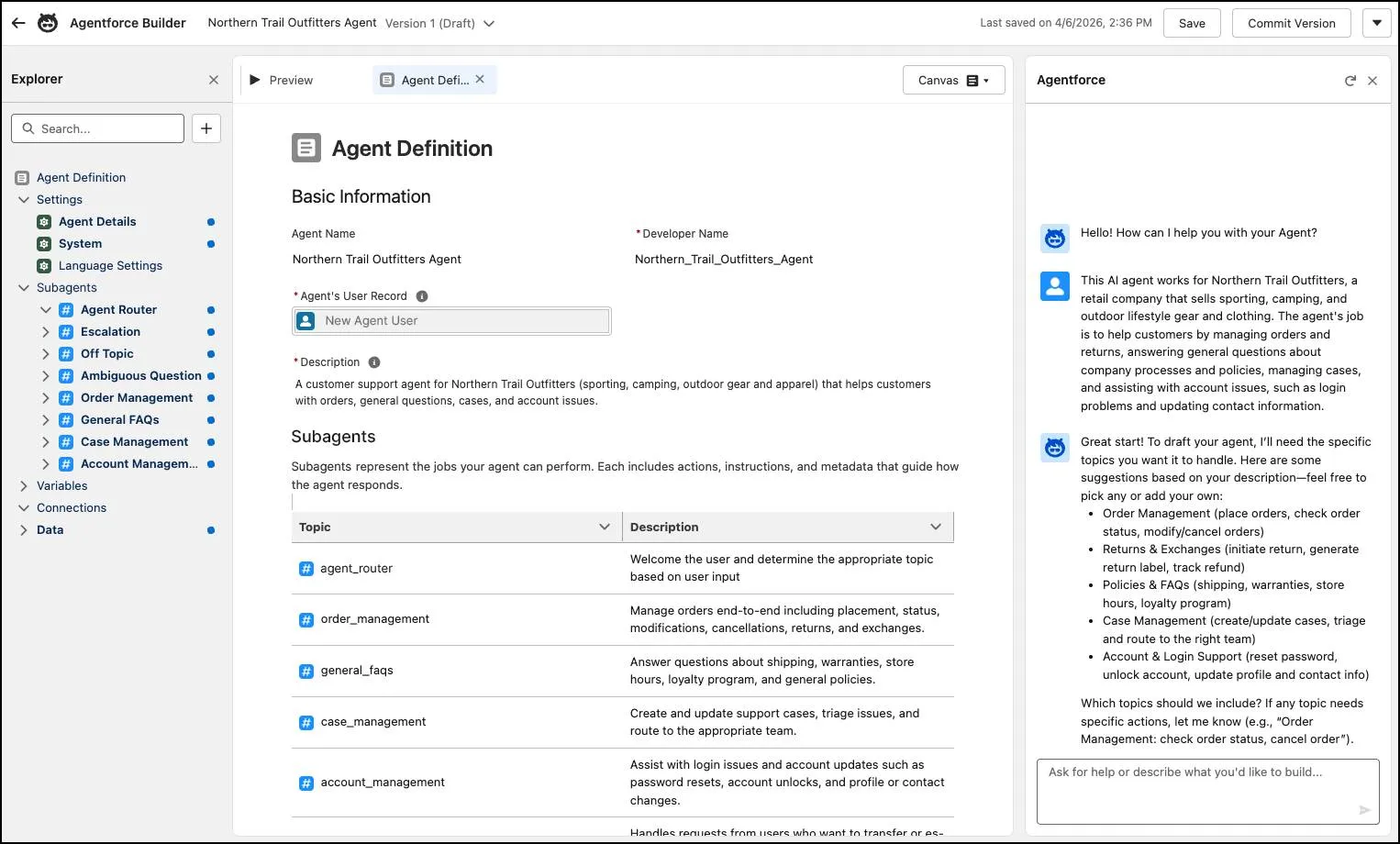
Agentforce agent configuration showing topics, instructions, and the actions an agent is permitted to take.
Where the boundary is set: the tools an agent may call are configuration on both sides, in Anypoint and in Agentforce. That is what makes the boundary reviewable rather than a matter of trust.Screenshot © Salesforce; product UI may vary by edition and release. See Agentforce.

Expose deliberately

An MCP server over an existing API rather than a new back door, with the read and write surface listed explicitly so somebody can review it in an afternoon.

Topics from real APIs

Topic Center builds Agentforce topics from your API design or the APIs you already run, which keeps agent capability tied to something governed rather than invented alongside it.

Audit what agents call

Every agent-initiated call attributable, so when somebody asks why a record changed the answer is a log entry rather than a shrug.

Ask what is safe to expose

Governance & operating model

Who owns an interface once the project that built it has closed?

Every sprawling estate was tidy once. Each project ships an interface, closes, and leaves something load-bearing with no owner. Two years on nobody can say if it is still needed. The fix is a name against each interface, not more architecture.

Two engineers reviewing code together at a workstation.
Someone has to own it: an interface with no owner is a future incident with a delay attached. The cheapest governance artefact in existence is a name in a column.Photo: Pexels.

Interface ownership

A name per API

Recorded in the catalogue, reviewed when people move on. It is the single highest return governance artefact and it costs a column in a spreadsheet.

Versioning and deprecation

A way to retire things

A published policy for breaking changes and a route to switching an API off, because an estate that can only grow eventually stops being changeable.

Policies by default

API Manager

Authentication, rate limiting and logging applied as a baseline rather than remembered per API, so a rushed release cannot quietly ship without them.

Secrets and credentials

Rotated, not remembered

Properties encrypted, secrets managed rather than sitting in a config file, and a rotation process that somebody has actually run at least once.

Runtime currency

So this does not recur

A standing cadence for runtime patches and version upgrades, because the whole reason estates rot is that tidying up was always next quarter.

Agent exposure review

MCP surface

A periodic read of what agents can currently reach and change, because that surface grows quietly as topics are added and nobody re-reads the whole list.

Pair the work with a governed data programme when identity and lineage need attention before agents scale. See Data 360 services.

Plan a governance workshop

Who we work with

Integration is the one budget that is easier to get for security than for design

The same piece of work gets funded or deferred depending on who is asking and what they call it. A runtime migration is unglamorous; the same migration described as removing unpatched middleware from between your core systems is a different conversation. Tap the group closest to you to pre-scope the conversation form.

Colleagues working through a systems architecture together.
Operating cue: the platform team usually knows exactly what needs doing and has been unable to get it prioritised. An audit that quantifies the exposure is often worth more to them than the delivery that follows it.Photo: Pexels.

Book a free estate audit

Partnership criteria

Why teams choose SynconAI for integration

Integration specialists sell integration, so the answer is always more of it. We also run the Salesforce practice, which means native tooling is genuinely on the table when it is the right answer, and we lose nothing by saying so. Learn more about our Salesforce consulting partner approach.

We inventory before we opine

Audit first

Applications, runtimes, real call volumes and unread flows. You keep the document whether or not you engage us, and it usually shows fewer critical interfaces than anyone expected.

We sequence by exposure

Not by ease

The applications on the unsupported runtime handling the most sensitive data go first. Progress that does not reduce risk is motion, and it is easy to mistake for delivery.

We will say you do not need it

Native tooling counts

Flow callouts, External Services, Platform Events and Salesforce Connect come with licences you already own. When they do the job we say so, which costs us the larger engagement.

Failures reach a human

Operability

Real error strategies rather than a catch-all, alerting that goes somewhere, and runbooks for the failures you already know about. The measure is whether you find out before your customer.

Delivery geography

US · AU · worldwide

Hubs in Delaware, Sydney and Hyderabad, a named team on your business hours, and travel onsite for discovery, cutovers and executive sessions.

Long-term operator

After hypercare

The same architects for new interfaces, runtime currency and the incidents, so nobody has to rediscover why a flow was written the way it was.

Book a free estate audit

Delivery method

How we deliver integration engagements

Six beats we repeat on every engagement, with transparent gates and no surprise scope. The unusual one is second: triage happens before design, because an estate with an unsupported runtime has a security problem that should not wait behind an architecture exercise. Same method as our broader Salesforce consulting practice.

Integration engagement: Inventory · Triage · Design · Build · Govern · Extend

  1. Inventory

    Every application with its runtime version, deployment target and last release, which APIs are genuinely called and by whom, and the undocumented flows read rather than left as unknowns. You keep the write-up either way.

  2. Triage

    Unsupported runtime and unmanaged APIs ranked by exposure rather than by ease, so the first thing delivered is the thing that reduces risk. Retirement candidates identified here too, because the cheapest migration is the one you do not do.

  3. Design

    API-led layers introduced where a second consumer genuinely exists, with the system-of-record boundary agreed before anyone writes a connector, and the specification published so other teams can build against it.

  4. Build

    Interfaces with real error strategies, retries, idempotency where money is involved, MUnit tests as a release gate, and monitoring configured before go-live rather than after the first incident.

  5. Govern

    Policies applied by default, versioning and deprecation published, a catalogue people search before building, and a named owner against every interface so the estate does not become nobody's again.

  6. Extend

    MCP servers and Agentforce topics once the APIs underneath are worth exposing, plus runtime currency on a cadence so this does not recur. Optionally continue with managed services or ongoing Salesforce administration.

Salesforce Partner

Client reviews

What clients say about working with our architects

Verbatim reviews from SynconAI Salesforce and Agentforce engagements across the United States, Australia and globally. Anonymised clients are labelled by sector.

5.0 average · 5 client reviews

 Salesforce Select Partner16+ architect certificationsDelivery across USA, Sydney & India

Simply Outstanding

“SynconAI Consulting are Simply the Best in the Business When it comes to Salesforce implementation and AI-powered solutions, SynconAI are in a league of their own. Their expertise, dedication, and ability to deliver results that truly move the needle sets them apart from every other consulting partner we've worked with. What they achieved with our Sales Cloud, Service Cloud, and custom Agentforce agent has completely transformed how we operate streamlining our pipelines and our customer service, and automating tasks that used to consume hours of our team's time. They don't just implement technology they transform businesses. If you want the best, you work with their team.”

Sales CloudService CloudAgentforce
Jack BennettConsumer Goods & Retail · United States

“I had a very urgent deadline for our project reporting to be delivered and needed to build the module, dashboard and output reports in Salesforce. SynconAI were very responsive - they met with me online, responded to my emails quickly and took calls - whatever was needed to progress the work quickly. We are thrilled with the outcome and will continue to work with SynconAI in the future to continue to build our Salesforce capability and platform.”

Sales CloudService CloudNonprofit Cloud
Salesforce Managed ServicesAustraliaSalesforce Verified

“The team at SynconAI were fantastic, and promptly delivered on each project. They were able to guide us through every stage and made sure we were satisfied with the outcomes on multiple scopes of work.”

Sales CloudSlackFlowAgentforceMuleSoft
ManufacturingAustraliaSalesforce Verified

“They have been great and helping us transform out business by bringing what I conceptualize to life. Great at translating process/workflow needs into a solution. Been a pleasure work with and they're a critical part of our team and will be instrumental into bringing about my vision.”

Sales CloudFinancial Services CloudArchitectureAI
Financial ServicesUnited StatesSalesforce Verified

“Working with SynconAI was a seamless and highly professional experience from start to finish. They took the time to deeply understand our business processes before designing and implementing a Salesforce solution tailored specifically to our operational needs. The team demonstrated strong technical expertise across Salesforce configuration, automation, integrations, reporting, and user experience design.”

SalesforceExperience CloudCustom DevelopmentAutomationReporting
Salesforce ImplementationSalesforce Verified

Frequently asked questions

integration, answered honestly.

Straight answers on what your edition allows, whether native Salesforce tooling is enough, when middleware earns its cost, and who owns an interface after go-live.

Often natively. Where Salesforce is one end of the integration and the requirement is modest, Flow with HTTP callouts, External Services, Platform Events or Salesforce Connect for read-only external data will do it on licences you already hold. Middleware earns its cost when you have many systems, real governance obligations, reuse worth enforcing, or an agent programme that needs a controlled way to reach everything. We map the requirement against both before recommending either.

It can be, and it is the most common thing a project discovers too late. API access is included by default in Enterprise, Unlimited, Developer and Performance. Professional Edition has to order the Web Services API product separately, and buying the Additional API Calls add-on does not enable API access for Professional. Group and Essentials cannot buy it at all. If anything on your roadmap involves connecting a system, settle this before you sign, not in month nine.

This page is the decision and the delivery: what has to connect, which approach the requirement justifies, and who runs it afterwards. The MuleSoft page goes deep on one platform — Anypoint, runtimes, Mule 3 end of life and API-led layers — and is the right read once you have decided MuleSoft is the answer, or if you already own it.

Salesforce supports both, so the protocol is rarely the hard part. REST is the default for new work. SOAP still matters when the system at the other end only speaks it, which in finance and older ERP estates is common. Volume work goes to Bulk API 2.0, and anything that should react to a change rather than poll for it goes to Change Data Capture or Platform Events.

Rarely the connector. Projects miss on assumptions: that a system could take the load, that the data was as clean as the schema suggested, that a flow nobody had read did what its name implied. Each of those moves an estimate by weeks, and finding them in testing is what turns a fixed price into an argument. We surface them in the mapping stage instead.

Someone should, in writing. The common failure two years on is not a broken connector but an interface nobody can say is still needed, so nothing is ever retired and everything is slightly risky to change. We hand over a named owner per interface, a rule for what happens when a source system changes, and monitoring that tells you before a customer does.

Salesforce, MuleSoft, Anypoint Platform and Agentforce are trademarks of Salesforce, Inc. SynconAI is an independent certified Salesforce consulting partner and is not created by, affiliated with, or endorsed by Salesforce, Inc. Edition entitlements, API allocations and packaging are set by Salesforce; the Salesforce release notes and your account team remain authoritative. Screenshots are reproduced for illustrative purposes.

Free architect conversation

Talk to an architect, not a sales rep.

60 seconds to brief us. A certified architect replies within one business day.

What do you need from your integration estate?

Pick the closest fit. The estate audit is free and you keep the written inventory either way.

Which clouds or systems are in scope?

Optional. Choose any that apply, or skip ahead.

Where does your org stand today?

Optional. A few sentences is plenty: what is working, what is stuck, and what you want to be true. Or skip ahead and tell us on the call.

Who should the architect reach?

A certified architect will reply to these details.

Takes about 30–60 seconds · No obligation · Architect replies within one business day

Protected by reCAPTCHA. Google's Privacy Policy and Terms apply.

Free estate auditCallWhatsApp

Solutions, built
for the future

Sales CloudSales Cloud
Service CloudService Cloud
Field ServiceField Service
Experience CloudExperience Cloud
Marketing Cloud NextMarketing Cloud Next
Revenue Cloud AdvancedRevenue Cloud Advanced
Salesforce CPQSalesforce CPQ
Data 360Data 360
Financial Services CloudFinancial Services Cloud
Nonprofit CloudNonprofit Cloud
Health CloudHealth Cloud
CRM Analytics & EinsteinCRM Analytics & Einstein
AgentforceAgentforce