
Salesforce to acquire Braze for $5.66 billion: what it means for Marketing Cloud
Salesforce has signed a definitive agreement to buy the customer engagement platform Braze in an all-cash deal. The interesting part is not the price. It is which layer of the architecture a real-time, event-streaming engine just landed in, and what that means if you already run Marketing Cloud or Braze.
 ChatGPT
 Claude
 Google AI
 Copilot
 Salesforce M&A
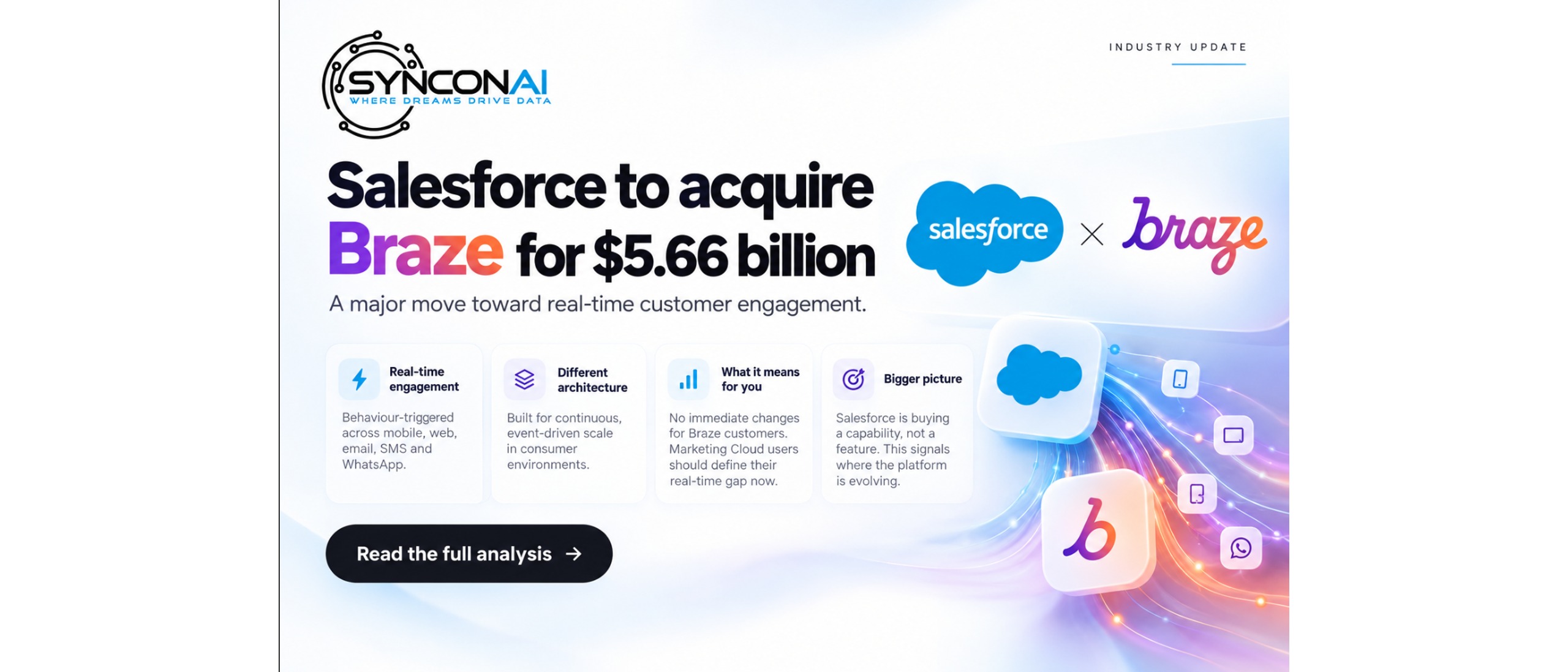
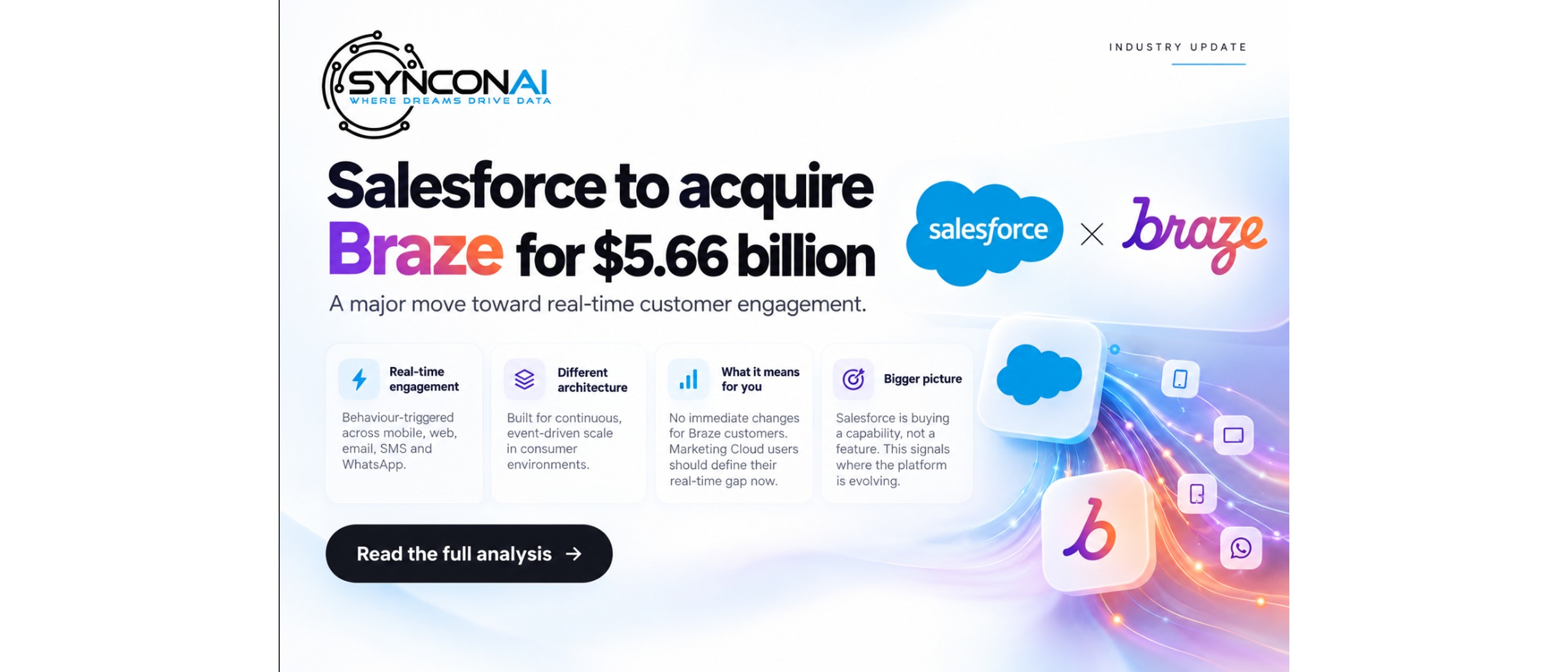
On 20 October 2026, Salesforce announced it had signed a definitive agreement to acquire Braze, the customer engagement platform, for approximately $5.66 billion in enterprise value. Braze Class A shareholders will receive $47.50 in cash per share. The deal needs Braze shareholder approval and the usual regulatory clearances, and Salesforce expects it to close in its fiscal year 2028, which starts February 2027.
That is the transaction. The more useful question, if you run Salesforce today, is what Braze actually does and why Salesforce wants it badly enough to pay $5.66 billion for it.
What Braze is
Braze is a real-time customer engagement platform, built on a cloud-native, event-streaming architecture rather than the batch-oriented model most marketing clouds grew up on. It sends personalised messages across mobile apps, websites, email, SMS and WhatsApp, triggered by what a customer is actually doing, not by a nightly segment refresh. BrazeAI layers AI-driven decisioning on top: what content, what offer, which channel, what moment.
Salesforce's release puts Braze's customer base at roughly 2,770 companies, naming Canva, Dairy Queen, Equinox, Instacart, Urban Outfitters and Venmo among them. That is a B2C-heavy, high-volume customer list, which tells you where the capability was built to perform: consumer apps where a message twelve hours late is a message that missed the moment.
What Salesforce says it is buying
Salesforce frames this as an architecture acquisition, not a feature acquisition. Its release states that Braze's real-time engagement and AI decisioning are expected to complement all four layers of Salesforce's architecture: Data 360, Customer 360, Agentforce and SIForce. The one product it names specifically is Marketing Cloud, which Salesforce says will gain stronger cross-channel personalisation.
Patrick Stokes, President of Applications and Marketing at Salesforce, put it this way: "Braze was built to turn live customer behavior into personalized engagement at scale." That is a precise claim worth taking at face value. It is not "Braze adds AI to marketing," which Marketing Cloud already has in some form. It is "Braze reacts to behaviour as it happens, across channels, at volume," which is a harder, more architectural problem than bolting on another AI feature.
Bill Magnuson, Braze's CEO and co-founder, is expected to lead the Braze team within Marketing Cloud after close, alongside co-founder Jon Hyman. Magnuson has said Salesforce's platform will help Braze innovate faster, and that Salesforce shares Braze's commitment to marketers.
The architecture gap this actually closes
Salesforce's release stays at the level of "complements four layers." That is accurate and also not very useful if you are trying to work out what changes in practice. Here is the gap stated plainly, as our own read rather than Salesforce's words.
| Marketing Cloud today | What Braze adds | |
|---|---|---|
| Trigger model | Journeys fire on scheduled batches and defined entry events, refreshed on a cadence | Event-streaming: a trigger fires on the behaviour itself, continuously, not on the next scheduled pass |
| Decisioning | Einstein scoring and send-time optimisation, applied within a journey you built | BrazeAI chooses content, offer, channel and timing per customer, per moment, as part of the engine itself |
| Channel reach | Strong on email, strong on SMS, web push supported | Mobile-first by design: push, in-app, SMS, email and WhatsApp treated as one coordinated surface |
| Built for | Enterprise, B2B-leaning journeys with moderate event volume | Consumer apps at B2C volume, where a late message is a missed moment |
None of that is a knock on Marketing Cloud. It is a different architecture, optimised for a different problem, and Salesforce's own customer list for Braze (Canva, Instacart, Venmo) tells you which problem. The acquisition is Salesforce buying the second architecture rather than building it, which is usually faster and usually messier in the first year than either side's marketing admits.
The naming question
Salesforce's own release refers to the product as Marketing Cloud throughout. Secondary coverage, including Techzine's reporting on the deal, describes Marketing Cloud as "now referred to as Agentforce Marketing," which would be consistent with Salesforce's pattern over the past year of folding products under the Agentforce name. The press release itself also names "SIForce" as one of the four architecture layers Braze is expected to complement, without explaining that this was previously branded AIForce.
Worth being precise about what is confirmed and what is reported. The deal terms, the price, the four-layer framing and the Marketing Cloud target are all stated directly by Salesforce. The specific rename to Agentforce Marketing is reported by outlets covering the deal, not stated in Salesforce's own release in those words. Expect the terminology to firm up as the deal approaches close, and treat anything you read with "now called" in front of it as current reporting rather than settled fact until Salesforce's own materials confirm it.
If you run Braze today
Nothing changes on the day of this announcement, and nothing changes for some time after it. Three things are worth holding onto:
The deal has not closed. It needs Braze shareholder approval and regulatory clearance, and Salesforce is not expecting that before its fiscal 2028, which begins February 2027. That is a minimum of several months, and acquisitions of this size can take longer.
Braze continues as its own brand. Magnuson has said so directly. Your implementation, your contract, your integrations and your support relationship keep working exactly as they do today.
The acquisition rationale argues for continuity, not disruption. Salesforce is buying Braze specifically because of what it does well. An acquirer who paid $5.66 billion for real-time, event-driven engagement has every incentive to keep that capability working while it figures out how to connect it to Marketing Cloud, not to break it on day one.
If you are mid-renewal or mid-implementation with Braze right now, the acquisition is a reason to ask your account team how they see the roadmap, not a reason to pause a project that is solving a real problem today.
What is actually worth doing now, before close, rather than waiting:
Get the data processing terms in writing. An acquisition does not change your existing contract, but it is the point at which to confirm, in writing, what happens to your data if the entities merge: data residency, sub-processor changes, and whether Salesforce becomes a named sub-processor under your current DPA.
Ask who you escalate to. Account teams reorganise around acquisitions. Get a named point of contact who is accountable for your account through the transition, not a generic support queue.
Keep your integration documented. If Braze is wired into Salesforce today through custom API calls rather than a native connector, document exactly what that integration does. That documentation is the thing that lets you move fast later, whether Braze ends up deeper inside Marketing Cloud or stays a separate system you connect to.
If you run Marketing Cloud today
The honest read is that Salesforce has told you exactly where it thinks Marketing Cloud is weakest: reacting to customer behaviour in real time, across channels, at the volume a consumer app generates. If that is a gap you have been solving with a third-party tool, a custom event pipeline, or simply accepting as a limitation, this acquisition is worth watching rather than ignoring.
It is not yet a reason to change anything you are building. Braze capability has not shipped inside Marketing Cloud. Nobody outside Salesforce and Braze knows the integration timeline, what stays separate, or what gets rebuilt. Architecting around an announced acquisition, before any of its capability exists in the product you actually have a contract for, is a common and avoidable mistake. Build for the Marketing Cloud you have. Revisit the design once Braze capability is actually in a release you can test.
Two things worth doing in the meantime, not the usual advice to simply wait:
Name your own real-time gap precisely. Not "we want better personalisation," but the actual event your current journeys cannot react to fast enough, and how many hours or days of delay that costs you today. That is the brief you hand an architect once Braze capability ships, and it is also the brief that tells you whether this acquisition will ever matter to your build at all.
Ask your account executive for the integration roadmap, not the press release. Salesforce's own materials will not have a shipped timeline this early. A direct question to your AE, in writing, creates a record you can hold them to later, and it costs you one email.
If you are choosing between the two right now
This is the group the announcement actually changes something for. If you were mid-evaluation, comparing Braze against Marketing Cloud for a new build, you are no longer comparing two independent vendors. You are comparing a platform that works today against one that is in the process of being acquired by its competitor.
That is not automatically a reason to prefer either one. It is a reason to evaluate on what each platform does today, under its current ownership and roadmap, rather than on a combined future state that has not been built yet. If Braze's real-time, mobile-first engagement is the specific capability you need, it exists today, under Braze, regardless of who owns the company in twelve months. If Marketing Cloud's breadth across the rest of Customer 360 is what you need, that also exists today. Decide on the problem you are solving now, and revisit the decision once the acquisition closes and the integration has a real shape.
The pattern this fits
This is not an isolated move. Salesforce has been acquiring capability into its AI and agent stack through the back half of 2026, including Own Company for $1.9 billion and Cimulate, aimed at Agentforce Commerce. Braze is the largest of that run and the most architecturally specific: a real-time engagement engine, bought to sit inside the layer Salesforce itself says Marketing Cloud needs to strengthen.
The practical takeaway is the same one that applies to every Salesforce acquisition before it has actually shipped. Read what was announced carefully, note what is confirmed versus reported, and build for the platform you have a contract for today. The capability this deal is meant to deliver is real and worth planning around once it exists in a release. It is not worth rearchitecting around before then.
- Salesforce Signs Definitive Agreement to Acquire Braze“Braze's real-time engagement and AI decisioning are expected to complement all four layers of Salesforce's architecture: Data 360, Customer 360, Agentforce and SIForce. Braze shareholders will receive $47.50 per share in cash, for enterprise value of approximately $5.66 billion.”
- Salesforce acquires Braze for 5.66 billion“Braze's real-time AI technology will be folded into Salesforce Marketing Cloud, now referred to as Agentforce Marketing. Braze will continue to operate as a separate brand, according to co-founder and CEO Bill Magnuson.”