



Salesforce held TrailblazerDX 2026 in San Francisco on April 15 and 16. Two days, 400 sessions, and a set of announcements that represent the most significant architectural shift the platform has made in 25 years.
Most of the coverage focused on the product names. This post focuses on what the announcements actually mean for businesses building and operating on Salesforce right now — and what the ones that move well are going to do differently to the ones that do not.
The theme nobody said out loud
Before getting into the individual Salesforce TDX 2026 announcements it is worth naming the thread that ran through all of them.
Salesforce is no longer positioning itself primarily as a place where your team works. It is positioning itself as the infrastructure underneath the AI agents that do the work.
That is a fundamental shift in premise. And it changes the conversation every business on the platform should be having about their Salesforce investment.
Salesforce Headless 360 and App Studio: Two announcements, one bet
The headline announcement at TDX was Headless 360. The one that did not get enough attention was App Studio. Together they tell a single story that most of the coverage missed.
Headless 360 exposes the entire Salesforce platform — every workflow, every record, every piece of business logic accumulated over years — as APIs, MCP tools, and CLI commands. AI agents can now consume Salesforce directly. No browser. No human clicking through screens.
Parker Harris, Salesforce co-founder, framed it on stage with a question that stopped the room.
“Why should you ever log into Salesforce again?”
That was not provocative. That was the product roadmap.
App Studio, previewed in a sneak peek session, takes the other end of the platform in the same direction. Teams describe what they want in plain English. An AI agent builder does the work. The admin reviews and approves before anything goes live. It works from Slack. No developers. No backlog. No six week wait for something that should have taken a day.
Most coverage treated these as separate stories. They are not. Headless 360 changes how Salesforce gets consumed at the top end by agents and developers. App Studio changes who can build on it at the bottom end. Together they represent Salesforce placing one deliberate bet at both ends of the platform simultaneously.
What this means for your business
The businesses that will get the most from both announcements are the ones that already have a clean foundation underneath them. Both Headless 360 and App Studio expose the same underlying risk. If your architecture was not designed properly the first time, autonomous agents will surface that faster than any human review ever did. And App Studio will let teams build on top of existing problems at a speed that was never possible before.
The question worth asking right now is not what can we automate. It is whether what you have built on Salesforce is worth automating in the first place.
Slack CRM and Agentforce: The adoption problem finally has an answer
The statistic Salesforce slipped into the Slack session at TDX deserved a bigger moment than it got.
Custom AI agents on Slack have grown 300% since January 2026.
That is not a product metric. It is a signal about where enterprise adoption is actually heading. Not inside Salesforce. Inside Slack, where people already spend most of their working day.
Slack CRM is now live. Salesforce data, agentic AI, and your team’s daily workflow in one interface. Slackbot has been rebuilt as an AI agent powered by Claude — part of the Salesforce and Anthropic partnership — that handles meeting prep, deal summaries, CRM updates, and follow up drafts from a single conversation thread. No switching between tabs. No manual logging. No reminders that nobody ever acts on.
This matters because the number one reason Salesforce implementations underdeliver has never been the technology. It has been adoption. People do not work in Salesforce. They work in Slack, in their inbox, in back to back meetings. So data does not get logged consistently, pipeline visibility suffers, and leadership makes decisions on numbers nobody fully trusts.
What this means for your business
Connecting Slack to a poorly architected Salesforce org does not solve the adoption problem. It gives your team faster access to unreliable information. An agent operating on bad data does not surface better insights. It surfaces bad insights faster and with more confidence.
The businesses that will genuinely transform how their teams work from this announcement are the ones with clean data and well designed processes underneath it. For everyone else this is a conversation about foundations before it is a conversation about features.

MuleSoft Agent Fabric: The announcement most businesses should have paid closest attention to
While the coverage focused on Headless 360 and Agentforce Vibes, Salesforce expanded MuleSoft Agent Fabric into something that will matter more to most businesses than either headline announcement.
Agent Fabric is now a full cross-vendor AI control plane. It automatically discovers and governs autonomous agents running across Salesforce, Microsoft Azure, AWS Bedrock, and more. One place to see every agent operating across your organisation regardless of who built it or where it lives. One place to enforce data governance and set the rules.
The reason this matters right now is not theoretical. The pattern emerging inside organisations of every size is the same. The Salesforce team deploys an Agentforce agent. IT connects something on AWS. Operations builds a workflow on Azure. Someone in marketing signed up for a tool last month that three people are now using without anyone else knowing. Nobody has the full picture. Nobody is accountable.
Six months later there are agents making overlapping decisions, pulling from different data sources, generating costs nobody can explain, and creating compliance exposure nobody planned for. This is agent sprawl. It is already happening.
What this means for your business
AI governance is not the cautious part of an AI strategy. It is the part that determines whether the investment holds up two years from now. The businesses that build a proper governance layer now will scale their AI investment cleanly. The ones that skip it will spend significant time and money untangling something that should never have been allowed to get complicated.
Agentforce Vibes 2.0: Faster development is only an advantage when the direction is right
Agentforce Vibes 2.0 was the announcement that generated the most excitement in the room at TDX. And it deserves the attention.
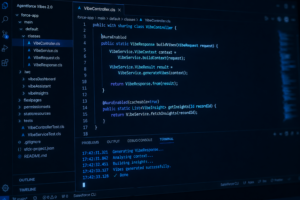
An AI agent platform development environment built directly into Salesforce. Running on Claude on Agentforce by default with GPT-5 available in Pro Mode. It understands your custom objects, your schema, your metadata. It generates Apex, LWC, and React. Salesforce is claiming up to 40% faster development cycles and the tooling genuinely supports that direction.
But there is something that did not get said on stage that every business responsible for a Salesforce implementation needs to hear.
Faster development on a poorly architected org is not progress. It is a more efficient route to the same destination you were already heading to the wrong way. Technical debt from a bad implementation does not announce itself on day one. It shows up six months later when every new requirement costs three times what it should because the decisions made at the start were never right.
Vibes is a genuine leap forward for teams with clean foundations. For teams without them it accelerates existing problems.
What this means for your business
Before your team touches Agentforce Vibes 2.0 there is one question worth sitting with. What did you get wrong the first time that you are about to build on top of. That question is worth more than any productivity gain the new tooling offers.
AgentExchange: 13,000 listings and a new problem to go with them
Salesforce consolidated AppExchange, Slack Marketplace, and the Agentforce ecosystem into one destination at TDX.
AgentExchange now has 13,000 plus listings. 10,000 Salesforce apps, 2,600 plus Slack apps, and 1,000 plus pre-built Agentforce actions, tools, and MCP servers. AI-guided discovery. One click activation. Partners spanning AWS, Google Cloud, DocuSign, Notion, Stripe, and Zoom all in one place. Salesforce also committed $50 million to accelerate partner and ISV growth on the platform through the AgentExchange Builders Fund.
The proof points were notable. Notion cut its average sales cycle from four months to three weeks after listing. DocuSign processed over 200 private offers with 60% faster time to signature.
Whether you are looking for industry-specific AI agents or custom AI agents for enterprise use cases, the consolidated marketplace makes discovery significantly faster than it has ever been.
What this means for your business
13,000 listings solves the discovery problem and creates a new one. Knowing which solutions are actually worth deploying for your specific business, your data model, your processes, and your regulatory environment is not a problem AgentExchange solves. It is a problem that still requires someone who understands what they are activating and why.
Out-of-the-box AI agents work well for commodity use cases. For anything involving complex workflows or regulated industries the listing is not the implementation.
Revenue Cloud and CPQ: The clock is now official
Salesforce confirmed at TDX what many in the ecosystem had anticipated for some time. CPQ is end of sale.
Existing customers retain support. Nothing breaks tomorrow. But the platform’s direction has never been clearer. Every new conversation Salesforce is having starts with Revenue Cloud now, positioned under the broader Agentforce Revenue Management umbrella.
What most of the coverage missed is the capability shift that comes with it. Revenue Cloud workflows are now exposed directly to AI sales agents. An agent can initiate a quote, process an order, and trigger billing without a human in the loop. The natural language quoting skill is already in pilot. The quote to cash process is becoming agent-driven and the gap between businesses that architect their migration around that capability and the ones that simply move their existing CPQ logic into a new system is going to be significant.
What this means for your business
CPQ migrations that go wrong almost always follow the same pattern. The business maps existing logic into the new platform line by line and calls it a migration. What they actually did was move the problem. Every pricing exception, every approval chain nobody fully understood, every piece of complexity accumulated over years now lives in Revenue Cloud instead of CPQ.
The migration is the moment to fix that. The businesses that treat it as a redesign opportunity rather than a technical exercise will come out the other side with a revenue operation that looks fundamentally different. That window is open right now.

The builder gap: The conversation TDX did not have on the main stage
There was an uncomfortable subplot to TDX that nobody addressed directly from the keynote.
Salesforce made the most ambitious set of announcements in 25 years. And in doing so made the community that built the ecosystem feel like the conference was not really for them.
Headless 360, Agent Script, MCP tools, native React, ADLC skills. Every major announcement required a software engineering background to fully appreciate. The admins and declarative builders who delivered billions of dollars of business value without writing a single line of Apex were watching a keynote aimed at a different audience.
App Studio was the exception. And it may be the most strategically important thing Salesforce showed all week precisely because of that. Describe what you want. The agentic framework builds it. The admin approves it. No code required.
It is still roadmap. But it is the clearest signal yet that Salesforce understands the ecosystem it built its business on cannot be left behind entirely.
What to do with all of this
TDX 2026 was not a features conference. It was Salesforce telling the market that the platform is becoming infrastructure for autonomous agents rather than a destination for humans.
The businesses that will benefit most are not the ones that move fastest. They are the ones that move with the right foundation underneath them.
That means asking honest questions about the state of your current implementation before activating anything new. It means thinking about data governance before deploying agents at scale. It means treating any upcoming migration as a redesign opportunity rather than a technical exercise.
Whether you are on Sales Cloud, Service Cloud, or navigating a move from legacy CPQ to Revenue Cloud — the conversation is the same. Is what you have built worth building on top of.
And it means having a partner who understands not just what Salesforce announced but what it means for how your business specifically operates.
If any of the announcements in this post raised questions about where your organisation stands, that is exactly the conversation we have every day.
Talk to SynconAI
SynconAI is a Salesforce Select Consulting Partner specialising in multi-cloud implementations across Sales Cloud, Service Cloud, Agentforce, Revenue Cloud, Field Service, and more.
If you want to understand what TDX 2026 means for your specific Salesforce environment, we offer a structured discovery process that cuts through the noise and gives you a clear picture of where you stand and what to prioritise.
Or reach us directly at synconai.com